
Running an ecommerce SEO strategy for your store in the present digital economy has this surreal form of push-pull: things are so much faster, automated, data-driven, yet ranking on Google tends to feel so much slower, more fragile, almost like cultivation. You plant seeds, nurture them, remove weeds, wait through seasons, and after that, growth comes in—steady, compounding, and very rewarding. Using professional ecommerce SEO services can help guide this process effectively.
That is the secret to ecommerce SEO: it is not instant gratification but durability. Owning a store front on the busiest street of the city versus renting a booth in a noisy market-the difference is ownership, permanently.
When you study the brands that thrive without reliance on paid ads — Ruggable, Beardbrand, Allbirds, Warby Parker — you find a pattern: They didn’t win because they yelled the loudest. They won because they built something buyers could find over and over. They designed product pages that pre-answered questions customers never thought to ask. They built category pages that felt like merchandised shelves, not alphabetized databases. They created content that didn’t just rank, but educated, inspired, and solved problems.
Search engines evolved, customer behavior shifted, AI is changing how results appear-but one thing stayed constant: people use search when they want to understand, compare, evaluate, or buy. That is what makes SEO the only marketing channel that grows in silent mode in the background, without burning your budget like an ad campaign gone haywire.
The following roadmap has been crafted to take you on a step-by-step journey of how best to maximize that channel-step by step, deep, clear, and no shortcuts. Whether it’s stronger rankings, higher visibility, or long-lasting sales, here’s where your goal will take you.
Let’s start with the backbone of all SEO: keyword research.
-min.png)
1. Do Comprehensive Keyword Research
To start with, every successful ecommerce business begins with an understanding of your customers’ language. Whether SEO stands as your map or compass, without keyword research, your SEO strategy would be mere guesswork masquerading as hustle. Professional ecommerce SEO services will make sure that your keyword research will be spot on and buying-intent driven.
Some brands pay so much attention to design, product photography, or ad campaigns-important things, of course-but totally forget that none of that matters if buyers can’t find the store when they go to search for that product. That’s why keyword research isn’t optional; it forms the bedrock foundation of every page you will ever create.
Think of keywords as intent signals. Each one’s a revelation of what a buyer wants, how aware he is, and how far he will take action.
A person who searches “the best dog shampoo for shedding” is more ready to buy than one who’s typing in “why is my dog shedding”.
Whomever is typing “women’s running shoes size 7 waterproof” is a lot closer to buying compared with the person just typing “running shoes”.
Knowing the difference will help you focus your energy more judiciously and optimize your pages for conversions, not just traffic.
Okay, let’s break it down.
2. Start with Product-Focused Keywords
Most stores do keyword research backward. They chase blog topics first: “how to clean leather,” “best gifts,” and so on. That’s useful later, but your revenue engine is built on pages that sell things — not articles.
Product-focused keywords let you know exactly what people want. They are specific, driven by purchase intent, and indicate a clear intent one way or another: the buyer knows exactly what they are after; they just have to find the right version.
Suppose you are a vendor of utensils that go into the kitchen. Consider these searches:
“silicone spatula”
This would be termed a “heat resistant silicone spatula”.
“silicone spatula for nonstick pans”
“bpa free silicone spatula set”
Each one of those variants tells you more about what this buyer is caring about: heat resistant, nonstick compatible, safety, sets. It’s informative for how you could better your product description, better title structuring, and pages that match the psychology of the searcher.
Enumerate every possible product variation that might come into your customer’s mind. This later will evolve into complete product-page optimization, comparison charts, FAQs, and filters.
3. Uncover Hidden Buyer Intent using Amazon Suggest
Amazon is the closest thing to the alive global shopping brain. It captures millions of real-time searches and displays long-tail variations that Google sometimes hides.
Go to Amazon and type “pet grooming gloves” without hitting Enter. The following are what you get as suggestions:
Smoothening gloves for pets canine.
Gloves to groom long hair
Reusable Pet Grooming Gloves
shedding grooming gloves for pets
These are not random. They’re distilled customer behaviour surfaced directly from what real people type when they’re ready to buy.
Amazon Recommendations show:
• purchase-specific differences
• Pain points: “for shedding”
DEMOGRAPHICS: “for long hair pets”
features of the product itself, like “reusable.”
These variations then become super-effective keywords for product titles, bullet points, descriptions, category pages, and even comparison content.
Do this for every category of product that you have. This is one of the easiest and most accurate ways to judge demand from buyers.
4. Expand Your Keyword List with Tools
Take core terms directly from Amazon and refine them within keyword tools, not to find new ideas, but to validate demand.
Keyword Tool Dominator
Great for bulk export of Amazon-style long-tail keywords. Perfect for large catalogs.
Semrush Organic Research
Your competitors’ rankings are like cheat codes. Just put the domain of any competitor and check in the section Organic Research → Positions. You will immediately see:
-
Keywords they rank for
-
Categorize the phrases that are missing from
-
Product modifiers used by customers
-
Long-tail keywords that have proven to convert consistently
Sometimes you’ll find complete product ideas your competition is earning from in silence.
Google Keyword Planner
Not ideal for ideation, but very good for checking search volume and finding seasonality spikes. This comes clearer when using it in conjunction with a tool like KWFinder, as then the graphs will be clearer.
Put together, all these ensure that your keywords are relevant and commercially meaningful.
5. Assess and Select the Right Key-words
Not every keyword is worthy of notice. A good keyword in ecommerce possesses four qualities:
- Enough search volume “Enough” volume depends on your niche. A keyword with 150 monthly searches in a niche industry might generate thousands in yearly revenue.
- Perfect Keyword-Product Fit What’s important is relevance, not numbers. You can ignore the keywords for the products that you don’t sell even when the volume is tempting.
- Strong Commercial Intent Watch out for terms labeled “transactional” and “commercial”-those are indicators of purchase intent.
- Low to Medium Competition Check the first page on Google. If the results are weak, unoptimized, or irrelevant, then that’s an opportunity.
How Ecommerce SEO Works Behind the Scenes

All ecommerce businesses want more visibility, more clicks, more visitors who don’t leave after two seconds, and more customers who add-to-cart instead of drifting away. But before any optimization process, it would be useful to grasp what goes on beneath the surface of all Google searches, product catalog pages, and checkout paths. Professional ecommerce SEO services can help analyze these patterns and identify opportunities for improvement.
Ecommerce SEO is not an event; it’s a comprehensive link chain of relevance, authority, trust, satisfaction, and structured data. Envision your ecommerce site as an enormous virtual market. Google’s crawlers navigate it as if they were shoppers exploring store aisles. And should it be well-organized aisleways with labeled merchandise and excellent lighting and an easy check-out process, shoppers will tarry — and Google will be pleased.
So if your aisles are cluttered, your site is slow, or your product information is limited, your spot in search result rankings contracts. But here’s the bright side: Ecommerce SEO relies on reason, structure, and psychology. When you grasp it, every optimization option becomes simpler and more predictable.
“Let’s walk through the mechanics.”
1. How Search Engines Crawl and Understand Your Ecommerce Website
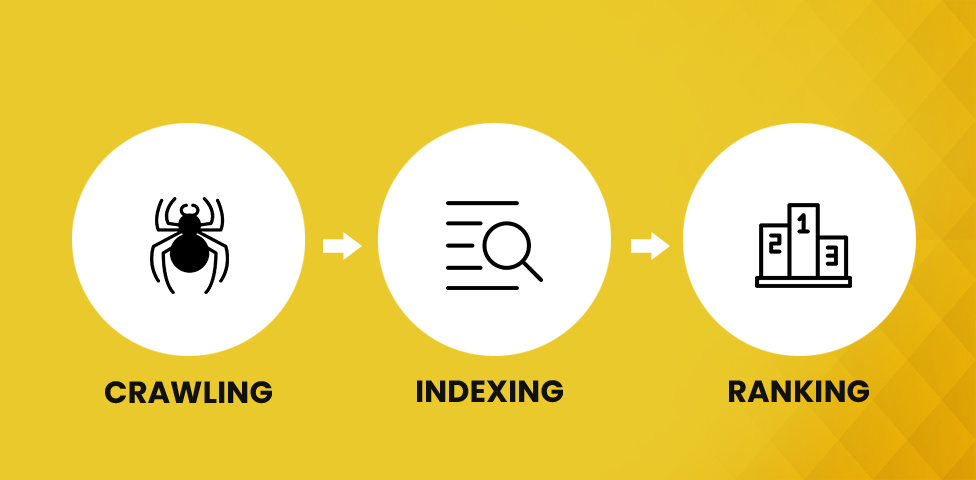
For search engines to learn about your store, they will require these two things:
-
A clear map of your website
-
Enough information to trust your pages
Just picture yourself giving Google a massive box with millions and millions of boxes inside and no labels. Google will have no idea what these boxes have inside, what’s more important, and what they should be shipped. These labels and keywords are what Google requires.
It goes on and on and on without…
Crawling
Google’s crawlers enter your site via links. But if these links are broken, hard to find, or poorly structured, crawling will end. That’s why internal linking can be so useful for SEO. There should be meaningful destinations for every product page – categories, links to similar products, guides, and FAQs.
Indexing
It’s at this stage that Google determines if your page will make it into its database. To be a good indexer, your page should have these factors:
-
unique content
-
descriptive titles
-
keyword-driven headings
-
structured product data
-
Fast performance
-
mobile compatibility
A sign that indexing is being impacted on your site is if your pages are either copies of your competitors’ pages, thin content pages, or pages filled with repeated descriptions from suppliers.
Ranking
It’s here that strategy becomes most valuable. To rank, you need a combination of high-quality content, link acquisition, user experience, brand factors, and technical authority. Ecommerce SEO, more so than other forms of SEO, requires a marathon-like strategy that highlights structured ecommerce stores beating poorly constructed ecommerce stores with an ov
Ecommerce SEO vs. Website SEO – Why Ecommerce SEO Is Tougher
A blog or business website may have 20-50 pages, An ecommerce website may have:
-
100 product pages
-
50 category pages
-
multiple filters
-
seasonal products
-
discontinued pages
-
product variants
-
reviews, FAQs, comparisons
“This scale introduces complexity”, The challenges include:
1. Duplicate Content: A large number of ecommerce pages are at risk of duplication due to repeated usage of product descriptions, specifications, or product names.
2. Handling URLs: With Filters Creating an Infinite Crawl Loop, For instance:
shoes?
/sh
Google considers these as different URLs, despite there not being anything unique among them.
3. Thin Content on Product Pages: A single sentence description can never be adequate.
4. Strong Competition: Large brands invest millions of dollars on SEO. Small business stores have to succeed with accuracy.
5. Constant Updates: Constant changes affect SEO:
“Prices, product availability, and product SKUs — these fluctuate on a daily basis. SEO
Comprender los desafíos permite construir una estrategia de SEO estable y escalable.”
Creating a Framework for Ecommerce SEO
Ecommerce SEO involves more than just online optimization. Key components include:
Technical SEO:

Just like your ecommerce site’s skeleton. Without it, your whole site will fall apart. You might have great content or product descriptions, but without good structure, they will not rank.
Below are detailed explanations of the pillars of technical strength.
1. Website Speed: Fast Stores Win

Speed is an explicit rank factor but also a user experience multiplier. The more loading times, the fewer conversions.
Everyone on the internet demands immediate satisfaction. If your product images take too long to load, they will leave your site. When your checkout process slows down, they will abandon their purchases. Google catches on and ends up suppressing your pages.
Optimizing speed is one of the key offerings in ecommerce SEO services. Speed improvements can be achieved through:
• compressing product images
• lazy loading enable
• next-gen formats such as WebP
• selecting a reliable hosting service provider
• scripts – third-party apps
• CSS and JavaScript optimization
• implementation of CDN (Content Delivery Network)
Images account for more than 60% of weight on an ecommerce site. Faster loading times have implications that extend beyond technical superiority.
2. Mobile First Optimization
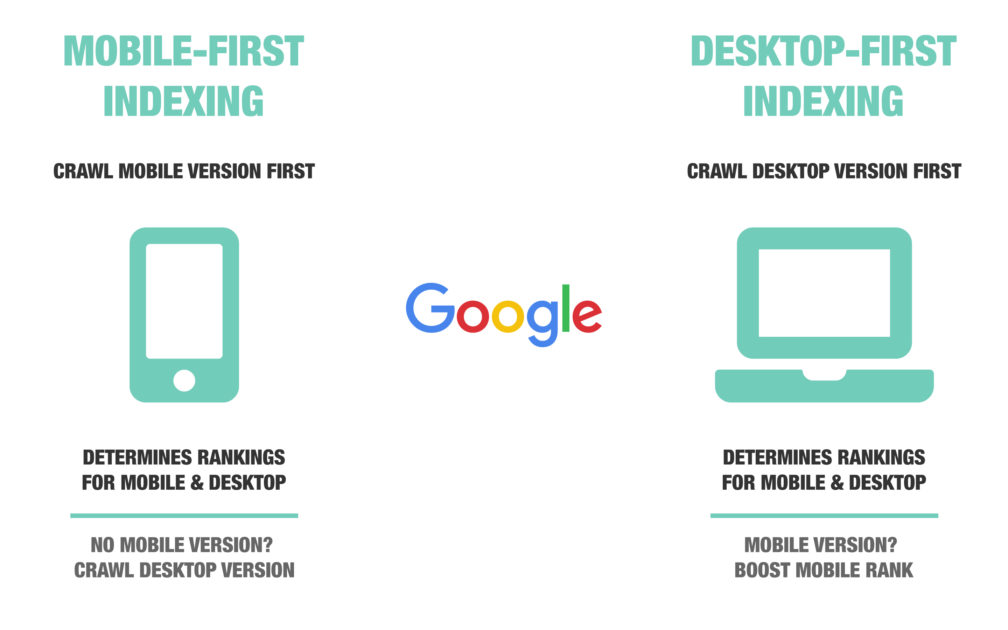
Ecommerce purchases have become primarily mobile. Which means that your online store needs to be perfect on smaller screens.
It means that:
• readable text
• easy-to-push buttons
• images scaled properly
•Checkout forms optimized for touch
• product pages which don’t need zooming functionality
• fast loading on mobile data connections
Google ranks your pages based on mobile versions. A beautiful store on desktop may have low rankings if it doesn’t focus on mobile.
3. Clean URL Configuration

Ecommerce site urls should be descriptive and not chaotic.
Clear URL:
/mens
Unparseable URL
/product
A clean URL assists Google in understanding context and boosts user trust. A clean URL is a imperative aspect of large catalogs.
4. Secure and Safe Browsing

SSL certificates are not optional. You have no choice but to use them as a
Unsecured sites are punished by search engines, and people are apprehensive about submitting credit card information on these types of pages.
A secure ecommerce site should have:
• HTTPS
• properly configured SSL
• no mixed content advisories
• secured payment gateways
• updated plugins and themes
• malware-free hosting
trust: an invisible but essential commodity.
5. Structured Data and Schema Markup

A schema markup serves as a messaging platform between your site and search engines. Google will know precisely what your product page holds because:
• price
• availability
• rating
• reviews
• brand
• SKU
• image
• category
A schema allows your product listings on your site to qualify for rich snippets on search engine result pages. That means your product listing shows stars, price tags, and availability, and it increases click-through rates.
It is one of the most influential ecommerce SEO factors because it highlights your product even before you attain position one.
6. HTTP Status Management (404, 301, 410)
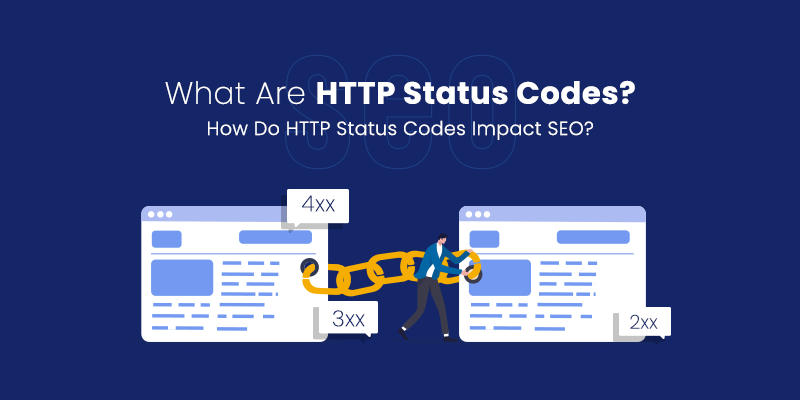
Ecommerce URLs commonly fluctuate because of:
• discontinued products
• seasonal products
• Restructued categories
• updated names
“If these URLs aren’t managed, your SEO bleeds authority.”
• 301 redirects have link value for search engine rankings
• 404s are acceptable but should not proliferate
• 410s inform Google that the page is permanently gone
Handling status properly maintains your index clean.
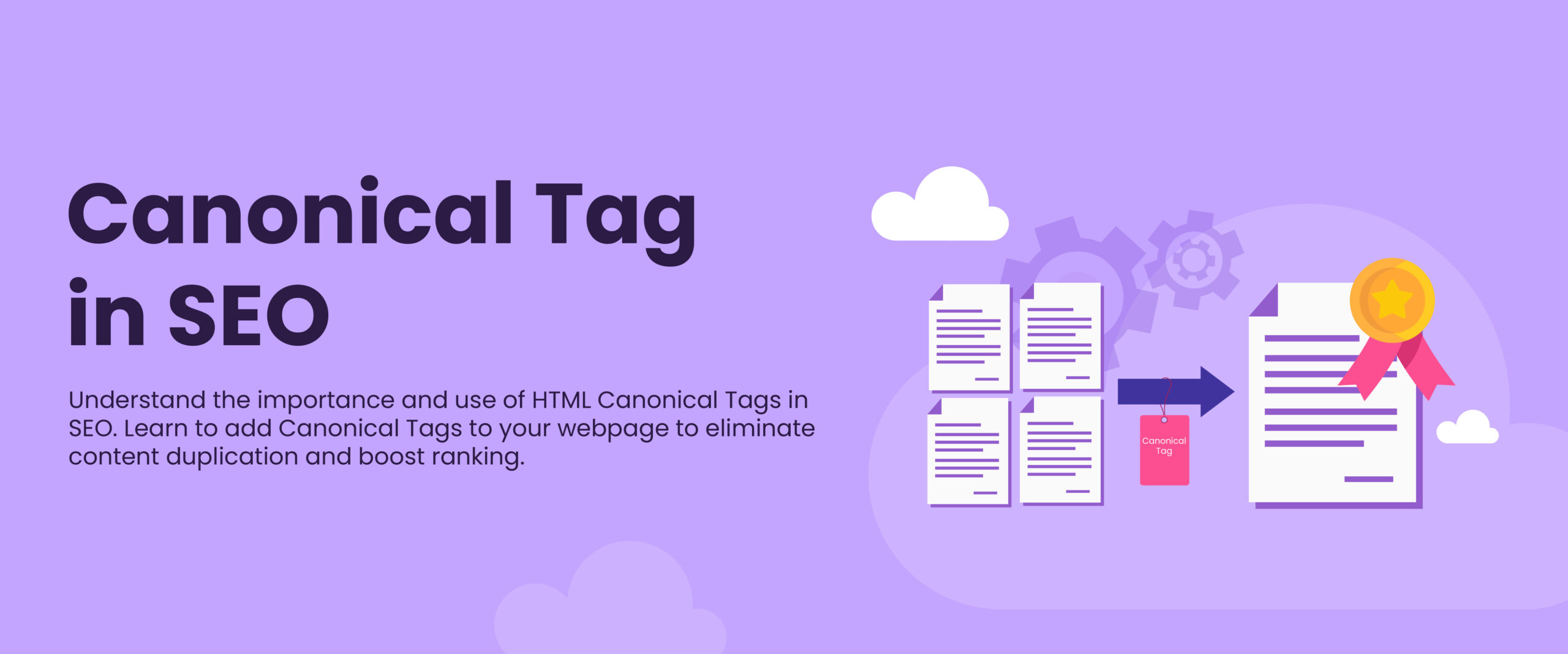
7. Canonical Tags for Handling Duplicate Content Issues
Internal Linking: The Secret Agent of Ecommerce SEO

Some people might define Internal linking can be thought of as roads within your e-market. Without these links, Google’s crawlers would be lost, and customers would bounce.
Effective ecommerce internal linking would feature:
• linking product pages with similar items
• linking category pages to blogs
• linking blogs to product pages
• linking your main pages via your homepage
• incorporating “people also viewed” sections
• creating topic clusters for SEO purposes
Internal linking is also usually overlooked, but it’s among the quickest methods for enhancing visibility, indexing, and search engine rankings.
Technical SEO to Be Resolved Prior to Content and Backlinks
Introduction
Creating content or outreach without a strong technical background doesn’t solve a problem, because it’s like decorating a house with broken plumbing. You can make it very pretty, but it still won’t work.
Technical SEO issues are tackled first because it helps in:
• crawling speed
• deeper indexing
• fewer errors
• more product visibility
• greater user engagement
• increased conversion rates
Once you have your invisible infrastructure in position, you can proceed with keyword research, optimization, and link building.
While technical SEO sets up the structure, keyword research sets up the direction. Ecommerce SEO has a slightly different dynamic compared with regular blogs and service pages. You’re no longer just attracting people who want information but also people who want to buy at various points within the buying cycle. Every keyword carries an intention, an urgency, a desire, and an eagerness to spend.
Product pages just drift in this enormous sea without keyword targeting. But with it, they become magnets for people who are searching for exactly what you offer.
We can analyze an ecommerce SEO strategy that is detailed and actionable.
Ecommerce Search Intent
1. The Key to High-Converting Traffic
A reason exists for every keyword. And if you incorrectly interpret the meaning for a given keyword, you will end up optimizing the wrong pages or attracting uninterested visitors or competing with giants before your time.
Ecommerce SEO keyword intent will normally belong to any of these four categories:
2. Informational Intent
These users are researching, comparing, and learning.
Examples:
• “best running shoes for beginners”
• “how to choose a gaming laptop”
• “what is organic skincare”
These keywords are ideal for your personal blogs, product reviews, comparative pages, FAQs, and evergreen pages.
3. Commercial Investigation Intent
These are “I’m almost ready” shoppers.
Examples:
• Nike Air Zoom review
• “Samsung 4K TV price in India”
• “top cruelty-free skincare brands”
It requires pre-purchase verification. It responds well to comparison guides, reviews, top 10s, and product roundups.
4. Transactional Intent
This, my friends, is where the money is. The user knows what they want.
Examples:
• “buy Adidas ultraboost online”
• “MacBook Air M2 discount”
• “organic face serum shipping”
Product pages, landing pages, and category pages should be optimized for these.
5. Navigational
“These searches are brand-specific.”
Examples:
• “Zara official website”
• “apple store india”
• “Myntra login”
You don’t compete for these – unless your brand awareness is very strong.
It becomes easier for you to relate it with the appropriate type and form of content.
How to Build a Winning Ecommerce Keyword List
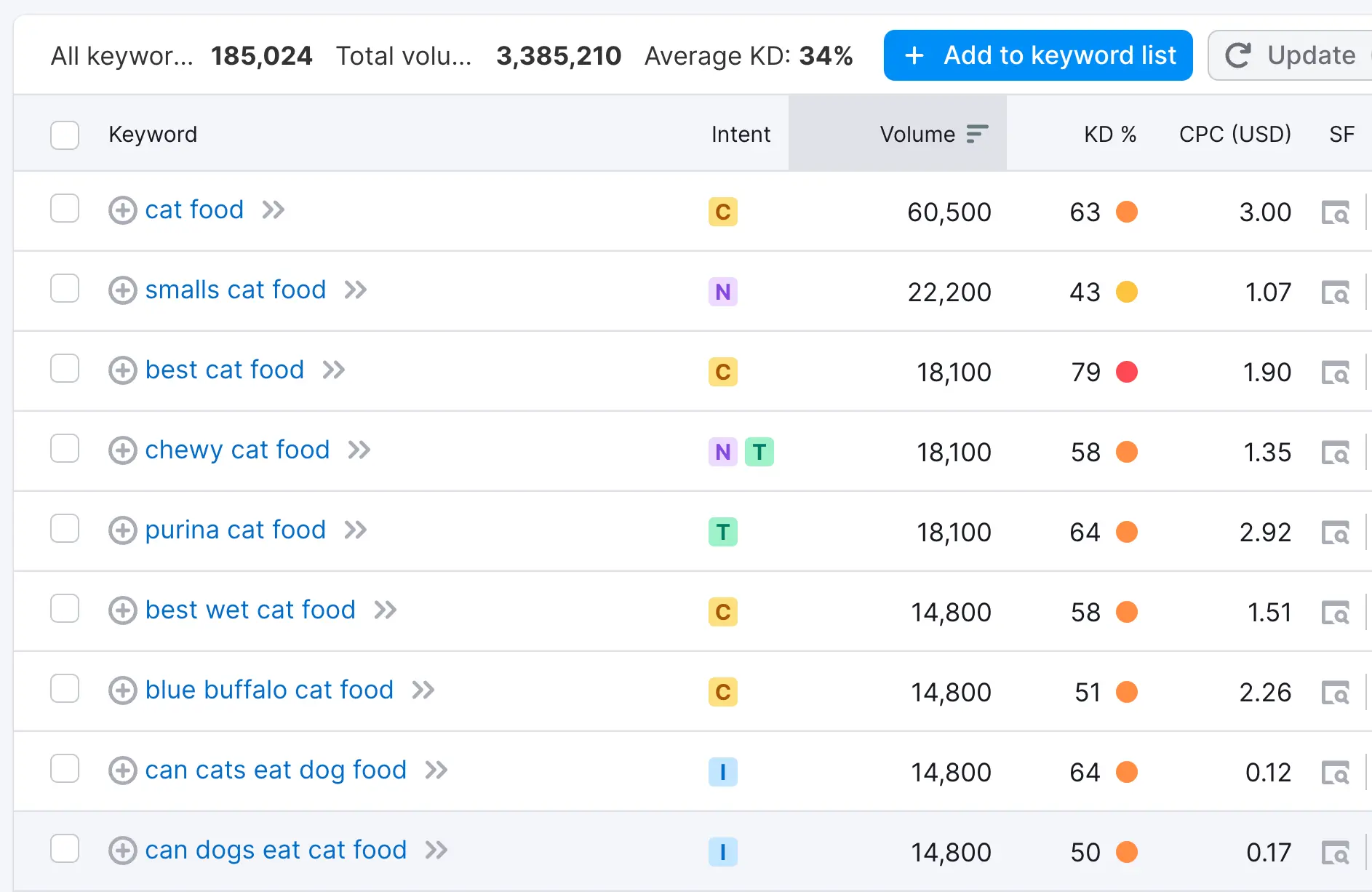
As opposed to finding and optimizing for more general and highly searched keywords like Amazon, Myntra, Flipkart, and so on, an ecommerce site needs a more layered focus on SEO.
A pyramid representing your list of keywords might look something like this:
- Top: Competitive Keywords
- Middle: Mid-volume, moderate-competition
- Beginning with: Long tail and intent keywords
The bottom portion of the long tail will generate the most conversions because these people will already have an idea about what they want. A no-nonsense guide on finding impactful keywords follows below.
1. Start with Your Product Range (Your Keywords Already Exist)
Your product catalog is a gold mine full of keywords. You have these keywords associated with every product:
• a name
• a category
• features
• materials
• specifications
• brand
• Use Cases
Example: “Sell vegan leather crossbody bags” and you will immediately gain access to:
• vegan crossbody bag
• leather-free bag
• cruelty-free bag
• vegan sling bag
• eco-friendly crossbody purse
Your products already have the words your customers use – extract them.
2. Analyze Competitors the Smart Way
Your competitors have done half the work for you. Study:
their category page titles
• best-selling product pages
• URL templates
• Keywords within descriptions
• schema structure
• editorial content
• FAQs
• internal linking patterns
SEMrush, Ahrefs, Moz, or even Google Autocomplete will provide these insights. But what I believe is the most underappreciated method goes back to examining things manually.
Try to analyze your competitors’ highly ranked pages and formulate your own unique advantage based on theirs.
3. Use Search Engines as Your Research Assistant
Google offers keyword ideas for free. It doesn’t cost anything, and the service is available within Google’s search engine result pages.
Use
• Auto-complete suggestions
• People Also Ask questions
• Related searches
• ‘Brands people also buy’ panels
• ‘Products frequently mentioned’ sections
All these hints show demand patterns. When someone searches for “running shoes,” Google might give these hints:
• “best running shoes for flat feet”
• “running shoes under 3000”
• “lightweight running shoes for women”
All these turn out to be new keyword opportunities.
4. Take Advantage of Ecommerce
General SEO tools are good, but ecommerce-specific tools will provide more insights. Examples include:
• Jungle Scout
• Helium 10
• Kajha data
• Google Merchant Center insights
• Amazon keyword tools
These show keyword demand at a product level. A common search pattern on marketplaces as well as Google is reflected here.
5. Create Long-Tail Groups of Keywords (The Secret Weapon)
A long tail keyword would be more specific and less competitive. These are perfect for smaller stores.
Examples: Rather than “running shoes”, Target:
- “running shoes for knee pain”
- “lightweight running shoes for women beginners”
- “best running shoes under ₹3000 in India”
Long tail keywords usually refer to:
- high buyer intent
- identify user pain points
- strong conversion rates
- untapped opportunities
Your SEO plan begins making money at this stage.
Creating a Connection Between Keywords and Correct Pages (The Ecommerce SEO Architecture)
As soon as you have your set of keywords, it’s all about mapping. Unsound mapping will result in cannibalization, which occurs when more than two pages target the same keyword and end up damaging the rank position for each page.
Ecommerce mapping functions as follows:
1. Category Pages → Broad Keywords
Example:
“women’s running shoes”
“gaming laptops
“Organic Skincare Products
These pages act as a portal for a group of associated products.
2. Subcategory Pages → More Specific Keywords
Example:
“trail running shoes for women”
“budget gaming laptops”
“Organic Face Serums
These pages assist visitors with refining search and enhancing relevance.
3. Product Pages → Very Specific and Intent-Driven Keywords
Example:
“Nike Air Zoom Pegasus 39 women’s running shoe”
“ASUS TUF Gaming F15 i7 12th Gen laptop”
“vitamin C organic serum 30ml India”
Product pages should pick up committed transactional keywords.
4. Blog Pages → Informational & Commercial Intent Keywords
Example:
“how to clean white sneakers at home”
“best vitamin C serums for glowing skin”
“top 10 laptops for students 2025”
Blogs get both top and mid funnel traffic.
5. Comparison Pages → Commercial Investigation Keywords
Example:
“Nike vs Adidas Running Shoes Comparison”
“iPhone 15 vs Samsung S24 Battery Life”
“best cruelty-free serum brands comparison”
These words trap customers before they make purchases.
The Keyword Gap Strategy (Reveal What Your Competitors Rank For—But You Don’t)

Analysis on keyword gaps reveals that:
• what your competitors are ranking for
• keywords you don’t currently target
• highly trafficked terms
• opportunities to build new pages
It’s like discovering secret rooms within your SEO house that you are not aware exist.
Ahrefs, SEMrush, and Moz are tools that make it easier.
When you find a competitor with a page that gets a lot of traffic, you don’t steal it but instead build on it and make it more useful.
Creating Keyword Clusters (The New Approach to Ecommerce SEO)
SEO today isn’t about optimizing a single webpage for a single keyword. It’s about topic clusters.
A keyword cluster refers to a set of related keywords that are used cumulatively to develop topical authority.
For instance:
Main keyword: ‘running shoes’
Cluster:
• best running shoes for women
• Flat feet running shoes
• Lightweight running shoes
• running shoes less than 3000
• ways to choose running shoes
• running shoes pros and cons
• running shoes buying guide
Because your site represents an entire topic ecosystem, Google considers your site an authority on it. As a result, your entire site shows up on Google search results.
This approach will be particularly useful for convenience stores that have large competitors.
How Search Volume, Competition, and Intent Impact Your Strategy
Your ultimate list of keywords will be determined after considering three factors:
Search Volume:
Higher education may be tempting, but sometimes it becomes too competitive.
Competition:
Less competitive keywords offer quicker wins.
Intent:
The single most influential factor here: intent decides conversions.
At times, a keyword with 150 searches per month will bring more conversions than a keyword with 15,000.
“The magic is in finding keywords that correspond with product intention and search behavior.”
Because finding specific keywords and making these pages available on Google can be quite
The Continuing Necessity for Keywords in Ecommerce SEO

Your store isn’t static. Product offerings change. Trends emerge and then fade. New brands enter. Consumption behavior shifts. Google changes its algorithm.
All these imply that keyword research is an on-going process.
Fresh research every 30-45 days keeps your catalog up-to-date with what’s trending.
When you regularly update your keyword targeting:
• rankings rise
• product pages remain competitive
• new opportunities arise
• old keywords are replaced
• seasonal demand is captured
-floor
-about
-services
-contact
Category pages are the unsung heroes of ecommerce SEO. It’s the area that falls exactly between your homepage and product pages, and it plays a large role in informing search engines and customers about your merchandise. Your homepage might be the store facade, product pages might be your shelves, but category pages are your aisles, which lead customers exactly to what they’re looking for.
As category pages are optimizing for very broad and high search volume keywords, they end up attracting the biggest piece of organic traffic. Not only do they bring traffic, but they also lead it down the path of purchases.
Now let’s discuss ways to optimize your category pages to become rank machines.
WHY CATEGORY PAGES MATTER EVEN MORE THAN MOST ECOMMERCE SITES REAL
Here’s what makes them so valuable:
“They rank for broader keywords”:
They rank for terms with higher search volume, helping your store reach users earlier in their buying journey.
They aid Google in understanding your site structure.
They share internal link equity.
They influence shoppers while they are deciding what to buy.
They enhance user experience through clearer navigation.
A good category page isn’t just an inventory list. A good category page explains what the category is, answers questions, and makes it easy to filter.
Figure 2.13 illustrates an example of an optimized category page.
A properly optimized category page will be search engine friendly as well as user friendly. Google would like pages that serve user needs, are valuable, and remove friction.
The category page should include:

A prominent H1 with matched category intention
Something like:
• Women’s Running Shoes
• Gaming Laptops
• Organic Skincare Products
It makes it easier for search engines like Google and Bing to grasp what exactly the
Brief introductory description
Brief description of the category.
Users don’t want essays here — they want context. Keep it simple, clear, and useful.
A more detailed SEO description at the end of the page
It’s at this stage that you insert keyword-rich content that doesn’t disrupt user experience at the top.
Filter and sorting options
• Price
• Size
• Colour
• Material
• Brand
• Ratings
The filters will have SEO-safe URLs. These will prevent them from running infinitely.
Quality images
Filtered category searches should be loaded rapidly without compromising readability.
Internal Site Links to Important Pages
Link to buying guides, related categories, and best sellers.
Unique Meta Titles and Description
An entry per category.
Marca de es
Particularly ItemList schema, which assists Google in understanding your product list structure.
Putting all these factors together will make your category page a premier entry point on your site for both your visitors and search engines.
“How To” Post: How To Write Category Page Content That Actually Ranks

The needs conveyed on category pages should be met without confusing shoppers. The most successful strategy will feature layering:
1. Top Section (User-Focused, Light)
2–3 lines welcoming the visitor.
Example:
“View our collection of women’s running shoes. Whether you’re new to running or a marathon runner, we have the perfect shoe for your stride.”
2. Middle Section (Optional, UX-Focused)
Examples include features like filters and product recommendations.
3. Bottom Section (SEO-Focused, Detailed)
You can provide here:
• more detailed explanations
• usage scenarios
• materials and features
• tips on maintenance
• brand comparisons
• benefits
• buying advice
It provides Google with the necessary content, and people who scroll down usually want more information.
Eliminating Duplicated Content on Categorical Pages

Purpose and
Among ecommerce SEO pitfalls, duplication ranks high. Ecommerce sites have a habit of mimicking product descriptions possibly supplied by the manufacturer.
Examples of Dangorous Duplication:
• “Men’s Running Shoes” and “Women’s Running Shoes” with the same content
• Duplicate usage of a given paragraph on multiple product types
• Copying and pasting descriptions from
A search engine might punish duplication with low ranks and indexing problems.
A category should have a distinct identity and a distinct set of contents.
A simple method to eliminate duplication:
• Incorporate varying pain points
• Differentiate benefits
• Meet gender-specific and intent-specific needs
• Employ specific examples
• Change tone based on category
The more it feels as if it were written specifically for your category, the better your rankings will be.
Internal Linking Strategy for Category Pages
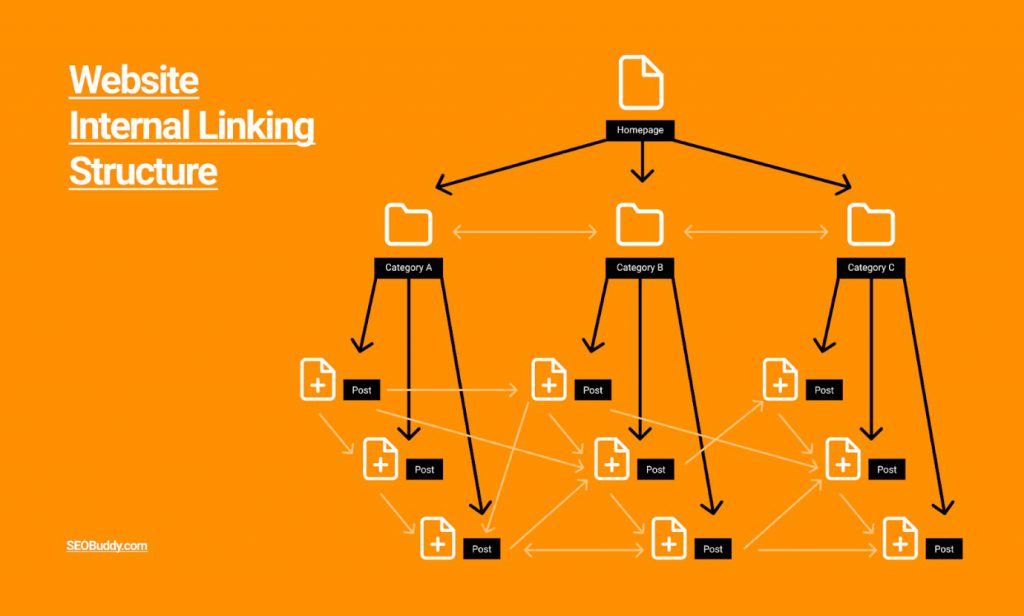
Its category pages have enormous link equity because it acts as a hub site. You can use it to share link equity.
Link category pages to:
• subcategories
• main product pages
• related articles on our blog
• buyer guides
• Comparison pages
• seasonal collections
Example:
A category page with the title “Organic Skincare Products” might link to:
• “Organic Face Serums” (sub
• “Top 10 Organic Skincare Brands” (Blog)
• “Best Vitamin C Serums” (comparison guide)
It will increase your authority on the topic and assist search engine crawlers with understanding links on your site.
“So we don’t have a people problem, we have a product problem.”
Now Let’s
Product pages are where the energy of transaction is at its core. It’s at this stage that a customer is just a click away from putting a product into their cart. But here’s the shock: most product pages on the internet are dead.
This is your advantage.
By writing product pages that are detailed, full of character, easy to understand, and search engine optimized, you will beat big brands even with a new online store.
We will walk you through a detailed analysis of what constitutes a highly converting and highly ranked product page.
A Product Page That Satisfies Search Engines’ Expectations
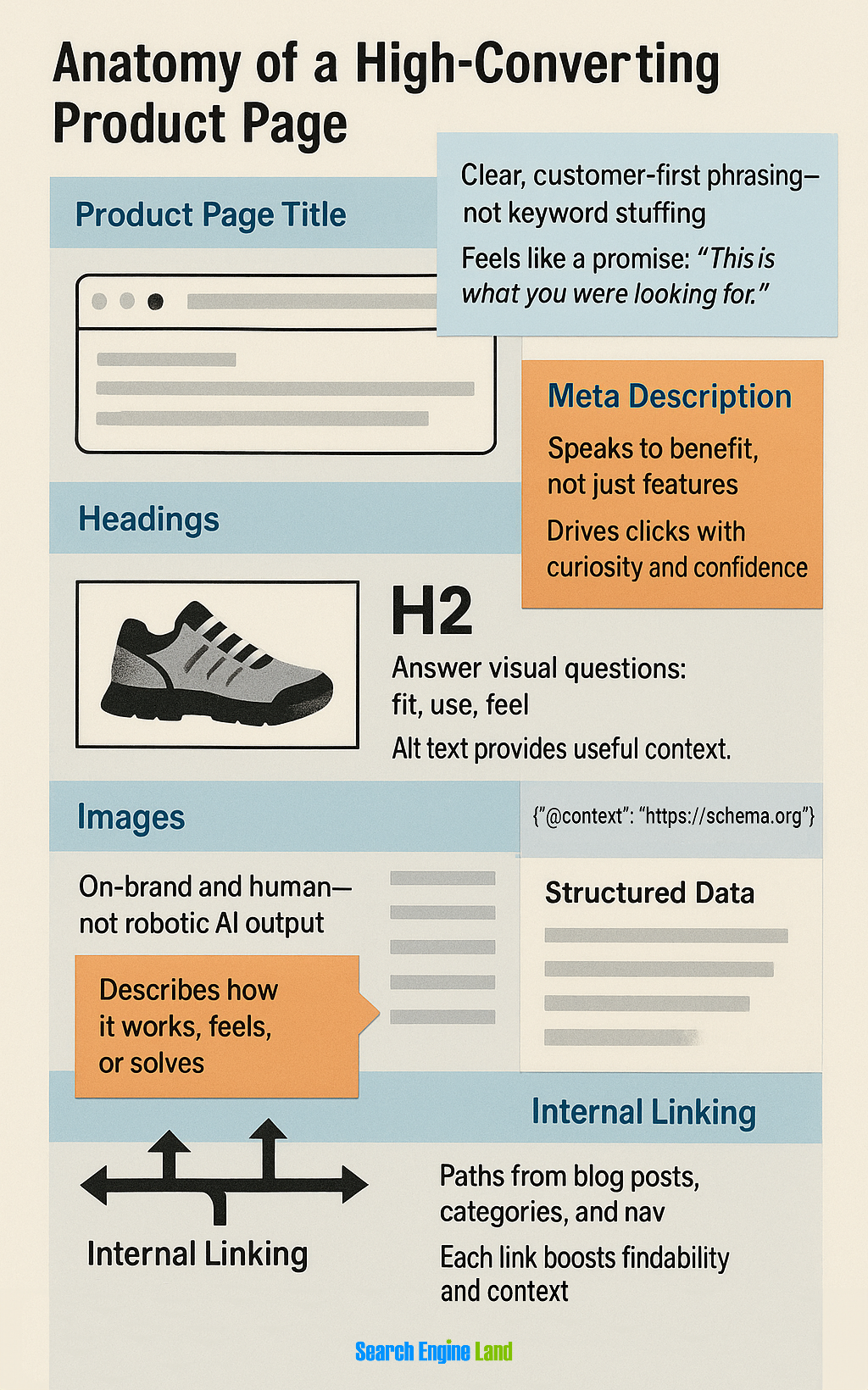
Search engines have specific recommendations, A product page would be considered useful, authentic, and informative enough for buyers by search engines. To be useful and authentic, a product page should have these characteristics:
- Unique product title: Brief, descriptive, and keyword-heavy.
- Quality Images: Multiple views, zoomable, fast.
- A Conversion-Driven Product Description: It is at this stage that most online stores are failing.
- Structured data (Product Schema): Price, availability, condition, brand, images, review_count.
- User reviews: These are essential for credibility and help shoppers make confident decisions.
It boosts trust and search engine rankings. - FAQs: It will help reduce bounces because it will address some user
- Fair Pricing and Offers: It’s a conversion killer.
- Trust signals
• secure checkout
• return policy
• shipping information - Suggested related products: Upsell and Cross Sell Opportunities.
Creating Product Descriptions That Rank and Convert
It doesn’t have to be hard. Your product description needs to mix storytelling and search engine optimization. Consumers want more than just information about what your product is. They want to learn more about how they will benefit from it.
An effective product description should include:
1. A Clear Opening Statement
Describe the main advantage, not merely the feature.
Example:
“Enjoy unparalleled comfort on your daily jogging with our cushioning AirFlow running shoes.”
2. Feature Breakdown
List the attributes but assign benefits.
Feature: “Breathable mesh upper
Benefit: “Keeps your feet cool during long workouts.”
3. Use Cases
Demonstrate usage of the product and when and where it should be done.
4. Real Pain Points
Identify what customers are commonly worried about.
5. SEO Keywords (Naturally Integrated)
Example:
• women’s running shoes
• Light running shoes
• Beginning running shoes
No overstuffing – just intelligent placement.
The Role of Unique Content on Product Pages
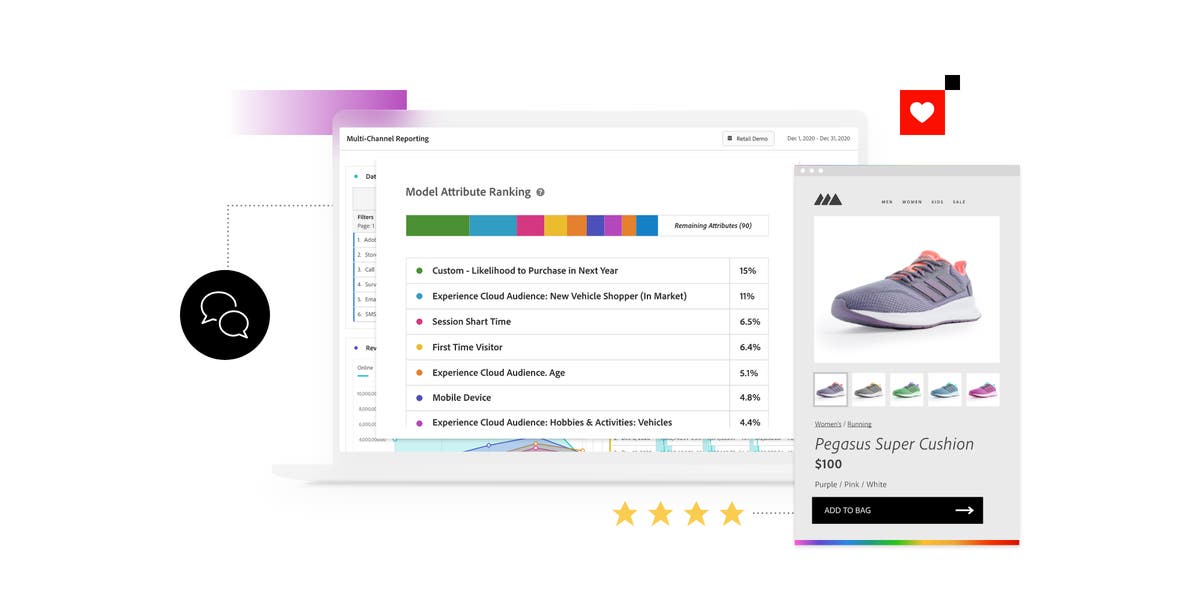
A “thin” or “copy” product page will result if you duplicate manufacturer descriptions. As a consequence, your rankings will be negatively affected.
Your task is to:
• rewrite
• expand
• personalize
• improve
• contextualize
Although your news will encompass more or less the same facts, your scoop will be more detailed and informative.
Your product page should be viewed as a miniature guide, and not as a space filler.
The Role of Product Schema in Winning the SERP War

It will make your product appear prominent on search engine result pages. Google will be able to show these on your product page with schema appropriately added:
• price
• availability
• rating stars
• review count
• Sale Information
This will improve your click-through rate even if you’re not at position number one.
Ecommerce schema types will primarily be these:
• Product
• Offer
• Review
• AggregateRating
• Breadcrumb
When done properly, schema will put your pages at an immediate competitive advantage.
Adding an FAQs Section on Product Pages

FAQs resolve user queries and make it easier to reduce bounces. FAQs also improve your chances of getting on page one for ‘questions’ related to your business.
For instance:
“Does it suit my oily skin?”
“Do these shoes have support for people with flat feet?”
“How long does shipping take?”
“What is the warranty?”
When these answers show up in search engine result pages, people trust your site even more.
Creating Your Ecommerce Content Machine: Blogging and Topic Authority
A healthy ecommerce site is more than just an online catalog. It’s a hub of knowledge. Search engines favor sites that showcase expertise, provide comprehensive answers, and address an issue from every conceivable perspective. Ecommerce content marketing becomes a superhero here.
It will turn your store from a spot where people buy goods to a spot where people make decisions. And search engines love sites that improve decision-making.
We should examine methods for developing a content system which drives rankings and your category pages and helps attract dedicated customers.
Why Ecommerce Brands Need Content More Than Ever
Because ecommerce continues to grow and, A few years back, online ecommerce sites could rely on online ads and simple SEO. But today, it all sounds like noise. Online ads are more expensive, and there’s global competition. Online search engines have more demands as well.
Content marketing bridges these gaps because it does three things:
• It resonates with customers well before they’re ready to make a purchase.
• It educates them and builds trust.
• It enhances your SEO because it shows expertise.
Most likely, your target customers aren’t typing “buy black yoga mat” at the very beginning of their journey. They’re searching for something like:
• “best yoga mats for home workouts”
• “how to clean a yoga mat”
• “thickness of yoga mats”
By answering these questions with useful articles on your store’s site, you build trust before you make a sale. And then, once the user is ready to make a purchase, your brand will be at the front of its mind – and frequently at the front of search engine results.
Uncovering Topical Authority (Your Secret Ranking Weapon)
A search engine will search for sites that have knowledge on an entire topic, not merely specific words. This method is known as topical authority.
Example:
You might be an online retailer for pet products. And if your site contains links to dog toys and dog beds, Google regards it as a store. Adding articles about:
“Why Pets Should be Adopted from Animal Shelters,”
“Choosing
• dog training manuals
• nutrition advice
• breed-specific care
• grooming tips
• Behavioral insights
• pet safety guides
Something changes. You’re no longer just a store – you’re a resource. That’s when search engines start giving you more respect.
Topical expertise is created through groups of content that address an issue from various facets. Rather than publishing various articles on random topics, you build related content pillars that link with each other.
Creating an Ecommerce Content Pillar
A content pillar helps with
A content pillar represents a central idea with additional ideas associated with it. It will allow Google to see how much you know.
By way of example, if your main category is “Running Shoes,” your pillar structure could be as follows:
Pillar Article:
“Total Guide to Buying Running Shoes”
Supporting Articles:
• “How to Pick the Best Running Shoes for Flat Feet”
• “Cushioning Levels Explained for Running Shoes”
• “Running Shoes vs. Training Shoes: What’s the Difference?”
• “How Often Should You Replace Running Shoes?”
• “Best Running Shoes for Marathon Training”
Each proofing article contains links to:
PhR
• the pillar article
• category page
• product pages that are relevant
This leads to a triangle of authority. Your site structure and relevance are highly prized by search engines as an indication that your site contains authoritative information on a given subject.
Topics on Which Ecommerce Sites Should Focus on Their Blog
The most optimal ecommerce content belongs to four broad categories: Informational, Comparison, Intent-driven, and Lifestyle.
1. Information Guides
People prefer learning before they purchase. These articles will be useful for answering general questions such as:
• “How to choose…”
• “Beginner’s guide to
• “Everything you need to know about …”
These guides help attract early-stage users and generate trust.
2. Comparison Content
Compared-to precio compara tudo. Ajude os compradores a fazê-lo
• “Product A vs. Product B”
• “Top 10
• “Best for…”
Articles about comparisons function extremely well because they target people who are more likely to be buying.
3. Content Supporting Intent
These articles are more about nudging people towards making a purchase.
• ‘Do I need…’
• “Is it worth it to buy…”
• “Signs you should replace….”
They eliminate hesitation. They remove doubts. They emphasize the importance of the product.
4. Lifestyle and Inspiration Content
Not everything needs to be educational. Some materials are for brand association.
• “Home gym setup ideas”
• ‘Outfit inspiration for winter running’
• “Healthy morning routine essentials”
These types of articles make your brand more personable.
How to Write Blog Posts That Rank (Even in Competitive Niches)
But blogs aren’t about keyword stuffing. It’s about marrying functionality with readability and search engine optimization.
A good ecommerce article should include:
- A useful and informative introduction
Describe what will be explained in the article. - Subheads for Readibility
Articulate information in bite-sized pieces. - Straightforward Answers
Don’t use technical terms if you don’t explain them. - Visual Examples or Metaphors To make abstract concepts easy to grasp.
- Integration with natural keywords Variations, Not Repetitions
- Links to Relevant Products or Categories Personalize your audience with your shop.
- Responding to actual customer questions Search engines favor content with low user friction. The more your articles assist people in understanding things as opposed to selling things, the better your rankings will be.
The Power of Answering Search Intent Correctly

Techniques and Algorithms
All search queries have some sort of intention. A search result will not rank if your article doesn’t fulfill the intention associated with your keyword.
For example:
Key Term: ‘best yoga mats for beginners’
Objective: Comparison and recommendation
Article should have a list, comparisons, pros and cons, and buying tips, and not be an essay about the history of yoga.
Keyword: “how to clean suede shoes”
Not Applicable
Steps, tools required, do/don’t tips have to be included in your article-not product pitches.
Matching intention is the greatest influencer on determining rankings on blogs.
Internal Linking: The Lifeline of Your Content Strategy
One of the most underrated ecommerce SEO tips would be linking your blog postings with your products.
Simple rule of thumb:
But every blogger entry should link at least to:
• One category page
• 1 product page
• Related article: One
It establishes link paths for search engines and visitors, dispersing link authority throughout your site. Internal linking also reduces the rate of bounces because these links direct visitors to more relevant pages based on their search queries.
Creating Content for a Lower Competition Keyword Term Wins
To better address client
Ecommerce sites would want to rank for broad terms like:
• “running shoes”
• “skin care products”
• “sets of cookware”
These are dominated by large brands.
But with long tail topics, you have opportunities such as:
• “best running shoes for shin splints”
• “vegan Skincare Routine for Dry Skin”
• “non-stick cookware alternatives for health-conscious cooks”
These keywords will get targeted visitors much closer to making purchases. Once these articles get some visibility, it will result in an increase in the authority site rank as a whole, and your category pages will get a boost because of them.
A long tail should be viewed as the roots of a tree. A tree with strong roots will stand tall.
Evergreen and Seasonal Content
Your own blog should include evergreen as well as seasonal articles. That is, your articles should be some that are evergreen and some that are seasonal.
Evergreen Content:
• ‘How To Choose The Right Mattress Firmness’
• “Benefits of Resistance Training at Home”
It is evergreen because it does not have an expiration date.
Seasonal Content:
• “Best Skincare Gift Sets this Holiday Season”
• “Fitness basics for summer”
It increases significantly in specific months of a year. It leads to quick wins.
A well-balanced content strategy will attract consistent traffic as well as seasonal traffic on its own merit.
The Real Magic: Content + SEO + Products Working Together
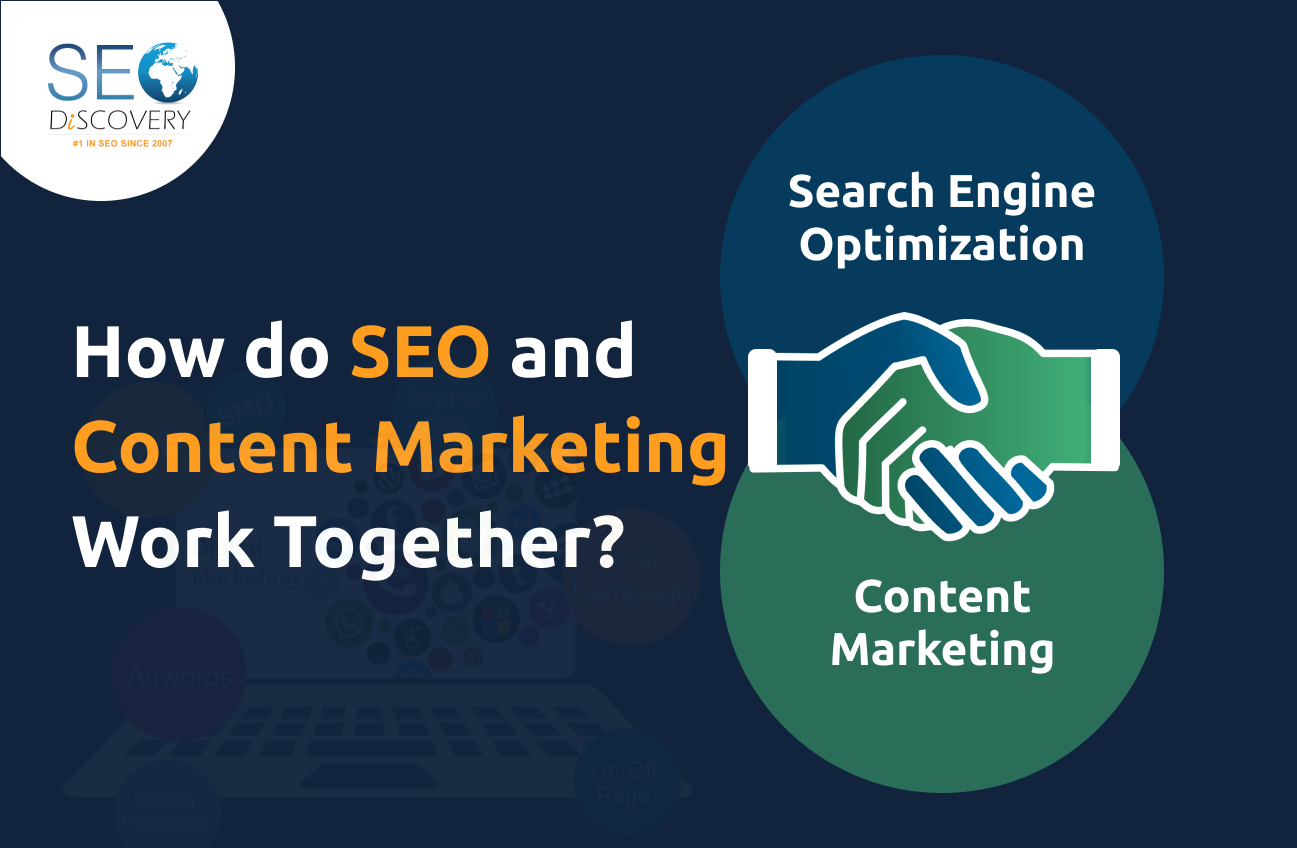
When your content, product pages, and categories all start to reinforce each other, a little bit of magic begins to occur:
.pullv{“style”:.”simulate”}
Thankfully, a search engine views an eco-system. That is, they believe they are being directed and not sold.
Your store will be considered an authority source and will be trustworthy. Ecommerce businesses use this method to scale organic traffic without spending more on ads.
The Role of On-Page User Signals in Ecommerce SEO
By Markus Voellmecke
Approx. 1,000 words
Search engines have an appetite for behavioral truths, and your ecommerce site is communicating with them on your behalf with every single visitor that lands on your site. It’s a story that’s based on subtle signals people leave on your site, and it includes dwell duration, click paths, scroll paths, and return visits. These aren’t exactly exciting terms, ranging from “canonical tags” and “schema markup,” but they play an integral role in search engine recognition of your site as useful. And for an online business, it’s not just an SEO issue – it’s an issue of survival.
Why User Signals Matter
The ultimate goal for search engines is satisfactory search result outcomes. Users will continue to have a satisfactory experience on a site, and search engines will perceive it as value. Conversely, if people click away too soon or don’t interact well, search engines will assume that people were not satisfied with the page. Notably, on ecommerce pages, user intention can be transient and may be made within seconds.
User signals don’t replace other signals like content and structured data – they magnify them. A product page with excellent structure and bad user signals will rank slightly lower than a page with excellent content and excellent user signals. Just as a whisper can be an extremely loud voice.
SEO-Driven Engagement Metrics
There are several behavioral factors that not only Google but any search engine monitors. Yes, they don’t list them as factors for rankings. They don’t have a reason to. Their algorithms can detect these factors without stating them.
- Time on Page
By browsing, comparing, and viewing information, it implies that your content meets your visitors’ intention. Ecommerce sites providing elaborate product information about materials, size, usage, and warranties have a natural hold on people’s attention. Brief product descriptions bring that hold to an end. - Scroll Depth
A user scrolling down the entire page is repeating something fundamentally different. It’s saying, “Give me more.” Search engines have to acknowledge that scroll action as a whisper of approval. Hugely, pages with lots of information- blocks with images, FAQs, tables comparing things, reviews- force much more scrolling. - Interaction Events
Clicks count:
• Filtering options
• Add-to-cart actions
• Variations of Products selected
• Size Charts opening
• Image zooming
• Verifying shipping schedules
And interaction is engagement, and engagement shows satisfaction.
- Reduction of Pogo-St
Pogo sticking A pogo stick user is someone who clicks on your page and then goes back and clicks on a different result on your search engine. To get your message across without pogo sticking, your ecommerce site should be very easy to navigate. - Return Visits
When people return to your product pages on their own, that’s retention. A large number of return visits usually imply either high product value or high brand value.
Improvement of These User Signals Naturally
You cannot control user behavior, but you can totally design for it. All enhancements that benefit your customers will benefit your SEO-as an added bonus, here’s a case where your business aims and SEO aims are perfectly in sync.
1. Create Product Pages That Are Visually Attractive From the First Second
Attention is like a scared animal: it will jump and will run. So, if your product page does not convince the buyer within a couple of seconds, they will remove you from consideration.
Hero image, layout, and necessary information up front. High-quality images, 360-degree views, and short product videos greatly improve user interactions. The images should load instantly. The videos should start instantly. Broken images will drive users away. Sharp images will engage them more.
2. Be All That You Claim and Claim All That You Are
Well, it detects that they have stopped scrolling because they believe they have a ‘thin’ page. But if they have stopped because they have reached what they exactly wanted, it is satisfaction. It should expand with useful content.
Should include:
• General Information
• Product story (“Why we made this…”)
• Material decomposition
• A size or fit guide
• A troubleshooting or usage guide
• Benchmarking against competing products
• Warranty or return procedures
• User-uploaded images
Each block becomes a new reason for people to scroll and engage, thus helping to generate more engaging patterns.
3. Add Smart Micro-Interactions
Micro-interactions refer to some tiny bits of UI/UX that encourage the user to engage more with your site with hardly any effort at all. It makes these shoppers believe that they are being responded to on the page.
Examples include:
• Animado button al paso del mouse
• A calculator for delivery dates based on pin codes
• Glides with smooth popping-up size guide
• Variants with immediate updates for price
• Mini-cart sliding out when a product added
These attributes result in less friction and more opportunities for interactions, which are excellent signals.
4. Improve Mobile Experience and Lower Bounce Rate
Ecommerce traffic is overwhelmingly mobile. And if mobile pages appear crowded, sluggish, and confusing, user engagement will quickly deteriorate.
Your mobile page should be almost as if it were a native app for online shopping. That includes:
• Full-width product images that load quickly
• Sticky add-to-cart buttons
• Swiping Galleries
• Large, easy-to-tap filters
• As little text as possible above the fold
• Smooth checkout process
All these changes result in an improvement in user retention, scroll depth, and conversion rates.
5. Make Your Page Emotionally Predictable
Humans abhor ambiguity. A page that inspires confusion—or even hints at it—invites an abandoning user. Ecommerce sites don’t want unpredictability. It wants predictability.
Predictable components include:
• Product titles
• Prices for hunting expeditions are not included
• Delivery times predicted instantly
• Coupon codes visible upfront
• No reviews are hidden under complicated tabs
The better it synchronizes with customer intentions, the easier it will be to attract and hold their attention.
6. Create Product Descriptions with a Conversational Tone
Robot-like and template-based descriptions will destroy engagement. Consumers will not want a boring, general summary on a screen. Product descriptions should be put together as if someone were leading the customer.
Expert speak instead becomes simplicity. Keyword rich text instead becomes storytelling. The goal here would be to improve cognitive ease so that more people remain on the site and read more.
A product description answering an actual question about things like comfort, longevity, materials, and so on will be doing something completely nuts. It will be giving dwell time, and that’s among the best user signals you can provide.
7. Use Internal Linking to Keep People Moving
Internal linking helps search engines navigate. When an online shopper moves among various pages on a site, it signals to search engines that it contains a value chain as opposed to a single point of interest.
Link To:
• Similar products
• Themed online digital collections
• “You may also like” sections
• Blog guides or comparison pages
• Accessories or Bundles
When internal links are helpful and aren’t forced, it benefits SEO as well as conversions.
8. Give Shoppers a Reason to Return
Shoppers today have return visits improve your site’s credibility with search engine algorithms. To get return visits, you should:
• Wishlist and save-for-later functionalities
• Price drop alerts
• Back in stock alerts
• Email sequences with valuable information (including but not limited to discounts)
These factors will have your users coming back to your site on their own—and that will send an excellent signal back to the search engines.
The user signal reflects user experience. A search engine optimization strategy might be attractive as thinking about some sort of machine-based solution, but user signals are a sure check that it’s anything but. The more actual humans who visit your site and spend more time there, engaging with it and engaging with your pages and digging around, the more so your site will be seen as valuable within the search engine.
That’s the secret about user signals: they don’t need rocket science expertise. It’s the essence of the message and value you provide. By optimizing for an exceptional user experience as a shopper and customer, you will automatically reap search engine rankings as a reward.
Move Your Ecommerce SEO Forward
You have seen the impact that signals, product page experiences, and intelligent on-page actions have on outcomes. The next step: Just put these things into practice.
Look at your own store and identify remedies and changes that would have the greatest impact. Work on an area at a time – your rates, your category pages, your tech.
To help stores that seek professional advice, Bloom Agency provides full-scale ecommerce SEO services that can be effectively implemented for such ends. From on-page optimization to technical optimization, these ecommerce SEO services will help your store be optimized for better rankings and conversions.
Smarter progress today will result in better rankings and more conversions tomorrow. From Bloom Agency, intelligence will continue to be provided based on project experience, testing, and ecommerce growth.






Rahul M.
B2B Service Provider