
Discover how AI SEO Services — from intelligent keyword research to automated, insight-driven content strategies. Learn what AI SEO is, why it matters now, and how it helps brands improve visibility, rankings, and measurable results in an AI-first search landscape.
Artificial intelligence is fundamentally reshaping how people search and how brands get discovered online. Search engines no longer rely solely on blue links and keyword matching. Instead, they increasingly generate answers directly through AI models, synthesize insights from multiple sources, and prioritize clear, authoritative entities over isolated pages or exact-match terms. This evolution has given rise to a broader and more strategic discipline known as AI SEO.
As AI-generated answers, conversational search, multimodal result blocks, and chat-based discovery become part of everyday user behavior, visibility is no longer limited to traditional search engine results pages. Brands can now surface in classic SERPs, AI-powered summaries, and conversational responses — often without a direct click to a website. Being discoverable means being understandable to machines, not just optimized for rankings.
For marketers and growing businesses, this shift changes the definition of success. Visibility is no longer measured by keyword positions alone. Instead, it depends on how clearly content is structured, how consistently entities are defined, and how reliably AI systems can extract, interpret, and represent brand information across multiple discovery surfaces.
At Bloom, we approach AI SEO as the intersection of strategy, structure, and intelligence. It’s about aligning content with how modern retrieval models evaluate relevance, authority, and context. It’s also about building a visibility framework that works across both traditional search results and emerging AI-driven environments.
This guide explores how AI is transforming search behavior, how modern retrieval and ranking systems assess content, and how brands can build a future-ready SEO strategy that delivers visibility not just in SERPs, but across the entire AI-powered discovery ecosystem.
What is AI SEO?
AI SEO refers to the process of making your content discoverable, trustworthy, and easily extractable across various AI-powered search environments. Although it builds off of traditional SEO principles like valuable content, technical optimization, semantic structure, and authority, it takes a further step inhow AI systems interpret, summarize, and surface information.
Whereas with traditional SEO, the focus is on reaching the top of search results, AI SEO Services goes further to include retrieval and citation in AI responses. It considers not only how AI models score entities but also extracts relevant passages that determine which sources to cite when compiling answers across various AI-powered platforms such as Google AI Overviews and AI Mode, Bing Copilot, Perplexity, ChatGPT with browsing, and other emerging AI-driven discovery interfaces.
Specialty terms have proliferated to describe strategies and techniques unique to the AI SEO genre. Terms like GEO, or Generative Engine Optimization, AEO, Answer Engine Optimization, and the study of how large language models reference or interpret brand information reflect both the growing sophistication of this discipline but also point to methods by which brands ensure their content is not just visible in, but well-represented within AI-powered search experiences.
AI SEO: Expanding the Scope of Search Optimization
AI SEO is not a standalone approach or a replacement for traditional SEO. Rather, it is the discipline that unifies multiple strategies and perspectives, helping brands optimize their visibility across both conventional search results and AI-driven environments. While traditional SEO focuses primarily on organic rankings, AI SEO emphasizes discoverability across all AI-influenced search experiences. It complements and expands standard SEO practices, giving marketers a unified approach to visibility in an increasingly AI-powered landscape.
Why AI SEO Matters
Search is evolving at an unprecedented pace. Modern algorithms, such as Google’s, now consider over 200 ranking factors and undergo thousands of adjustments each year. At the same time, users increasingly encounter AI-generated summaries, multimodal result blocks, and conversational interfaces before ever reaching traditional organic listings on the SERPs. These experiences pull information from multiple sources simultaneously and reward content that is clear, semantically consistent, and easy for AI systems to interpret.
As a result, visibility is no longer determined solely by page rankings. How well AI systems can extract, understand, and reference your content now plays a critical role. AI SEO bridges the gap between classic SEO strengths and these new realities, helping marketers stay ahead in an environment where AI increasingly shapes discovery.
Through AI-supported analysis, teams can identify patterns that may be difficult to detect manually, such as semantic gaps, unclear entity relationships, or inconsistent terminology. Addressing these issues leads to clearer content and more reliable decision-making. Additionally, generative engines provide insights into the types of explanations, definitions, and factual details that users expect. Teams that understand these patterns can create content that aligns more closely with emerging search behavior and user intent.
AI-augmented monitoring also enables faster diagnosis of changes in visibility or user behavior. By highlighting unusual trends earlier than traditional monitoring methods, teams can adjust content strategies or technical foundations before minor issues become major setbacks. Furthermore, as search no longer happens in a single location, content must be accurately represented across multiple touchpoints, including traditional SERPs, AI-generated summaries, chat interfaces, and multimodal result blocks. AI SEO ensures consistent and accurate representation across all these surfaces.
Finally, AI SEO provides clearer guidance on content quality. AI systems tend to favor pages that offer concise explanations, precise definitions, and strong entity clarity. By prioritizing these elements, teams can create content that performs effectively in both traditional search environments and emerging AI-powered discovery channels.
As long as search engines press forward in incorporating AI elements into their functionalities, the “SEO vs. AI SEO” debate will become less about distinct strategies and more about the ever-broadening definition of “visibility.”
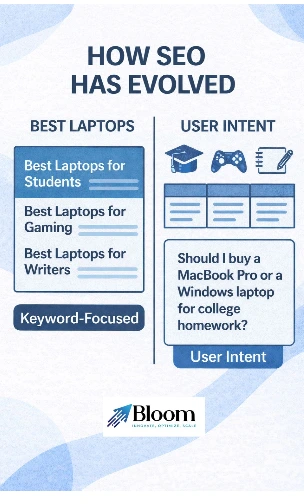
SEO has developed in relation to significant patterns in the interpretation of information by search engines and user expectation of information access. From matching to the interpretation of intent and, more recently, artificial intelligence-driven information retrieval, there has been a paradigm shift in the way in which searches are conducted. From
Keywords to Intent
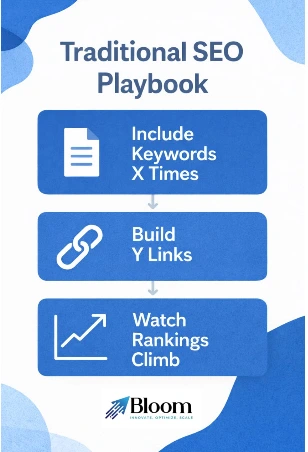
Traditional SEO was a simple proposition: find high traffic keywords, put them in the right densities on a page, get links with the keywords in them, and rank higher,” explains Moz’s Danny Sullivan. “It was a simple matter of writing the right keywords X number of times, getting links Y number of times, and poof—rank higher.”This way of optimizing for keywords was quantity over quality or relevance.
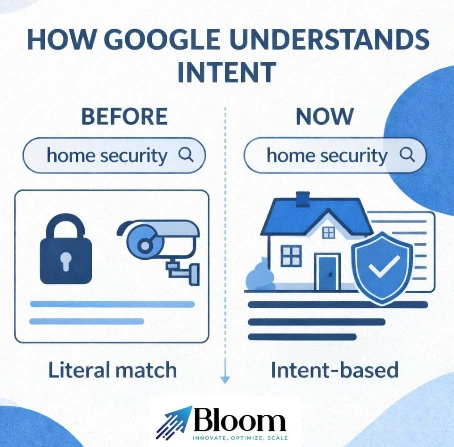
AI search engine optimization deals more with understanding what a user wants to search and presenting content that is relevant, comprehensive, and of high quality. Today, search engines like Google understand searches using natural language processing, allowing them to return results specifically related to what a user wants to search for.
For example, with a search query like “apple nutrition data,” Google can now understand the search query is presumably about the nutritional content of an apple and not about nutritional facts for products from Apple Inc.
Rise of AI-Powered Search
Search engines have undergone a profound transformation, integrating advanced AI systems at their core. This shift goes far beyond routine algorithm updates and fundamentally changes how search functions.
Key AI technologies now powering search include RankBrain, BERT, MUM, and Google’s AI Overviews as part of the broader Search Generative Experience (SGE). RankBrain, introduced in 2015, uses machine learning to interpret previously unseen queries by connecting them with similar known searches. It influences all Google queries and adapts results based on user interactions, effectively learning which results satisfy specific intents. BERT, launched in 2019, processes natural language by understanding words in context, capturing subtle linguistic nuances that earlier algorithms often missed. In 2021, MUM (Multitask Unified Model) arrived, offering 1,000 times more processing power than BERT, understanding content across 75 languages and multiple formats simultaneously, and enabling answers to complex queries that once required multiple searches. Most recently, AI Overviews within Google’s SGE synthesize information from multiple sources to provide direct answers to complicated questions. As of March 2025, AI Overviews appear in approximately 13% of Google searches, nearly doubling in just a few months.
These developments represent a shift from document retrieval to information interpretation. Modern search systems increasingly analyze insights across the web, evaluate source reliability, and generate synthesized answers at scale.
Generative Engine Optimization (GEO)
As AI-generated answers become more prevalent, generative engine optimization (GEO) has emerged as a key focus. GEO encompasses practices that help content appear in AI-generated summaries, answer panels, and synthesized responses across platforms like Google AI Overviews, Bing Copilot, Perplexity, and ChatGPT’s browsing environment. AI SEO represents the overarching discipline of optimizing content for AI-driven search visibility, with GEO specifically ensuring content is easily selected, extracted, and synthesized by generative systems.
The fundamental distinction between traditional SEO and GEO lies in intent. While conventional SEO targets ranking a webpage, GEO aims to position content as a source for AI-generated answers, establishing the brand as an authority informing AI responses. GEO is not a standalone strategy but one component of AI SEO, emphasizing content that aligns with how generative systems retrieve, interpret, and integrate information.
Generative engines differ from traditional ranking systems. They pull insights from multiple sources simultaneously, prioritize entity clarity and factual accuracy, favor well-structured extractable passages, and synthesize knowledge rather than simply listing links. GEO focuses on defining clear entities, maintaining internal consistency, providing concise explanations, using structured formats like lists or steps, and signaling expertise and trustworthiness. The goal is not to “write for AI,” but to make content interpretable and reliable for generative systems. As AI Overviews, answer boxes, and chat-based search interfaces become standard, GEO has evolved as the natural extension of featured snippet optimization—broader in scope, more reliant on semantic clarity, and increasingly essential in shaping user decisions.
Answer Engine Optimization (AEO)
Answer engine optimization (AEO) existed before GEO, and its focus on featured snippets, justice answers, and voice-assisted answers remains valid to date. Although the competitive arena has undergone transformations, AEO prioritized the display of direct answers in traditional and AI-powered search result pages.
The difference could not be clearer: the goal of SEO is to rank, while the goal of AEO is to answer. Rather than fighting for the number ten link, the objective of AEO focuses on providing the most concise and truthful information possible that can be indexed instantly by engines. In today’s atmosphere of Artificial Intelligence, AEO incorporates both snippet-level visibility and the deployment of AI answers.
AEO is dependent on aligning its content to the questions asked, developing FAQ boxes, defining content for clarity, utilizing definition boxes or glossaries, schema application, and simpler vocabulary. This remains a fundamental principle of an AI SEO, especially for an established brand whereby accurate definitions direct consumer behavior, for instance, product, technical, and policy.
Large Language Model Optimization (LLMO)
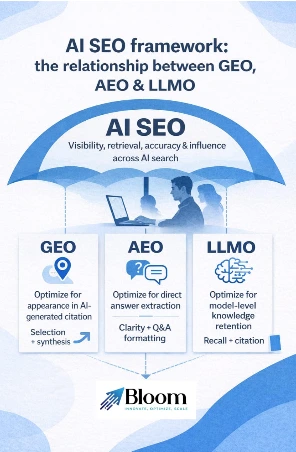
Large language model optimization (LLMO) focuses on making content discoverable, retrievable, and accurately cited within LLM-based AI systems such as ChatGPT, Gemini, Claude, and Perplexity. If GEO determines whether content is selected for AI-generated answers, LLMO ensures that content can be referenced internally by the model during generation. The objective is not ranking or immediate answering—it is embedding content into the knowledge base that models use to generate responses.
LLMO emphasizes clear entity definitions, semantic grounding, citation reliability, structured self-contained facts, crawl accessibility, and consistency across sources. Because LLMs synthesize knowledge from multiple origins, visibility can occur even without a direct page visit. In this sense, LLMO supports AI SEO by making content extractable, accurate, and model-friendly at the knowledge level, complementing the visibility goals of traditional SEO and GEO.
The Rise of Zero-Click Search
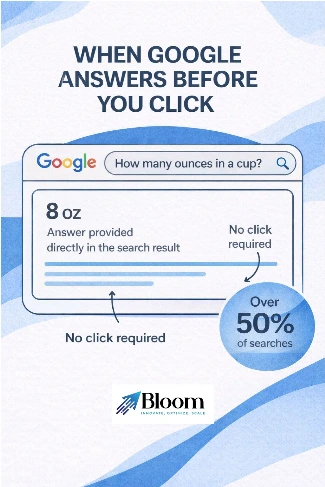
Zero-click search has quickly become a hallmark of the new search landscape. From featured snippets to knowledge panels, People Also Ask sections, and-even-more recently-AI-powered responses that present instant answers directly on the search results page, searchers don’t have to click through to a website for information anymore. The search engines have moved from being traffic drivers to answer engines, which fundamentally changes how brands achieve visibility.
This is a shift supported by very compelling data. According to a study by Rand Fishkin of SparkToro in 2024, 58.5% of all Google searches in the United States returned zero clicks-that is, the information was directly available on the results page. In the European Union, zero-click searches were as high as 59.7%. These numbers show a critical reality for brands: go-with-the-flow SEO strategies focused merely on clicks are no longer sufficient.
This means, for businesses, visibility now matters just as much as traffic. Featuring in featured snippets, AI summaries, and rich results is about brand authority, awareness, and trust. To us at Bloom, zero-click search represents not a threat, but an opportunity-to position brands where user attention is increasingly being concentrated: directly within the search experience itself.
Integrating GEO, AEO, LLMO, and SEO
In the AI SEO ecosystem, GEO, AEO, and LLMO work alongside traditional SEO fundamentals—they do not replace them. Without strong technical health, structured content, and well-defined entities, AI-driven visibility lacks a stable foundation. Together, these layers create a comprehensive approach: traditional SEO ensures discoverability and authority, GEO drives generative answer visibility, AEO delivers concise, direct answers, and LLMO embeds content into AI knowledge systems.
This integrated framework allows brands to maintain visibility across both conventional search results and emerging AI-powered discovery platforms, creating a unified strategy for modern search optimization.
9 Tips to Optimise for AI
AI SEO is not a collection of shortcuts or one-off tactics. It’s the practical application of strong SEO fundamentals adapted for a search environment where AI-generated answers, summaries, and new interfaces play an increasingly central role.
By focusing on semantic structure, schema markup, and topical authority, brands can strengthen visibility across both traditional search results and AI-powered discovery surfaces. With that foundation in place, the following nine strategies can improve performance across AI-driven and classic search experiences alike. These approaches don’t need to be applied in a fixed order and can be implemented individually or together, depending on business goals and resources.
1. Prioritize semantic search and structured content
Modern search engines and AI systems interpret content contextually rather than relying on exact keyword matches. Semantic optimization improves both organic rankings and AI visibility by helping systems understand meaning, intent, and relationships.
Implementation strategy:
- Develop comprehensive topic clusters that address all major aspects of a subject. Folloze found that shifting from narrow pages to in-depth topic clusters resulted in ranking for 68% more long-tail keywords year over year across their content library.
- Write in natural, conversational language that reflects how people actually communicate. Content that mirrors real-world phrasing improves comprehension, usability, and engagement across search, voice interfaces, and AI-generated experiences.
- Use a clear heading hierarchy with one H1 per page, supported by H2s and H3s for logical organization. AI systems heavily rely on heading structure when determining relevance and extractability.
- Present complex information using tables, lists, and comparisons. Structured formats help break down dense material into scannable, accessible sections that benefit both users and AI systems.
Example: Rather than publishing a keyword-stuffed page targeting “best running shoes,” create a comprehensive guide with sections for trail running, marathon training, cushioning types, and comparison tables that reflect how runners actually research footwear
2.Schema Markup Implementation and Optimization
Structured data provides a clear understanding for the search engines regarding the contents of a page. It enhances the understanding of an entity and ensures that AI is able to categorize, summarize, and use the information in the right manner. The use of effective schema markup ensures that the contents are featured in the rich result and answers generated through AI.
Implementation strategy:
- Use schema types like Article, Product, FAQPage, HowTo, and VideoObject as needed.
- Use schema and add all necessary properties instead of minimal implementation. Google further recommends a comprehensive schema for better listings in the enhanced results.
- To establish relevance and promote citation context, the use of entity-related attributes such as “about,” “mentions,” and “same as” helps in
- Use nested schema structures when applicable, for instance to add an FAQ Page to an article.
For instance, a shopping site using the Product schema, which incorporates aspects like pricing, availability, reviews, and product features, helps AI algorithms easily cite particular points while responding to related questions.
3.Target the long tail and conversational queries
AI-powered searches are heavily dependent on questions and follow-up questions. The more naturally phrased the content is in question form, the easier it is for AI systems to match, extract, and summarize.
Implementation strategy:
- Use AI-assisted query research to uncover long-tail questions and conversational phrasing. Pull insights from search data, internal site search, customer support logs, and sales conversations.
- Create structured sections of FAQs using real user language. Properly formatted FAQs increase visibility in AI-generated overviews and voice-based answers.
- Cascade optimization of questions by anticipating follow-up questions and structuring the content to actually answer such through progressive explanations and internal linking.
Example: A financial advisory might produce content addressing very specific questions, such as “How should I allocate my 401(k) in my 40s with kids in college?” versus relying on more general terms like “retirement planning.”
4.Develop first-party expert-level content
Google’s guidelines for E-E-A-T and AI citing behavior are tending toward content written by experts and persons with direct experience. Original thoughts are what help AI distinguish between expert content and an abstract.
Implementation Strategy:
- Show experience through case studies, process improvement initiatives, and original research. These are what establish credibility and demonstrate genuine expertise.
- Add data or insights that are proprietary or cannot be discovered anywhere else. The more unique the information presented, the greater the chances of citations and the more it can enhance the authority of the search results.
- Give a clear definition for authorship with authentication based on credibility.
Example: A dermatological practice that writes in-depth articles from board-certified dermatological experts through case studies and original research is likely to be cited when answering medical-related inquiries through AI.
5.Enable content to be extractable for generative engines (GEO)
Optimizing for the generative responses requires making information accessible enough that it may be correctly quoted and summarizied. The most important explanations have to be understandable without context.
Implementation strategy:
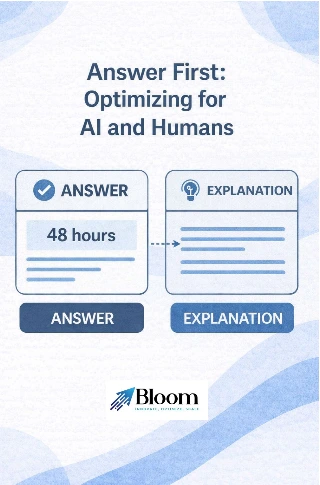
- Locate brief, self-contained “answer” blocks at the start of sections to facilitate extraction.
- Speak in an expert tone to convey confidence.
- Make use of figures and statistics to create an element of reliability.
For instance, a travel guide for Japan might start its sections with direct answers like “The best time to visit Tokyo is in late March and early April,” and then proceed with relevant background information, helping AI systems easily identify the right answers.

6.Use internal linking to build context and relationships
Internal linking builds a semantic network to help the AI understand topical depth, authorities, and relationships across content.
Implementation strategy:
- Organise content as hub-and-spoke topic clusters to support topical authority.
- Use descriptive links with context rather than just clicking here or generic links.
- Establish reciprocal links between highly connected pages to reinforce the relationships.
Example: A cooking website may interlink pasta guides with related pages on sauces, regional cuisine, and cooking techniques, signalling deep subject expertise.

7.Periodically update and enhance your current content
Being up-to-date has never been more important, especially when AI technology relies on current and accurate information.
Implementation strategy:
- Conduct content audits with performance data and competitive metrics.
- Ensure that the topics to be updated are those that are most volatile in nature and change frequently on the
- Emphasis should be on improvements, such as new research, new examples, and new explanations.
Tech review websites ought to update the purchase guide repeatedly through new models, new prices, or new comparisons, instead just through new reviews.
8.Essential technical site health
In AI-related SEO, “Technical SEO remains foundational to AI visibility.” What makes pages “fast, accessible, and easy to understand” remains crucial.
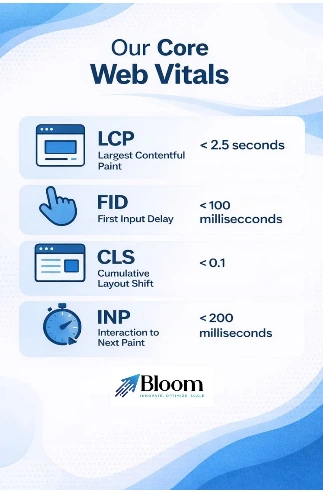
- Core Web Vitals Optimization for LCP, FID, CLS, and INP to Google standards.
- Provide crawlability for those pages on JavaScript-heavy sites that require dynamic rendering.
- Keep your crawl paths clean with internal linking and up-to-date XML site maps.
For instance, if an online publication uses improvements in image optimization and lazy loading, the effectiveness and efficiency of crawling by the AI are increased.
9.Rephrase as: Create multiple format content.
Search is becoming more multi-modal. Text, images, videos, and interactive elements all play a part in AI.
Implementation Strategy:
- Create strategies where each medium reinforces the same set of facts and definitions.
- Each format should be individually optimized instead of being repurposed content.
- Consistency in format to strengthen the signals of entities.
“A gardening website might integrate text tutorials with videos, planting schedules, or infographics to enhance user engagement and visibility to AI.”

9 Common Errors in AI SEO
With the evolving process of AI search technology, there are avoidable pitfalls that reduce visibility.
- Splitting off AI SEO into its own domain fragments strategy and dilutes consistency.
- Putting too many keywords before clarity and organization will affect the extractability.
- The production of a high volume of AI content without increasing the accuracy of facts can impact the credibility of information.
The optimization for ranks doesn’t consider answer inclusion.
- “Weak entity signals” are confusing to artificial intelligence systems.
- AI Overview Assessments as All-or-Nothing Outcomes ignore the bigger picture of influence metrics.
- “For the model” rather than “for the users” results in brittle strategies.
- Failure to focus on UX and tech health impacting performance on all touchpoints.
- Not updating information makes it less and less accurate.
Successful AI SEO requires clarity, organization, expertise, and accuracy to be considered long-term investments rather than short-term solutions.
How to Measure AI SEO Success
AI SEO reshapes how visibility works — and as a result, it also reshapes how success should be measured. While traditional metrics such as organic traffic and keyword rankings still hold value, they no longer tell the full story. AI-powered search introduces new discovery surfaces, new answer formats, and new visibility signals that don’t always result in direct clicks.
To understand whether your AI SEO strategy is delivering impact, measurement needs to evolve alongside search behavior.
Visibility within AI-generated answers
One of the clearest indicators of AI SEO effectiveness is how frequently your content appears inside AI-driven responses. This includes placements in Google AI Overviews, Bing Copilot summaries, Perplexity results, and AI-assisted browsing tools.
Key indicators to track include:
- Presence in AI-generated summaries
- Citations or references to your content
- Consistency of how your brand is represented across different AI platforms
Even without immediate traffic, this type of visibility influences perception, trust, and downstream decision-making.
Bloom insight: AI visibility monitoring tools that track entity mentions, SERP appearances, and citation patterns can help surface these signals early.
Mention share and entity-level presence
Modern AI systems rely heavily on entities rather than keywords. Measuring how your brand entity appears — and how accurately it’s understood — is essential for sustained AI visibility.
Evaluate:
- Frequency of brand or product mentions
- Accuracy of descriptions and attributes
- Preference signals compared to competitors
- Consistency of entity associations across AI outputs
Stronger entity clarity often translates into greater authority and preference within AI-generated results.
Passage-level extractability
AI systems favor concise, self-contained passages that clearly explain a concept, definition, or process. Pages designed with extractable sections are more likely to surface in generative answers.
Success indicators include:
- Your content being quoted or paraphrased in AI outputs
- Repeated extraction of specific paragraphs
- Structured elements such as definitions, steps, or lists appearing in summaries
This helps identify which sections of your content AI models trust and reuse most frequently.
Accuracy of brand and product representation
Inconsistent or outdated content increases the risk of AI misinterpretation. Monitoring how accurately AI systems describe your brand, offerings, and positioning is critical for trust and brand safety.
Review AI outputs for:
- Factual correctness
- Clear articulation of your value proposition
- Accurate comparisons with alternatives
- Alignment between source content and generated summaries
Consistent accuracy signals a strong AI SEO foundation.
AI-influenced traffic and conversions
While not all AI exposure results in immediate clicks, AI-driven visibility still impacts user journeys — often indirectly.
Track:
- Traffic originating from AI-assisted features
- Changes in behavior following AI answer inclusion
- Engagement patterns after AI-surface entry
- Influence on branded searches and assisted conversions
AI SEO frequently supports discovery and consideration stages rather than last-click attribution.
Combined SERP and AI visibility
Search is no longer confined to a single result format. A page may appear simultaneously in classic rankings, AI-generated answers, image packs, or knowledge-based modules.
A holistic view includes:
- Traditional keyword rankings
- Presence within AI-generated responses
- SERP stability over time
- Cross-surface visibility for priority queries
This blended measurement offers a more realistic view of performance in a hybrid search ecosystem.
Continuous improvement signals
AI SEO is not a one-time effort. Ongoing optimization should produce measurable
improvements in how AI systems interpret and surface your content.
Watch for:
- Increased inclusion in AI answers
- More precise contextual understanding
- Reduced misinformation or misattribution
- Faster recognition of updated or newly published content
These signals indicate that your AI SEO strategy is compounding over time.
Tools and Technologies Powering AI SEO
AI SEO is backed by a rapidly growing array of tools that are intended to enable the marketer to better comprehend how content is processed and made accessible in a contemporary search environment. Familiar categories of tools, such as crawling, analytics, content assessment, or keyword tools, are continuing to play an important role, but this role is changing. The focus is moving toward semantic clarity, entity relationships, and structured content.
These tools are not automatically “optimizing for AI.” They give the insight teams need in order to assess how content is performing on both traditional SERPs and AI-powered experiences, leading to quicker and more intelligent decisions on where and how to optimize.
All common AI SEO processes are based on four categories of tools.
Content analysis and semantic platforms
Such tools enable teams to analyze the clarity of the content, the level of topics, and the coverage of entities. They are used to compare rival pages, detect gaps in ideas, analyze term alignment, and compare new content with successful content in the same topic bucket.
The Onset of Zero-Click Searches
Zero-click search has become a hallmark of the modern search environment. With the rise of featured snippets, knowledge panels, and answers generated from Artificial Intelligence on the results page, searchers can now retrieve their required information without having to visit a site.
Rand Fishkin, through SparkToro, found in a 2024 study that 58.5% of all Google searches in the US had zero clicks, which implied that users got the info. they needed directly from the search results page. In the European Union, this percentage was a little higher at 59.7%. This just goes to show why AI SEO, AEO, and GEO strategies have become more prominent, considering the relevance of correctly interpreting search results, without necessarily clicking through to one’s brand.
Benefits of Implementing AI SEO
Organizations that implement AI SEO gain more than operational efficiency. They achieve greater clarity, stronger visibility, and improved adaptability across an increasingly complex search ecosystem. AI doesn’t replace strategy or human expertise — it reinforces the signals that matter most in an environment where content is interpreted across multiple AI-driven platforms.
Efficiency
AI significantly reduces the time spent on repetitive and resource-heavy AI SEO Services tasks, allowing teams to focus on planning, creativity, and strategy. Research from Influencer Marketing Hub shows that 17% of marketers save more than 10 hours per week by using AI-powered SEO tools.
By automating processes such as data analysis, content evaluation, and performance monitoring, AI enables faster execution without sacrificing quality.
Accuracy
AI-driven insights reduce guesswork by grounding decisions in large-scale data analysis. According to seoClarity, 64.48% of SEO professionals rank accuracy and reliability as the most important factors when choosing AI-powered SEO solutions.
For example, AI systems can analyze millions of SERPs in real time to identify ranking patterns that would be impossible to detect manually. This allows SEO teams to pinpoint which content elements — such as headings, internal links, structure, or depth — are most closely associated with strong performance within specific niches.
Big data analysis
AI excels at processing massive datasets and uncovering meaningful patterns. Capgemini research indicates that 62% of marketers use generative AI for data analysis, 60% for personalized experiences, and 56% for search engine optimization.
AI can evaluate millions of keyword combinations, behavioral signals, and performance metrics simultaneously to reveal high-converting content patterns. These insights would be nearly impossible to uncover through traditional manual analysis alone.
Scalability
AI enables SEO efforts to scale efficiently across large and complex websites. A 2025 report from SeoProfy found that 82% of enterprise SEO professionals plan to increase their investment in AI, highlighting its growing role in managing large-scale SEO operations.
For instance, AI tools can analyze thousands of pages and generate customized optimization recommendations or content briefs, allowing teams to improve extensive content libraries with speed and consistency that manual workflows can’t match.
Adaptability
AI improves responsiveness to algorithm changes by quickly detecting shifts in ranking behavior and emerging trends. Influencer Marketing Hub reports that 49.2% of businesses experienced ranking improvements after algorithm updates when AI tools were part of their SEO strategy.
This adaptability helps teams adjust content, structure, and strategy faster — reducing the risk associated with sudden search changes.
Future Trends Shaping AI SEO
AI SEO will continue to evolve alongside changes in how users interact with search. Several emerging trends are likely to influence how brands approach visibility in the years ahead.
Visual and video SEO
AI is enhancing how images and videos are optimized for search. As search becomes more visual, technologies such as computer vision enable search engines to interpret objects, text, and context within images and video content. These signals increasingly influence indexing, ranking, and discovery.
Personalized search experiences
AI enables real-time personalization by analyzing user behavior, preferences, and context. In ecommerce and content discovery, this supports tailored recommendations, more relevant results, and improved engagement throughout the user journey.
Predictive intent recognition
Search systems are becoming better at anticipating user needs before they’re explicitly stated. Content that addresses the full intent journey — from early research to final decision — is more likely to perform well as search engines evolve toward understanding why users search, not just what they ask.
Accuracy and trustworthiness
As concerns around AI hallucinations grow, search platforms are expected to prioritize reliable, well-supported content. Brands that focus on precise explanations, factual consistency, and clear sourcing will be better positioned to appear in AI-generated answers.
Hybrid search experiences
The boundary between traditional search results and AI-generated responses will continue to blur. Users will expect direct answers, visual summaries, and conversational explanations alongside links for deeper exploration.
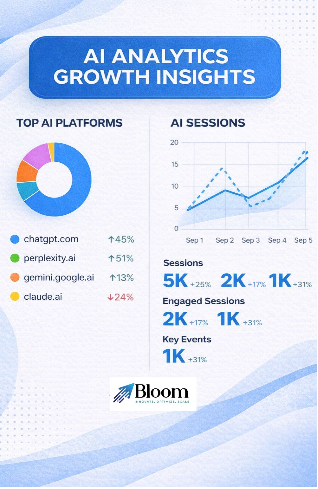
Making SEO Work in an AI-Driven Future
AI SEO represents the evolution of search — built on traditional SEO foundations, enhanced by new discovery methods, and shaped by the growing influence of generative engines.
Organizations that succeed will be those that combine strong editorial judgment with clear, structured, and accurate content that AI systems can confidently interpret and trust. Applying the strategies outlined in this guide helps position brands for visibility across both classic SERPs and AI-powered search environments.
A practical starting point is reviewing your most important pages to ensure they offer clear definitions, concise explanations, and meaningful topical depth. Improving structure and clarity within existing content can drive immediate gains across multiple search surfaces.
Search will continue to change, but its core purpose remains the same: helping users find what they need. Whether through AI-generated answers or traditional results, brands that invest in usefulness, accuracy, and clarity will continue to lead.
The AI SEO Framework: A Practical Model for Modern Visibility
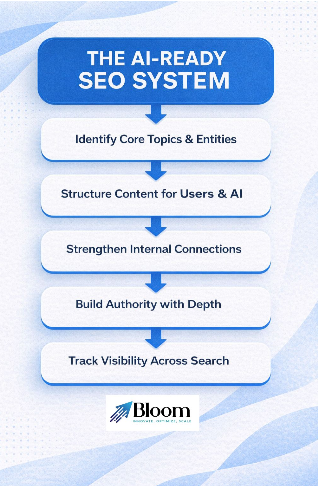
AI SEO expands on the notion of traditional discoverability, understandability, and trust across classic results pages and AI-driven search experiences, respectively. A practical model to guide planning, creation, or updating of the content with AI visibility in mind follows in the next sections.
It has its focus on five key building blocks: clarity, structure, authority, accuracy, and measures.
Clarity: Clearly Define Entities
Entities are at the very core of AI systems. Well-defined entities include clear, consistent definitions, which make your content more understandable for users and other service providers, and more likely to be included accurately in the answers generated by AI services.
This includes: consistent naming, accurate description of concepts or products, clear associations between entities, and minimal ambiguity across pages. Structural: Improve Content Clarity and Semantic Organization Information extraction capabilities of generative engines draw from clear, concise, self-contained passages. Logical, tabulated content with paragraph breaks, definition blocks, steps to how-to information, and other factual statements makes it far easier to parse and reference by AI systems.
Cavity and Implementing AI SEO
With AI SEO, organizations experience efficiency, accuracy, scalability, and adaptability in search experiences. AI does not disrupt strategy; rather, it amplifies the signals most valued in an AI-driven ecosystem.
- Efficiency: AI optimizes and automates many SEO tasks, leaving marketers and their teams more time for high-level strategy. This leads to marketers saving an average of more than 10 hours of work per week when using AI for SEO tasks.
- Accuracy: AI offers accuracy in decision-making, eliminating guessing. It has the capability to process millions of results per second in SERPs to identify patterns related to high rankings.
- Big Data Analysis: AI is used to reveal insights in big data, and patterns related to high-converting content, keywords, and behavior trends are found, which cannot be acquired through analysis.
- Scalability: This is an area where AI systems excel in optimizing large numbers of contents. Scalable teams are able to brief, analyze thousands of pages, and ensure consistency.
- Adaptability: AI technology assists in quickly reacting to changes in algorithms, finding trends, and changing approaches to rank higher.
Future Trends Shaping AI SEO
AI SEO continues to evolve with search technologies. Emerging trends include:
- Visual and Video SEO: Computer vision allows search engines to understand images and video content, making visual elements more relevant for indexing and ranking.
- Personalized Search Experiences: AI enables content delivery tailored to user behavior and preferences, improving engagement, product recommendations, and search satisfaction.
- Predictive Intent Recognition: AI increasingly anticipates user needs before queries are fully expressed. Content that addresses the complete user journey is likely to perform better.
- Accuracy and Trustworthiness: As concerns about AI hallucination grow, search engines will prioritize highly reliable and well-supported content for AI-generated answers.
- Hybrid Search Experiences: The line between traditional search and AI-powered answers will continue to blur, requiring concise explanations, visual insights, and direct answers supported by links for deeper exploration.
Making SEO Work in an AI-Driven Future
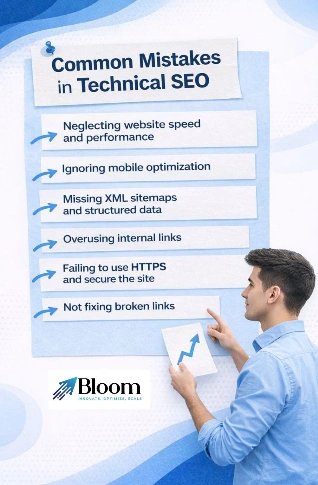
AI SEO is the natural evolution of search optimization: grounded in traditional SEO, enhanced by AI discovery patterns, and shaped by generative engines. Brands that combine editorial expertise with clear, structured, and accurate content will thrive in both classic SERPs and AI-powered environments.
A practical first step is reviewing high-impact pages to ensure they offer clear definitions, concise explanations, and strong topical depth. Improving clarity and structure can deliver immediate visibility gains across search surfaces.
The core goal remains: helping users find what they need. By investing in accuracy, clarity, and usefulness, brands position themselves as trusted sources—whether in AI-generated answers or traditional search results.
FAQs About AI Search
What’s the difference between SEO and AI SEO?
Traditional SEO focuses on ranking pages in organic SERPs. AI SEO expands this by optimizing content for AI-generated answers, where models summarize information instead of providing lists of links. The foundations are the same—clarity, technical health, and authority—but outputs differ.
How can I make my content more AI-ready?
Focus on clear definitions, strong entity consistency, concise extractable passages, factual statements with context, and structured layouts such as headings, lists, or steps. The goal is easy interpretation by AI systems.
Do keywords still matter in AI SEO?
Yes, but differently. Keywords help establish intent, but AI SEO relies more on semantic clarity, topical depth, and entity relationships than repetition alone. Keyword research remains a valuable input.
Will AI SEO replace traditional SEO?
No. AI SEO builds on traditional foundations—technical health, clarity, accuracy, and authority—while expanding visibility across AI-driven platforms. A hybrid approach is essential.
How to optimize for AI search?
Create content with high information gain: unique insights, original data, or deeper context. Structure content clearly, use schema markup, and optimize entities and relationships. Monitor AI-generated features regularly to refine strategies.
What is Generative Engine Optimization (GEO)?
GEO focuses on optimizing content to appear in AI-generated answers rather than just ranking traditionally. Success depends on information gain, structured content, clear formatting, and high-trust signals. Tools like Semrush Enterprise AIO help identify gaps, optimize outlines, and track AI visibility.
How do you perform GEO?
Identify AI summary opportunities, focus on unique insights, structure content clearly, use schema markup, and maintain entity clarity. Continuously monitor AI outputs to refine content and maximize citation potential.
Top GEO strategies for AI visibility:
Prioritize unique insights, structured content, schema markup, and entity-rich language. Audit AI-influenced SERPs to understand what gets featured and reverse-engineer success patterns. Focus on creating authoritative, AI-ready content.
Best SEO solution for AI visibility:
A hybrid approach combining traditional SEO with generative-first strategies works best. Tools like Semrush One track AI visibility, provide competitor insights, and guide entity optimization, content structuring, and information gain, ensuring your brand is both ranked and cited in AI-generated answers.







Rahul M.
B2B Service Provider