
SEO has changed a lot. A modern SEO audit is not just about checking rankings, keywords, backlinks, and technical issues like it used to. Now businesses also have to figure out how their site shows up across regular search, AI-powered search, local results, content discovery platforms, and the different moments in the customer journey.
You can end up with a website that has hundreds of indexed pages and still struggle to pull in qualified leads. Sometimes it ranks for dozens of keywords but the visitors feel far from buying, like there’s low purchase intent. Other times, even strong content doesn’t perform because there are technical problems, weak internal linking, messy conversion paths, or not enough authority (domain strength).
A full SEO audit service is meant to spot those bottlenecks, then narrow down which adjustments will create the biggest business impact. Not everything should be “fixed,” only the right things.
At Bloom Agency, our SEO process is focused on linking search visibility with real outcomes—such as qualified traffic, enquiries, leads, sales, and brand visibility.
Key Takeaways
A modern SEO audit should evaluate much more than keyword rankings. Technical health, content quality, search intent, website architecture, internal linking, backlinks, conversion paths, local visibility, competitor performance, and AI search visibility all deserve attention.
Many websites do not necessarily need more content. They may need to update declining pages, resolve keyword cannibalization, improve internal linking, strengthen commercial landing pages, or fix technical issues.
AI search is also changing how people discover businesses. Visibility can now come through Google AI Overviews, AI-powered search experiences, ChatGPT, Gemini, Perplexity, industry publications, review websites, forums, YouTube, and other third-party sources.
The purpose of SEO services is not to create a long spreadsheet of errors. The objective is to identify the highest-priority opportunities and turn them into an actionable roadmap.
What Is an SEO Audit?
An SEO audit is a structured evaluation of a website’s ability to be discovered, crawled, indexed, ranked, understood, and converted through organic search.
A complete audit examines the technical foundation of a website alongside its content, keywords, website architecture, backlinks, user experience, conversion paths, and competitive position.
For modern businesses, the audit should also consider visibility beyond traditional search results.
This can include:
- Google Search
- Google AI Overviews and AI-powered search
- ChatGPT and other AI platforms
- Local search
- YouTube
- Industry publications
- Review websites
- Relevant communities and forums
- Third-party comparison and listicle pages
The result should be more than a list of problems. A useful audit explains what is wrong, why it matters, how it should be fixed, and which issues should be addressed first.
Why Businesses Need Regular SEO Audits
SEO is not a one-time activity.
Websites change constantly. New pages are published, old pages are removed, URLs are changed, website platforms are updated, businesses launch new services, competitors publish new content, and search behavior evolves.
Even a website that performed well previously can gradually develop SEO problems.
Website Growth Creates Structural Problems
A small website may begin with a simple structure containing a homepage, service pages, and a few blog articles.
As the business grows, additional service pages, location pages, product pages, landing pages, blog posts, category pages, and campaign URLs are added.
Eventually, websites can develop:
- Orphan pages
- Duplicate content
- Weak internal linking
- Duplicate metadata
- URL inconsistencies
- Cannibalization
- Redirect chains
- Thin pages
- Unnecessary indexed URLs
Without regular auditing, these problems can become increasingly difficult to identify.
Content Can Lose Its Search Visibility
A page that ranked strongly several years ago may no longer perform as well today.
Competitors may have published better resources. Search intent may have changed. The original article may contain outdated information. Google may display different types of results for the query.
Instead of automatically creating another article, an SEO audit should determine whether existing content can be improved.
Content may need to be:
- Updated when the information is outdated.
- Expanded when important topics are missing.
- Merged when several pages target similar search intent.
- Redirected when a page no longer has a useful purpose.
- Repositioned when the search intent has changed.
This approach can often produce more value than continuously increasing the number of pages on a website.
Complete SEO Audit Checklist
A comprehensive SEO audit should cover several interconnected areas.
Crawlability and Indexation
Search engines need to access and understand important pages before those pages can compete in organic search.
The first stage of an audit should examine:
- Robots.txt configuration
- XML sitemaps
- Index coverage
- Noindex directives
- Canonical tags
- Redirects
- Crawl errors
- Status codes
- Duplicate URLs
- Orphan pages
- Blocked resources
- Important pages excluded from indexing
The objective is simple: important pages should be accessible and indexable, while unnecessary pages should not consume search engine resources.
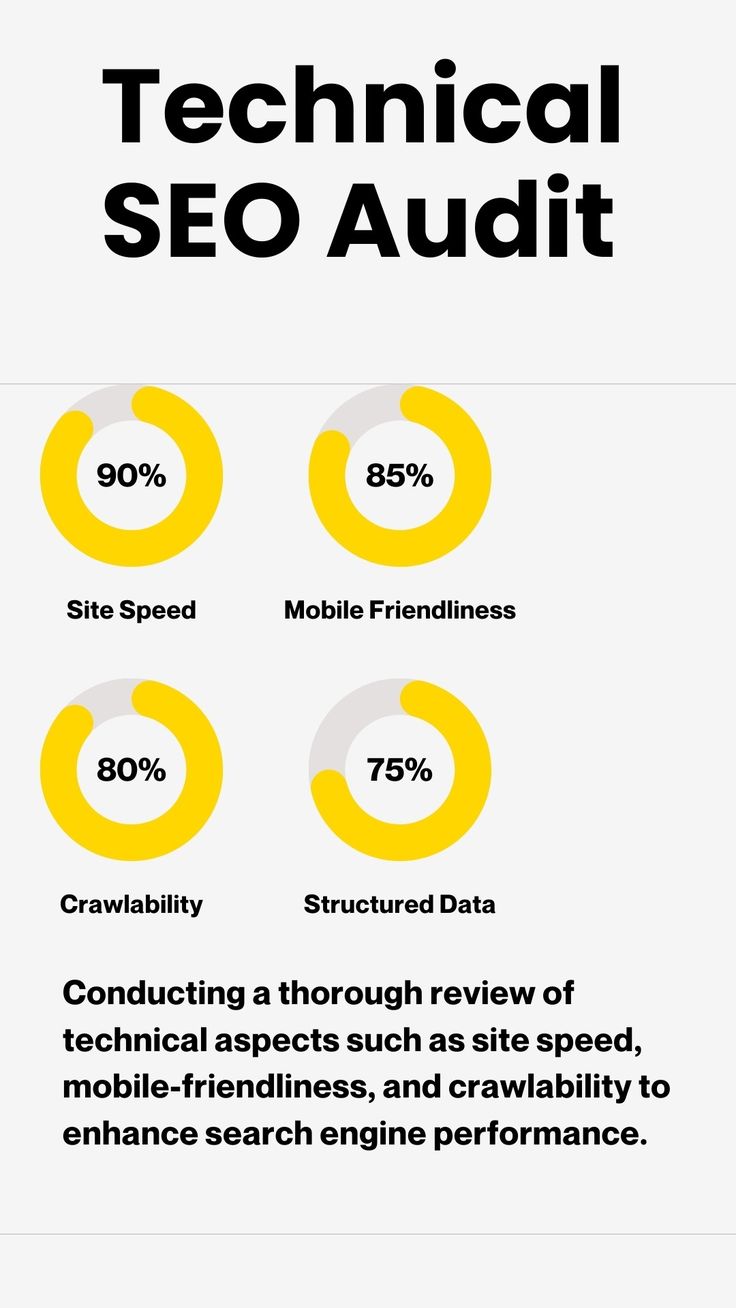
Technical SEO
Technical SEO provides the foundation for search performance.
A technical audit can evaluate:
- Website speed
- Core Web Vitals
- Mobile usability
- HTTPS
- JavaScript rendering
- Image optimization
- Structured data
- Broken links
- Redirect chains
- Server responses
- Canonicalization
- Pagination
- International SEO implementation where relevant
Modern websites can become technically complex, especially when they use JavaScript frameworks, ecommerce platforms, third-party scripts, plugins, and dynamic content.
Technical problems should therefore be evaluated based on their actual impact rather than treated as isolated checklist items.
Content and Keyword Mapping Audit
One of the most common SEO problems is creating content without a clear relationship between keywords, search intent, and business objectives.
A keyword should have a logical destination.
For example, an ecommerce business may require different pages for:
- Product searches
- Category searches
- Informational searches
- Comparison searches
- Brand searches
- Transactional searches
A service business may need dedicated landing pages for different services, locations, industries, and customer requirements.
During a content audit, each important keyword should be mapped to an appropriate page.
The audit should then answer three questions.
Does the Website Have Enough Coverage?
Identify important topics and commercial search terms for which competitors have relevant pages but the business does not.
Does the Page Match Search Intent?
A page should provide the type of information the searcher expects.
Someone searching for a service should not land on a generic blog article when a dedicated service page would better satisfy the query.
Is Existing Content Decaying?
Identify pages that previously generated traffic or rankings but are now declining.
These pages should be evaluated for updating, consolidation, expansion, or replacement.
Internal Linking and Website Architecture
Internal links help users navigate a website while helping search engines understand relationships between pages.
Important commercial pages should not be buried deep within the website.
A strong architecture generally ensures that:
- Important pages are easy to reach
- Related pages link to each other
- Blog content supports commercial pages
- Topic clusters are clearly connected
- Orphan pages are minimized
- Anchor text provides useful context
- Important landing pages receive relevant internal authority
For example, a website selling digital marketing services could build a topic cluster around SEO.
A central SEO service page can connect with supporting content covering technical SEO, local SEO, ecommerce SEO, content optimization, link building, AI search, and SEO strategy.
This creates a stronger relationship between informational and commercial content.
Conversion Path Audit
Traffic is not the final objective of SEO.
A website can receive thousands of visitors and still produce limited business results if visitors cannot easily take the next step.
An SEO audit should therefore evaluate conversion paths.
Questions include:
- Does the page have a relevant CTA?
- Is the CTA visible?
- Does the landing page match the search intent?
- Is the enquiry process simple?
- Are contact forms working?
- Are phone numbers clickable on mobile?
- Are important service pages easy to find?
- Does informational content guide users toward relevant commercial pages?
Different businesses may define conversion differently.
For an ecommerce business, it could be a purchase.
For a service company, it could be an enquiry.
For a real estate business, it could be a site visit request.
For an education company, it could be an admission enquiry.
SEO strategy should account for the actual conversion objective.
Local SEO Audit
For businesses serving specific geographic markets, local SEO can have a major impact on visibility.
A local SEO audit can review:
- Google Business Profile optimization
- Business name, address, and phone consistency
- Local landing pages
- Location-based keywords
- Reviews
- Local citations
- Business categories
- NAP consistency
- Local backlinks
- Location-specific content
- Map visibility
Businesses should also make sure their website provides clear information about their locations, services, operating areas, and contact methods.
Local SEO is especially important for businesses where customers prefer nearby providers.
Competitive SEO Audit
SEO performance should never be evaluated in isolation.
Competitor analysis helps identify where other businesses are gaining visibility and where opportunities exist.
A competitive audit can compare:
- Keyword rankings
- Organic traffic opportunities
- Content coverage
- Backlink profiles
- Domain authority signals
- Top-performing pages
- Search intent coverage
- Local visibility
- Brand mentions
- AI search visibility
- Third-party website presence
The objective is not simply to copy competitors.
Instead, the goal is to understand why competitors are visible and where your website can create a stronger alternative.
A competitor may rank well because it has better content.
Another may have a stronger backlink profile.
A third may have built greater brand visibility across review websites and industry publications.
Each situation requires a different response.
AI Search and AEO Audit

Search behavior is expanding beyond traditional Google results.
Users increasingly ask AI platforms questions about products, services, companies, and recommendations.
This creates a new visibility layer for businesses.
A modern SEO audit should consider whether a brand is being discovered or mentioned across relevant AI-driven search experiences.
An AI visibility audit can examine:
- Brand mentions
- Citations
- Product or service recommendations
- Competitor mentions
- Frequently asked questions
- Third-party sources referenced by AI systems
- Industry publications
- Review websites
- Community discussions
- YouTube content
- Comparison pages
Answer Engine Optimization, or AEO, focuses on making information easier for answer engines to understand and use.
This means content should be clear, well structured, factually supported, and directly aligned with user questions.
Off-Page SEO and Authority Audit
External authority remains an important part of SEO.
A backlink audit can evaluate:
- Referring domains
- Link relevance
- Link quality
- Anchor text distribution
- Lost backlinks
- New backlinks
- Competitor link gaps
- Toxic or suspicious patterns
- Digital PR opportunities
- Industry publication opportunities
However, the objective should not be to collect links indiscriminately.
A relevant mention from a credible website can be more meaningful than a large number of low-value links.
Modern off-page SEO can also include brand mentions, digital PR, expert contributions, industry publications, partnerships, and other forms of authority development.
Brand and Multi-Surface Visibility
Customers rarely rely on a single source when making important decisions.
They may search Google, watch YouTube videos, read reviews, browse social platforms, ask communities, compare providers, or use AI tools.
Therefore, businesses should evaluate their visibility across multiple surfaces.
A modern visibility audit can examine:
- AI search
- YouTube
- Review platforms
- Industry publications
- Business directories
- Relevant communities
- Social profiles
- Comparison websites
- Digital PR coverage
The goal is to become a recognizable and trusted entity rather than simply ranking for a handful of keywords.
Measurement and SEO Attribution
The final stage of an SEO audit is measurement.
Businesses need to understand whether organic visibility is contributing to actual business growth.
Important metrics can include:
- Organic traffic
- Non-brand traffic
- Keyword visibility
- Organic conversions
- Leads
- Sales
- Revenue
- Conversion rate
- Landing page performance
- Assisted conversions
- Search impressions
- Click-through rate
- Backlink growth
- Brand visibility
Tools such as Google Analytics 4 and Google Search Console can help connect search performance with user behavior and conversions.
The goal is to move beyond statements such as:
“Organic traffic increased by 30%.”
A better question is:
Did organic search generate more qualified leads, sales, enquiries, or revenue?
That is the information businesses need when deciding where to invest their marketing budget.
The 8-Part SEO Audit Framework
A practical SEO audit can be organized into eight connected areas.
| Audit Area | What It Covers | Why It Matters |
| Crawlability & Indexation | Crawling, indexing, robots, sitemaps | Ensures important pages can be discovered |
| Technical SEO | Speed, mobile, Core Web Vitals, rendering | Improves technical accessibility and user experience |
| Content & Keywords | Search intent, gaps, decay, cannibalization | Builds relevant search visibility |
| Site Architecture | Internal links, hierarchy, topic clusters | Helps distribute authority and context |
| Conversion Paths | CTAs, forms, landing pages | Turns organic traffic into business outcomes |
| Competitive Visibility | Competitor rankings, content, authority | Identifies opportunities and market gaps |
| AI & Multi-Surface Visibility | AI search, reviews, communities, publications | Expands discovery beyond traditional search |
| Measurement & Attribution | Analytics, conversions, revenue | Connects SEO activity to business performance |
These areas should not be treated independently.
For example, a website may rank well but have poor conversions. In that situation, creating more backlinks may not solve the primary problem.
Likewise, a business may have excellent content but weak technical infrastructure preventing search engines from efficiently accessing it.
The audit should identify the constraint that matters most.
Recommended SEO Audit Tools
Different tools provide different types of information.
Google Search Console
Google Search Console is useful for examining:
- Search queries
- Impressions
- Clicks
- Average position
- Indexing
- Sitemap status
- Search performance
- Page-level visibility
It is one of the most important sources of first-party search data.
Google Analytics 4
GA4 helps businesses understand what happens after visitors reach the website.
An audit can use it to evaluate:
- Organic engagement
- Conversions
- Landing pages
- User journeys
- Events
- Assisted conversions
- Revenue
Screaming Frog
Screaming Frog can be used for technical crawling and identifying issues involving:
- Status codes
- Metadata
- Redirects
- Canonicals
- Internal links
- Duplicate pages
- Indexability
Ahrefs or Similar SEO Platforms
SEO platforms can support:
- Keyword research
- Competitor analysis
- Backlink analysis
- Content gap research
- Ranking analysis
- Organic opportunity discovery
PageSpeed Insights
Performance tools can help identify:
- Core Web Vitals issues
- Slow-loading resources
- Image problems
- JavaScript-related performance issues
- Mobile performance opportunities
How Often Should a Business Conduct an SEO Audit?
There is no single schedule that applies to every website.
A smaller website may benefit from a detailed audit every six months or after a major website change.
Growing businesses can consider quarterly audits combined with regular monitoring.
Large ecommerce websites, publishers, and enterprise websites may require continuous technical monitoring and deeper audits several times a year.
An audit is particularly useful after:
- A website redesign
- Domain migration
- CMS migration
- Major URL changes
- Website launch
- Large content expansion
- Algorithm changes
- Significant traffic decline
- New market expansion
What Businesses Usually Discover During an SEO Audit
A detailed audit often reveals that the biggest growth opportunity is not where the business initially expected.
Common findings include:
Visibility Problem
The website does not have sufficient visibility for valuable search terms.
Content Problem
The website receives traffic but lacks content targeting commercial search intent.
Technical Problem
Important pages are difficult for search engines to crawl, render, or index.
Conversion Problem
The website receives organic traffic but fails to turn visitors into leads or customers.
Authority Problem
Competitors have stronger relevant backlinks, mentions, and third-party visibility.
Measurement Problem
The business cannot clearly determine how SEO contributes to enquiries, sales, or revenue.
Finding the correct problem is the first step toward creating the correct strategy.
Turning an SEO Audit Into an Action Plan
An audit becomes valuable when its findings are prioritized.
Not every issue deserves immediate attention.
A practical prioritization model can classify recommendations into:
High impact, high priority: Issues that can significantly affect visibility, traffic, leads, or revenue.
Medium priority: Improvements that can strengthen existing performance.
Low priority: Minor optimizations that can be completed after important issues are resolved.
A 90-day SEO roadmap might look like this:
Month 1: Technical Foundation
Resolve indexation problems, broken links, redirects, Core Web Vitals issues, sitemap problems, and major architecture weaknesses.
Month 2: Content and Internal Linking
Improve priority service pages, refresh declining content, address keyword gaps, resolve cannibalization, and strengthen internal linking.
Month 3: Authority and Visibility
Develop relevant backlinks, digital PR opportunities, brand mentions, competitive content, and AI/AEO visibility initiatives.
Performance should then be reviewed using organic traffic, rankings, conversions, leads, and revenue-related metrics.
Why Choose Bloom Agency for SEO?
An SEO audit shouldn’t just point out technical problems. It needs to give businesses a real, clear sense of how search performance can, sort of quietly, fuel growth over time.
At Bloom Agency we approach SEO like a mix of technical fine tuning, content strategy, keyword discovery, local SEO work, ecommerce SEO improvements, link building, conversion focused landing pages, and even emerging AI search optimization.
The main goal is finding those opportunities that actually match up with business objectives, not only chasing rankings for the sake of it.
So whether a company is rolling out a new website, seeing organic traffic dip, moving into new areas, leveling up an ecommerce store, or trying to pull in more qualified leads, a structured audit can be the base layer for a smarter, more focused SEO strategy.
Final Thoughts
SEO has become a broader discipline than simply ranking a website on Google.
Businesses now compete for attention across search engines, AI platforms, local results, review websites, communities, publications, and other digital channels.
A comprehensive SEO audit provides a way to evaluate all of these areas systematically.
The most effective audit is not necessarily the one containing the largest number of technical findings. It is the one that identifies the issues and opportunities most closely connected to business growth.
By combining technical SEO, content optimization, strong website architecture, conversion strategy, authority building, competitor research, AI search visibility, and accurate measurement, businesses can build a stronger foundation for sustainable organic growth.
Frequently Asked Questions
What is an SEO audit?
An SEO audit is a detailed evaluation of a website’s technical health, content, search visibility, website architecture, backlinks, user experience, conversion paths, and competitive position.
How often should I conduct an SEO audit?
Most businesses can benefit from a detailed audit every few months, while larger or frequently changing websites may require more regular monitoring and audits.
Does an SEO audit improve rankings immediately?
An audit itself does not guarantee immediate ranking improvements. Its purpose is to identify problems and opportunities so that the right SEO actions can be prioritized and implemented.
What does a technical SEO audit include?
A technical audit can include crawling, indexing, robots.txt, XML sitemaps, redirects, canonical tags, mobile usability, Core Web Vitals, structured data, JavaScript rendering, broken links, and website architecture.
Is AI search part of modern SEO?
Yes. AI-powered search has expanded the ways users discover information. Businesses can benefit from evaluating their visibility, mentions, citations, and presence across relevant AI and third-party discovery platforms.
Can an SEO audit help with conversions?
Yes. A comprehensive audit can identify whether high-traffic pages have appropriate calls to action, whether landing pages match search intent, and whether users can easily take the next step.
What is the difference between an SEO audit and SEO services?
An SEO audit evaluates the current state of a website and identifies priorities. SEO services involve implementing and continuously managing the recommended strategies to improve visibility and business performance.
Why is competitor analysis important in SEO?
Competitor analysis helps identify the keywords, content topics, backlinks, pages, and digital channels that are helping competing businesses gain visibility. This can reveal opportunities for differentiation and growth.
What is the main goal of an SEO audit?
The primary goal is to identify the technical, content, authority, visibility, and conversion factors that are limiting organic performance and then create a prioritized roadmap for improvement.
Build a Stronger Organic Growth Strategy With Bloom Agency
A successful SEO strategy really starts with figuring out where a website is standing right now, like what’s going on under the hood and in the rankings. Bloom Agency can help organizations look closely at their technical foundation, how content is performing, where search visibility sits, what the competitor landscape looks like, how strong their authority appears, which conversion paths are working (or not), and the newest AI search opportunities that are starting to show up more and more.
The end result should not be “just” another generic SEO report. Instead, it needs to feel like a practical roadmap, showing what must be fixed, what should be improved, which chances are worth pursuing, and what actions deserve priority before everything else.

Neetu Wadhwa is the Director of Bloom Agency, a Mumbai-based full-service digital marketing and web development company. With a strong focus on performance, innovation, and strategy, she leads the agency in delivering SEO, web design, and growth marketing solutions that drive measurable business outcomes.



Rahul M.
B2B Service Provider