
As customers rely more and more on AI-driven search experiences for product research, comparative shopping, and purchasing, ecommerce search is evolving. In the past, users visited several websites to find answers to their queries, but now they can meet with AI-generated summaries of relevant information from several websites. This opens up new possibilities for brand visibility and getting in front of potential customers for Shopify store owners.
Shopify SEO services for AI Overviews is all about optimizing an ecommerce site for search engines, which includes increasing its visibility and relevance. This includes enhancing technical SEO, composing helpful product descriptions, keeping product info accurate, generating helpful content, and establishing a trustworthy brand image.
But there are no sure ways to be featured in Google’s AI-generated responses. What businesses should pay attention to are the principles of good SEO, and how to make sure that they are answering customers’ questions. Bloom Agency can show brands how to align these activities with a practical approach that focuses on increasing their search visibility, enhancing their user experience, and driving business growth.
What Is Shopify SEO for AI Overviews?
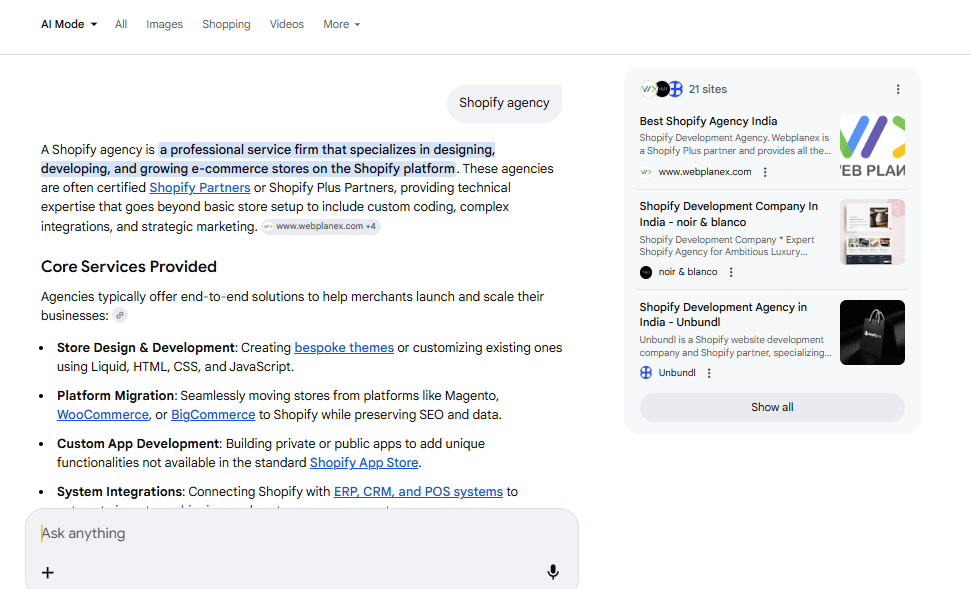
Google AI Overviews are AI-generated summaries that are displayed for some search queries. They help users to investigate topics and to make sense of information by synthesising appropriate information from web sources. These summaries can contain links to websites that provide more information or commentaries on the answer, depending on the query.
For instance, when someone is looking for skin care products, they may look for skin moisturizers that are good for sensitive skin. An AI Overview might give a summary of common points, clarify relevant ingredients, and offer links to valuable resources. If a Shopify link building store has accurate product information with supporting and informative content, it could be found as part of this research process.
Shopify SEO for AI Overviews involves optimizing your store’s pages to offer accurate, focused, and quality content when a searcher is using AI. Does not need a different SEO system. Google has shed light on the typical technical requirements for Search, which also apply to AI features, such as: Pages must be indexed and be eligible to appear with a snippet.
The goal of the practical part is to develop a website that meets the needs of customers, while at the same time making its information accessible to search systems.
The way AI Overviews are transforming Ecommerce Search.The Impact of AI Overviews on Ecommerce Search. Long-standing SEO has focused on targeting keywords. While rankings are still valuable, AI-driven summaries provide other avenues for consumers to discover brands and product details.
The number of inquiries with specific questions is increasing.There are more questions with specific details asked by customers.
People are beginning to search online for full questions on the product, instead of brief search terms. Rather than typing “running shoes” into the search engine, they may enter a more specific query like “running shoes for new runners who run 3 times a week on the road.”
These questions are detailed and help to get a better understanding of the shopper’s needs. In response, ecommerce websites can publish product information and buying guides that feature answers to specific use cases, product differences, and common concerns.
Product Research and Purchasing are getting closer and closer together.
The search journey can last anywhere from knowledge to purchase and back again. If someone is looking into jewellery materials, for instance, they can easily switch focus from the different levels of gold and compare specific designs.
Educational content should thus be linked to product and collection pages on a Shopify store. This will make it a more fruitful experience and will enable customers to gradually move from research to purchase.
There is no guarantee that the traffic generated by search queries will translate to clicks. AI-generated summaries provide a summary directly on the search results page, addressing the user’s question. This means a shopper might come across a brand name and not immediately go to the website.
That leaves brand recognition, the right information and supporting content to be more and more significant. There are a variety of metrics to consider for measuring SEO results, such as impressions, organic traffic, branded traffic, qualified leads, and revenue.
Develop a robust technical SEO backbone

To produce content that’s specifically optimized for AI search, it’s important to determine if search engines can locate and index your crucial Shopify pages. So even a great product description won’t help you get organic visibility if the relevant pages are blocked, inaccessible or not indexed.
Begin with Google Search Console to check the status of your main products, collections and blog posts. Examine pages that are not indexed and see if the issue is related to duplicate content, poor internal linking, technical issues, or lack of informative content.
Shopify generates an XML sitemap automatically; this can assist search engines find out store URLs. Use Search Console to submit the sitemap and check on indexing reports to detect issues.
Check your robots.txt file for any errors. There are some customisations that can be made in Shopify, but any adjustments that are not appropriate can block access for the crawlers to important areas. Likewise, review canonical tags; product URLs can be accessed in a variety of ways. The preferred canonical URL should be consistent with your intended site structure.
Large numbers of similar urls can also be caused by collection filters, sorting parameters and non-essential tag pages. Check if these pages are of value for search or if all variations create an indexable page.
A technical SEO audit can be incredibly useful in uncovering issues at the template level that can impact multiple products at once. Addressing these challenges can lead to improved results for both traditional search and AI-driven discovery.
Craft honest and persuasive Product Descriptions to attract more customers to your website
Product pages are a crucial part of ecommerce SEO, but many Shopify businesses use a short description from the manufacturer or generic promotional text. This content can reference a product without providing enough information to enable shoppers to decide if it is suitable for them.
A useful product page gives answers to practical questions. Describe the function of the product, who could use it, and what are some possible constraints of the product for the consumers. Add specifications where appropriate like ingredients, materials, dimensions, compatibility, sizing, how-to instructions, or warranties.
For instance, a clothing shop ought to supply precise information on cloth, dimensions, sizes handy, and treatment guidelines. A jeweller might describe the quality of the metal, the stone setting, the design of a jewelry piece, and how it should be treated.
If comparisons are useful to buyers, describe meaningful differences among the different options. Do not make unsupported superiority claims, and remember to stick to facts.
A brief Q&A section may be used to answer general questions on sizing, delivery, maintenance, compatibility or product use. Utilize questions from genuine customer support interactions, feedback, and sales leads.
Make sure to use Structured Data and Accurate Product Feeds
Structured data gives search engines more info about the content of the page. Product markup may refer to product information, including product names, images, price, availability, brand etc. for the ecommerce stores.
Structured data may be generated by Shopify themes and installed applications, but it is not guaranteed that it is complete and should be checked. If there is duplicate or missing marking or conflicting information, this can cause issues.
Check out a few key product pages using Google’s testing tools. Keep content of structured data aligned with the information a user can see on the page. Pay close attention to the mark-up of customer ratings and only include legitimate ratings that abide by pertinent rules.
Google Merchant Center is also beneficial to businesses that sell online. Ensure product titles, product descriptions, product prices, product availability, product images, and product identifiers are accurate and consistent from the product feed to the website.
Structured data can help search engines understand product information better, and can help pages be eligible for enhanced search features. But it’s not a guarantee for inclusion in AI Overviews or any specific search result.
The priorities of the concepts are always “accuracy” and “adding markup only where it makes sense technically.
1. To create Topic Clusters For Customer Needs

A good ecommerce content strategy must consider questions that customers ask before, during and after buying a product. These are grouped into topic clusters to more clearly organize the information than a separate blog post per blog post.
A fitness shop might post articles on selecting home fitness products, resistance degrees, and fitness product upkeep. Each article may be linked to relevant collections and product pages, as appropriate.
A jewellery company may develop educational material on gold purity, how to care for gemstones, picking everyday jewellery pieces and picking gifts for various events. These materials can be used to educate customers, guide them in their decision making and acquaint them with collections.
This will help with topical relevance and internal navigation. It can also provide valuable information to the shoppers in various phases of the buying process.
Bloom Agency can use these to determine the right keywords, link content to users’ intent and create internal links that connect useful pages to commercial goals.
Writing more articles isn’t always the answer. When updating content, prioritize addressing actual gaps, giving accurate information, and updating older content.
2. Show Firsthand Experience & Build Trust
With AI tools, general descriptions and summaries can be quickly created. Original information, actual customer experiences, and product-specific knowledge are valuable assets for ecommerce brands to set themselves apart.
Wherever possible use original product photographs and videos. Dimensions, textures, packaging, product usage or details that cannot be effectively conveyed by standard supplier images can be demonstrated in the form of a demonstration.
Customer reviews can help you get some real-world knowledge about the functionality of goods. Allow and react to any customer feedback in a constructive way. Avoid writing fake reviews and making false product claims.
Brands are also able to share the actual testing procedures, care recommendations, sizing observations or other information based on actual product experience. Education articles should reference other authors or experts as necessary when they provide valuable information.
Trust also relies on clear information in the business. Provide clear shipping and return policies, payment info and contact information. These practices enhance the shopping experience and offer a better sense of reality when it comes to a real business, real products and real customers.
3. Build a Brand Authority off of Your Website
The content on a company’s own domain is not the only thing that impacts search visibility. Editorial coverage, authentic reviews, industry referrals, and brand information can help build a larger online footprint.
One approach to creating it is through Digital PR. Relevant publications can solicit original research, expert commentary, or beneficial data, or insights from the business community. Ecommerce brands can even be included in lawful product roundups, business discussions, and related collaborations.
Put emphasis on relevance and credibility instead of on the number of links one gets. Purchased links and mass-produced guest posts that aim to get high rankings but fail to establish a great brand can cause harm.
Ensure that your brand information is the same in relevant business profiles and industry directories. Keep an eye out for genuine mentions on business and build connections with publishers or organisations that target the same audience.
There is no external mention that guarantees AI citations. The goal is to build a reputation of trust to help sustain long-term discoverability and customer confidence.
4. Blackjack Bonuses and Special Offers
The aim of a Shopify store is to provide a seamless shopping experience on smartphone, tablet and desktop devices. One of the key reasons for the importance of mobile usability is that people often look up products and buy them via their mobile devices.
Slow loading pages, hard-to-navigate websites, pop-ups and confusing checkout procedures can make shoppers less likely to make purchases.
Check the apps added to your Shopify store. When functionality is required in only certain parts of an application, some applications will include scripts in many pages. Uninstall unused applications and evaluate whether there are other tools available which have the same functionality and do not affect performance as much.
Optimise pictures, don’t have unnecessary animation, and use video sparingly. Use Google’s performance tools to test key pages, and track the Core Web Vitals as data becomes available.
Verify product variations, forms, menus and checkout interactions function properly on mobile devices. Increasing speed on the page is not the only thing that should be focused on.Improve the entire customer journey, not just the page speed.
A fast and easy-to-navigate website furthers usability, conversion potential, and overall technical excellence of an ecommerce store.
5. Business Results Measurement by 9. AI Search Visibility
Evaluating the performance of the AI Overview is difficult, as it features different search capabilities and reporting features. AI visibility scores should be used in conjunction with regular manual observation of the business—don’t use one or the other.
Google Search Console can provide you with information on impressions, clicks, and queries that drive visitors to your website. Analyze all queries (both questions and long-tail), and gain insights into the way your customers are finding your products and educational content.
Google Analytics and Shopify Analytics can be used to measure the results of landing pages, traffic sources, shopping behaviour, and sales. Don’t focus on traffic numbers, but rather if organic visitors interact with products and convert leads to revenue.
Key metrics to track are organic impressions, qualified organic sessions, branded search growth, product-page engagement, conversion rate, and revenue from organic landing pages.
To find out if SEO efforts lead to increased discoverability and business results, rather than just being a way to get AI-generated answers.
6. Shopify AI SEO Action Plan in Practice for 30 Days
With a set plan, ecommerce companies can make headway without making a complete overhaul of the site.
Week 1: Determination of the technical basis. Discuss indexation, canonical tags, robots.txt, sitemap health, internal linking and website performance. Determine the most significant products and collections in relation to the generation of business income.
Week 2: Enhance product information. Look at structured data, Merchant Center feed accuracy, product specifications, product description and essential metadata. Identify website discrepancies and resolve them in relation to product feeds.
Week 3: Improve the most valuable product descriptions and collection pages. Include helpful purchasing details, pertinent FAQs and links to supporting educational information.
Week 4: Create valuable, authoritative content. Create supporting guides, solicit authentic customer reviews, enhance internal links, and start performing relevant digital PR outreach. Set a baseline to measure the visibility of your organic performance and AI search.
Run through the changes completed and create the next round of priorities at the end of the month. Perform the process again, utilizing performance data to inform decision-making and business needs.
Bloom Agency can help you with Shopify SEO
There are various aspects of technical SEO, content quality, product information, user experience, and brand reputation that need to be taken into account when preparing a Shopify store for AI-powered search. The activities are also helpful to traditional search visibility and assist customers in their purchase decisions.
Bloom Agency assists businesses to improve their digital presence by implementing SEO, ecommerce optimisation, content marketing and digital marketing. Technical audits, product and collection optimisation, search-friendly content planning, internal linking, performance improvements and continuous reporting are all part of a practical Shopify SEO program.
The best way to begin is to gain insight into the issues and business objectives of the store. Instead of guaranteeing AI placements, the goal is to enhance the website’s utility, accessibility, credibility, and measurability.
As search evolves, companies that make constant enhancements to their sites and are able to address customer needs will be more likely to adapt.
Frequently Asked Questions
Do Google AI Overviews show up for Shopify stores?
Yes. AI Overviews may be generated for Shopify pages that is Google’s applicable search requirements. Although Pages must be accessible and eligible for indexing, being included in an AI Overview is not guaranteed.
Is the Shopify AI SEO plugin necessary?
No. You can’t find a specific plugin to ensure AI Overview visibility. Applications may help with metadata or structured data, or other SEO tasks, but their application should be checked for accuracy.
Is there a benefit to using structured data for AI Overview?
Structured data aids search engines in understanding the information on products and other features of the page. It can help qualify for the eligibility of features for searching, but it does not guarantee the inclusion of AI Overview.
Should Shopify stores develop their own content for AI search?
For most businesses, it is best to produce valuable information for people. Product details, buyer’s guides, product specs, and responses to real customer queries can be used for both conventional search and AI-driven discovery.
Should you still invest in traditional SEO for your Shopify store?
Yes. The factors of crawlability, indexing, helpful content, internal linking, mobile usability, and technical performance are still relevant. AI search should not be an alternative to a robust SEO strategy.
Conclusion
Using Shopify SEO for AI Overviews is a part of a robust ecommerce SEO strategy. When the information on the site is accurate, descriptions are helpful, pages are technically accessible, the content is informative, the reviews are credible, and the experience is reliable on mobile—there is a better website.
Ecommerce brands should focus on products that are easier to understand and pages that are more helpful to customers. With these basics and careful content planning and continuous measurement, businesses will be better equipped to boost their organic visibility and prepare for evolving search journeys.
By leveraging its expertise and data-driven strategy, Bloom Agency can assist ecommerce brands in establishing a robust SEO framework that enhances discoverability, customer trust, and long-term growth.

Neetu Wadhwa is the Director of Bloom Agency, a Mumbai-based full-service digital marketing and web development company. With a strong focus on performance, innovation, and strategy, she leads the agency in delivering SEO, web design, and growth marketing solutions that drive measurable business outcomes.




Rahul M.
B2B Service Provider