
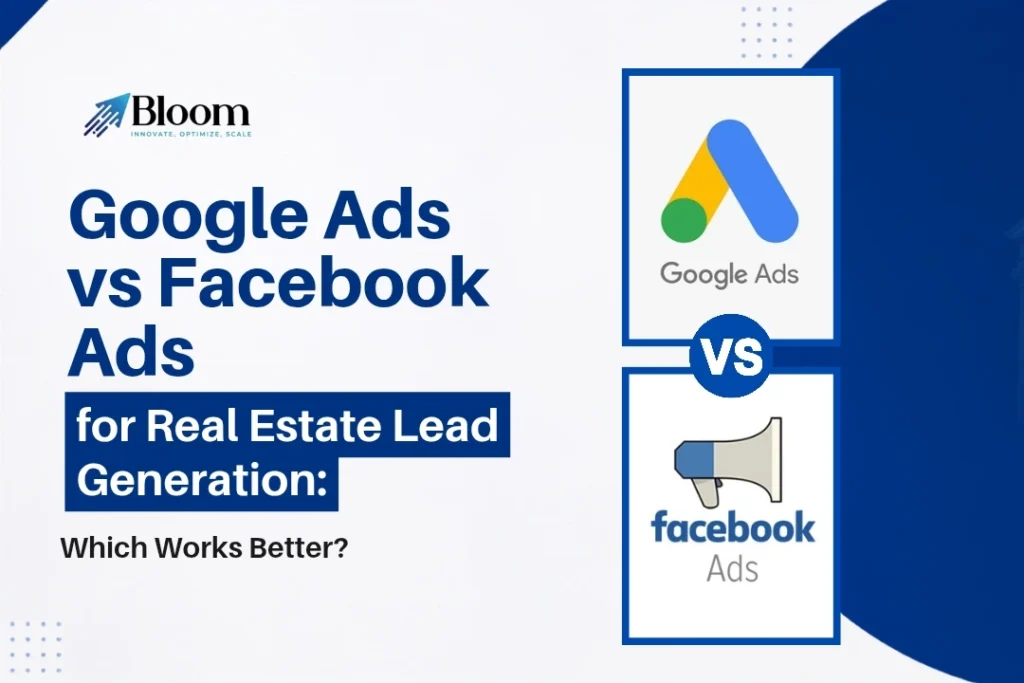
Google Ads vs Facebook Ads for Real Estate Lead Generation: Which Works Better?
Real estate businesses need to get a constant flow of hot prospects, arrange site visits and record bookings. But which advertising networks to choose to promote real estate projects and attract more clients? Google Ads and Facebook Ads are the most popular platforms for attracting customers, both have clear advantages, but they are different. Google Ads delivers people looking for a property, and Facebook Ads helps you reach the right people: those interested in real estate, who are often in the market to buy or rent. The specifics of each tool must be taken into account when attracting leads for real estate.
Thus, the choice of means depends on the specifics of the project, the characteristics of the target audience, the level of the advertising budget, and the desired sales. But what are the differences between Google and Facebook Ads?
Real Estate Lead Generation through Google Ads
Google Ads is a platform for creating and managing online ads. This tool helps you reach people interested in your services through search engine results. If a specific property is of interest to the customer and he/she is searching for it in Google, this advertising network can help you connect with the customer.
Google Ads has a huge advantage in terms of targeting and attracting a specific audience searching for a property. Therefore, if you are a real estate company, you can quickly generate sales leads for your project by using keywords related to the type of property, address, and other factors.
For example, you can target people searching for two-room flats in Mumbai or “commercial property for sale in Bengaluru” or those interested in buying real estate in Thane. The ads can be targeted at people searching for specific real estate projects and those interested in buying or renting property of a certain class.
Benefits of Google Ads for Real Estate
1. Targeted Customers Who Search For Properties
An individual searching for a particular property usually knows what they want to buy. In this case, such customers have already made a decision but are looking for the best deal. Therefore, the search ads are relevant to property buyers since the advertisers can specifically target them.
2. Keywords That Fit Specific Searches
One of the benefits of Google Ads is targeting particular keywords. The real estate ads can specify the location, property type, and intent to purchase. Therefore, it becomes possible to reach every customer segment with relevant advertisements.
3. Access to Campaign Data and Information
All the details about the campaign, including expenditure, are available to the advertiser. In addition, the information helps determine which keywords and landing pages bring customers. Consequently, it becomes easier to identify the best and worst-performing elements and optimize them.
4. Local Search Targeting of Properties
The local search targeting fits perfectly for real estate since it is impossible to relocate. In this case, the advertisers target the location, the specific city, and the project. Moreover, this strategy might work because many people search for properties in a specific area.
5. Quick Capture of Customers’ Attention
Combining the relevant keyword and the best landing page option leads to the most crucial benefit of Google Ads for real estate. In this case, the advertiser does not need to wait for months for the website to appear in search results. Instead, the customers can find the page and inquire about the properties sooner.
Understanding Facebook Ads for Real Estate Advertising
Using Facebook ads, one can advertise properties on Meta’s social media platforms, including Facebook and Instagram. Unlike traditional online advertising, which focuses on the search intent of a user, ads can be targeted at a specific location, demographic, interests, and lookalike audiences. For instance, an advertisement campaign can be created for a property developer selling new residential projects. The ads can include photographs, videos, floor plans, and highlights of the buildings and come in handy for creating awareness of new properties and generating leads.
How the Facebook Ad Features Work
The ads can be used to promote a property, generate replies, or retarget website visitors. For instance, businesses can use carousel ads to advertise multiple properties, engage users with video content, and collect leads using the lead generation feature on Facebook.
Moreover, ads can be used to remarket to relevant audiences. This feature works because the business has access to relevant audiences that visited their website, ads, or social media page within a specific period. However, remarketing should follow Meta’s advertising policies.
Benefits of Facebook Ads for Real Estate
1. Raise Awareness About Properties Among Potential Buyers
Facebook Ads can help reach those who are not looking for property to buy but have it in their plans for the near future.
2. Focus on Visuals
The main value of real estate is the visual experience it provides. Compelling photos, video walkthrough, 3D tour, and other visual marketing tools help get the message across to the target audience.
3. Easy Collection of Leads and Calls for Help
By using lead forms and chat plugins, businesses can make their services more in demand by making it easier for customers to inquire about them instead of visiting their website.
4. Multiple Available Segments
Facebook Ads can be used to cover different segments of the audience. There are several options to choose from, such as segments for different types of properties and locations, provided there are no restrictions for advertising real estate on Facebook.
5. Audience Retargeting and Re-engagement
By using the accumulated leads and engaging with them, the companies can build brand awareness and trust. It helps the buyers remember the project and the company when the time comes.
Google Ads vs Facebook Ads: Key Differences
The main difference between these platforms is how they reach potential customers. Google Ads is particularly effective for capturing existing search demand, while Facebook Ads is useful for generating interest and creating demand through visual advertising.
| Comparison Factor | Google Ads | Facebook Ads |
|---|---|---|
| Primary approach | Captures active search demand | Creates awareness and interest |
| Audience intent | Often higher when users search specific property terms | Varies depending on audience and campaign |
| Targeting methods | Keywords, location, search intent, and other campaign signals | Demographics, location, interests, and eligible audience signals |
| Creative formats | Primarily text-based search ads, with other formats available | Images, videos, carousels, and lead forms |
| Lead generation | Search-driven enquiries and landing-page conversions | Instant forms, messaging, and website enquiries |
| Best suited for | Buyers searching for specific properties | Project launches, awareness, and visual promotion |
| Competition | Depends on keyword demand and advertiser competition | Depends on audience, creative, placements, and auction competition |
| Lead quality | Often strong when keywords match genuine buying intent | Can vary with targeting, offer, form design, and follow-up |
| Measurement | Clicks, conversions, keyword performance, and cost per lead | Leads, engagement, conversion performance, and cost per lead |
| Main challenge | Competitive keywords and expensive clicks in some markets | Enquiries may be less qualified if campaigns prioritise cheap leads |
Neither Google nor Facebook ads guarantee higher quality scores and better-converting campaigns in all cases. The key to achieving consistently good results lies in the specifics of property offers, the attractiveness of landing pages, the relevance of creatives, and the effectiveness of the sales funnel.
Which Platform Produces Higher Quality Leads in Real Estate?
The quality of leads is more important than their quantity in this case. A hundred cheap leads from untargeted audiences that do not convert into actual property buyers will never bring as much benefit as 20+ warm leads. Google Ads tends to be more relevant when people know exactly what they are looking for in a property.
For example, an online ad campaign targeting three-bedroom houses or commercial real estate loans in a specific price range is likely to produce better results than a generic property search page. As for Facebook Ads, it is easier to get a bigger audience with this platform. However, this audience is often disengaged and unsure of their needs. At the same time, many buyers turn to Facebook to explore the market and identify their requirements. In this case, a large quantity of low-quality leads can still be useful for real estate companies that know how to process them.
How Can You Get Better Quality Real Estate Leads From Google And Facebook Ads?
Use this information and answer these questions in your advertisements, on your landing pages, and property descriptions:
• Location and type of property.
• Specific features required by the byer.
• Questions about the budget and desired time of purchase.
• The possibility of viewing the property as an option.
Personalization is another feature that can improve the quality of leads in real estate. Use landing pages that specifically describe the property advertised in the ad. Instead of sending customers to your real estate company’s homepage, consider using a custom page for each property. Landing pages should also be designed responsively and have an attractive interface.
Moreover, collect and analyze the information leads provide on landing pages. In addition, take steps to shorten the sales cycle as much as possible. This can be done by calling or writing to the client as soon as possible to understand their needs and answer their questions. Finally, collect and analyze statistics on your conversions and remarketing lists. If you want to measure the real impact of your campaigns on the bottom line of your business, take into account only qualified leads.
Can Google And Facebook Ads Be Cost Effective For Real Estate Businesses?
One metric that reflects the cost-effectiveness of Google and Facebook ads is the cost per lead. This indicator makes it possible to estimate how much money a real estate company spends to get a sufficiently warm customer to start the buying process. The main challenge here is to determine which leads are warm.
Google Ads tend to have higher costs per click and per impression due to the high competition for property keywords. At the same time, these costs can be justified if the campaigns convert leads into visits and sales.
On the other hand, while Facebook Ads has lower conversion rates, its campaigns have a lower cost per form submission. However, this metric is misleading if it does not take into account the quality of a lead and the ability of a real estate company to work with it.
| Metric | Google Ads | Facebook Ads |
|---|---|---|
| Monthly advertising spend | ₹60,000 | ₹60,000 |
| Leads generated | 60 | 120 |
| Cost per lead | ₹1,000 | ₹500 |
| Qualified leads | 24 | 24 |
| Cost per qualified lead | ₹2,500 | ₹2,500 |
These numbers are hypothetical and are used to demonstrate the impact of lead quality on campaign evaluation. They are not a representation of industry benchmarks or guaranteed outcomes.
In this scenario, Facebook Ads generates double the leads at half the cost per lead, but both deliver the same quantity of qualified leads at the same cost per qualified lead. This is why evaluating lead quality, site visits, bookings, and sales is just as important as cost per lead.
When Should Real Estate Businesses Use Google Ads?
Google Ads is frequently a powerful tool to acquire existing demand that is actively searching for something related to the property that the business is selling. This is a great option for established developers launching projects in areas where there is already search intent, brokers who are selling resale properties, commercial real estate companies targeting specific requirements, and rentals businesses.
For instance, a developer selling apartments that are ready to move into could target searches related to the project’s location, configuration, and price range in Mumbai. Google Ads is also suitable for starting out with, if the business has a clear understanding of its ideal customer, a compelling landing page, and sufficient search demand to justify the cost.
When Should Real Estate Businesses Use Facebook Ads?
Facebook Ads is frequently the best channel to build awareness, showcase properties creatively, and promote projects to a broad audience of eligible users. This is ideal for pre-launch marketing, under-construction residential properties, luxury real estate, plotted developments, and properties that require immersive visual content, such as a virtual tour.
For example, a developer launching a new property can use video and carousel ads to share details about its amenities, floor plan, location benefits, and updates during the construction. Facebook Ads can also retarget eligible audiences who have shown interest in a property but have not yet submitted an enquiry, which makes it a great channel throughout the entire buyer’s journey, and not just at the awareness stage.
Why Using Google Ads And Facebook Ads Together Is Powerful
In the context of real estate marketing, the most powerful strategy is rarely a choice between either Google Ads or Facebook Ads. Both channels can work in synergy to attract different segments of the target audience at various stages of the buyer’s journey. Google Ads can attract searchers, and Facebook Ads can showcase projects to a larger audience of potential buyers and re-engage those who have already shown an interest.
A possible structure for a campaign that uses both channels could be as follows:
1. Launch a social media marketing campaign to increase project awareness: Run social media advertisements to showcase property images or video walkthroughs, amenities and location benefits, and other pertinent information.
2. Target active demand with search engine marketing: Run Google Search Ads to target users that are actively searching for the property type and location that the business is selling.
3. Retarget qualified leads with contextual display advertising: Re-engage users who have visited the business website or viewed its advertisements with relevant display ads.
4. Nurture leads and drive conversions: Add leads to a customer relationship management (CRM) system, qualify them, and hand them over to the relevant sales agent for follow-up.
5. Evaluate cost vs. opportunity: Compare cost per lead, site visit, and booking, and measure the impact that each channel has on opportunity cost.
By using this approach, each channel will serve a specific purpose in the overall marketing campaign, and the sales team will have more visibility into the intent of hot leads.
How To Measure Real Estate Lead Generation Performance?
A successful lead generation ad campaign should be evaluated using a set of relevant performance indicators.
Cost per lead (CLP): The amount of money that the business spends on advertisements divided by the number of leads that it gets from them.
Cost per qualified lead: The cost of advertisements divided by the number of qualified leads, depending on the criteria that the business uses.
Site visit rate: The percentage of leads that visit the project website or physical location.
Lead to booking rate: The percentage of leads that eventually book a viewing, listing enquiry, or conditional booking.
Customer acquisition cost (CAC): The amount of relevant expenses that the business incurs when it acquires a customer, depending on the attribution model that it uses.
Return on ad spend (ROAS): The revenue that the business generates from the advertisements divided by the amount that it spends on them. In the case of property sales, determining revenue from advertisements can be challenging, depending on the sales process. However, businesses should use their own sales and CRM data, rather than information from advertising platforms.
Using these indicators will help the business realise whether its advertising spend is getting it results, rather than simply generating a high volume of unqualified leads.
Common Mistakes To Avoid In Real Estate Advertising
The first mistake is to select the channel according to the lowest cost per lead. A cheap lead without conversion is ultimately an expensive one. Another problem is using the same landing page for every advertisement, without segmenting the audiences according to their interests and needs. A person searching for a luxury villa in Pune is unlikely to be interested in the same properties as somebody else looking for a budget apartment in Ahmedabad. In addition, businesses should not use an unclear objective, fail to measure performance, and leave leads without follow-up.
Finally, the company must comply with advertising policies related to housing or real estate, including the use of audiences, lookalike modelling, and personal attributes. Similarly, pricing, availability, and amenities for advertised properties must not be misleading.
Final Verdict: Google Ads Or Facebook Ads For Real Estate Lead Generation?
Depending on the intent of the searcher, Google Ads is typically a superior channel to generate leads from existing demand, whereas Facebook Ads is more effective for creating awareness about new projects and targeting a larger audience of potential buyers.
However, this does not mean that one is categorically better than the other. The choice depends on the location and price range of the property, the target audience, the level of search intent, the availability of compelling creatives, and the overall sales strategy of the business. For developers, brokers, and real estate marketing agencies that want to expand their presence in the market, using both channels in unison can offer a balanced approach to generate demand and realise a higher volume of quality leads from advertising spend.
Bloom Agency can help real estate businesses get the most out of their digital marketing budget by providing a performance-focused approach to generating quality leads from existing demand and reach. From developing a marketing strategy and selecting audiences and creatives to optimising landing pages and tracking leads, the process should be focused on generating quality leads with a high possibility of conversion.
Ready to get started? Contact Bloom Agency for assistance with a digital advertising strategy to generate real estate leads, based on the property type, target audience, and budget.
Frequently Asked Questions (FAQs)
1. Which is better for property lead generation – Google Ads or Facebook Ads?
Google Ads can help you acquire leads at the “search” stage of the property buying cycle, while Facebook Ads is great for “awareness” and attracting potential buyer/sellers to your real estate portal. The two platforms can be used in conjunction with each other for excellent results.
2. Are Google Ads more expensive than Facebook Ads for property businesses?
Google Ads bidding is generally higher for competitive property related keywords. While Google Ads enquiries might cost more, the enquiries can be qualified and have a higher chance of conversion to property sales. On Facebook campaigns, cost per enquiry could be lower depending on your targeting and ad copy.
3. Which platform delivers high-quality property leads?
Google Ads can deliver high-quality leads depending on your chosen keywords and audience targeting. Facebook Ads can be used to market to a large pool of potential leads. Qualifying your leads, engaging content and a good enquiry form on your landing page are other key factors that influence the quality of your leads.
4. Can property developers use Google and Facebook ads to promote their properties for sale?
You can definitely use both Facebook and Google Ads to promote your residential or commercial properties. Google Ads will enable you to target people searching for property listings on Google. Facebook and Instagram ads can be used as a marketing tool to promote your property listings, virtual tours, amenities and more.
5. How can I get cheap property leads?
To acquire cheap property leads, focus on the most relevant keywords, target your ideal customer persona. Additionally, make your property landing page mobile-friendly, A/B test your ad copy and targeting and use enquiry forms to qualify your leads. It is also vital that you track your website visitors to help you understand which campaigns are delivering the best leads and sales results.
6. What’s the best advertising platform for luxury real estate?
Google Ads and Meta (Facebook and Instagram) can be used to advertise luxury real estate for sale. You can use Google Ads to target wealthy individuals searching for luxury properties for sale online. Meta channels offer the ability to showcase your luxury listing through high-quality images or property videos.
7. How quickly can I see results from property lead generation ads?
You can see immediate results on your Google Ads and Meta Ads account, however it might take some time before you start getting quality leads. The speed and scale of your ROI will depend on your daily budget, target audience, property offering, campaign configuration as well as the overall quality of your landing page.
8. How can a digital marketing agency help my property business with property lead generation?
A property marketing agency can help with property lead generation by building Google Ads and Meta ads campaigns, improving your click-through-rate and website conversions, setting up Google Ads automation, retargeting audiences and analysing your conversion data to help your property business acquire more qualified leads.

Neetu Wadhwa is the Director of Bloom Agency, a Mumbai-based full-service digital marketing and web development company. With a strong focus on performance, innovation, and strategy, she leads the agency in delivering SEO, web design, and growth marketing solutions that drive measurable business outcomes.



Rahul M.
B2B Service Provider