
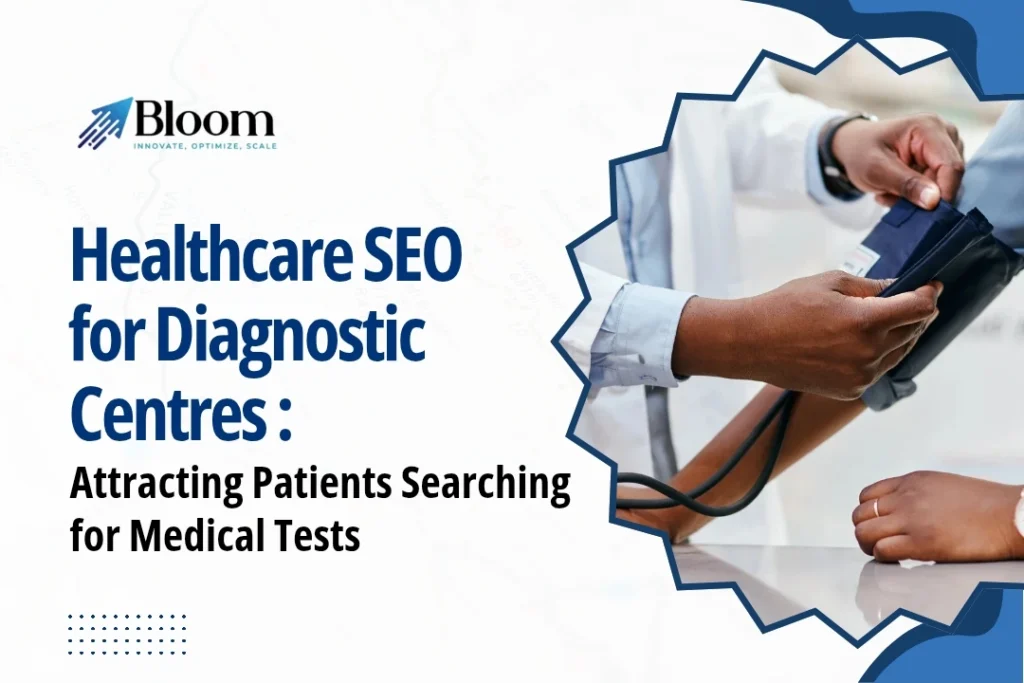
Healthcare SEO for Diagnostic Centres: Attracting Patients Searching for Medical Tests
When a patient needs a simple blood test or an MRI, the first thing they do is not call a diagnostic centre. They search for information on the internet. They compare prices, read reviews, check which diagnostic centres offer home blood collection and which do not. They research. And all of this takes place within a matter of seconds. The diagnostic centres that appear on the first page of search engine results get the appointments. The others, unfortunately, do not. This is why Healthcare SEO Services is vital for diagnostic centres and labs — it is one of the few acquisition channels that actually converts high-intent traffic into real-life patients. Unlike hospitals and multi-specialty clinics, which rely on doctor recommendations and other forms of network marketing, diagnostic centres are essentially “pure players”: the competition is much steeper, and patients are much more price-conscious. In this post, we will explore how healthcare SEO services can help diagnostic centres and labs to attract more patients by targeting their local market and answering their questions.
Why a Different Approach is Needed for Diagnostic Facilities?
Healthcare SEO is not a one-size-fits-all solution — different medical institutions have different needs. While a hospital or a dental clinic will focus on getting their services listed in directories and review sites, diagnostic centres should focus on creating informative content and optimising the existing pages for local intent. That does not mean that diagnostic centres should not appear in general medical directories. They should. But a multi-specialty hospital is not the same as a lab that primarily offers blood tests and other procedures.
Here are some of the most common characteristics of the searches made by patients that are looking for diagnostic services:
• Queries are more specific — e. g., “HbA1c test” rather than “health check-up”.
• They often indicate a specific need — e. g., the searcher has already received a blood test prescription from their doctor.
• They are highly localised — the searcher wants to find a diagnostic centre near them or one that offers home sample collection.
• They often include comparisons — e. g., home vs. in-clinic sample collection.
• They reflect urgency — e. g., the searcher wants to complete the tests as soon as possible.
• They often ask for prices and are concerned with affordability.
This means that your SEO strategy for diagnostic services should go beyond the homepage and generic services page. You need to optimise individual test pages, create informative blog posts that directly answer patient questions, utilise local SEO to appear in “near me” searches, build trust and credibility, and ensure that your booking process is as smooth as possible.
10 SEO Tactics to Help Diagnostic Centres and Labs Attract More Patients
1. Creating Landing Pages for Tests and Diagnostic Services
One of the biggest mistakes that diagnostic centres make is trying to stuff all of their services on one page. It is much better to create standalone pages for each of the tests and procedures that you offer. The benefit of this approach is two-fold: on the one hand, you will rank higher in the search results for each individual test; on the other hand, you will be able to provide much better information for the patient, thus building trust and reducing friction.
Some examples of pages that almost every diagnostic centre should have include:
• Complete blood count and other common blood tests
• Thyroid hormone tests and profiles
• Lipid profile and cholesterol tests
• Vitamin D and B12 tests
• HbA1c and diabetes screening
• Liver and kidney function tests
• CT scans, MRI, ultrasounds, and X-rays
• Full body health check-up and senior health screening
• Women’s health and fertility tests
For each of the tests, you will want to answer the following questions in detail:
• What is the test?
• Why is the test done?
• Who should get the test?
• How to prepare for the test, if applicable?
• How to get the results?
• How much does the test cost or is it part of a larger package?
• How to book the test?
All of this information should be included on the page for that particular test. That way, the searcher will be able to find exactly what they need without extra effort.
2. Conducting Keyword Research
It goes without saying that keyword research is the cornerstone of any successful SEO campaign. For diagnostic centres and labs, the keywords can be divided into several categories:
• Keywords that include the names of tests (e. g., thyroid function test, lipid profile test, MRI brain scan)
• Local keywords (e. g., blood test near me, diagnostic centre in [City], X-ray centre near me)
• Keywords that describe services (home blood sample collection)
• Keywords that describe pricing (MRI scan cost, price of health check-up)
• Informational keywords (fasting before a blood test, normal HbA1c levels)
Informational long-tail keywords are often the most useful, as they usually reflect the searcher’s intent to book a test. By creating blog posts and answering their questions, you will be able to boost the visibility of your centre and encourage more patients to book appointments.
3. Optimising for Local Searches
The searches made by patients looking for diagnostic services are often local. This means that you should optimise your centre’s page for “near me” queries.
Some of the most important optimisation techniques include:
• Setting up and optimising your Google Business Profile
• Adding all of the services that you provide
• Updating the CTA buttons and links
• Making sure that your hours of operation are up to date
• Adding photos of your staff and the interior of your centre
• Getting verified as a medical provider, if applicable
• Encouraging customers to leave reviews
• Featuring your most popular tests and specials on the page
If your centre has multiple locations, you should also create separate landing pages for each of them. Make sure to optimise them for “local” searches by including the city or town name. You should also add addresses, phone numbers, and hours of operation for each location. Whenever possible, use location-based modifiers, such as “blood test near me” or “X-ray centre in [City]”.
4. Building Trust and Enhancing Credibility
One of the best ways to improve the SEO of your diagnostic centre is to build trust and credibility with your audience. Google classifies medical websites as “Your Money or Your Life” or YMYL domains, which means that they are held to a higher standard. To enhance the credibility of your domain, you should take the following steps:
• Add trust signals, such as accreditations and certifications, where applicable
• Put together qualified team pages that describe the credentials of your doctors and specialists
• Make sure that all of your content is reviewed by medical professionals
• Provide accurate information about your services and pricing
• Add relevant contact information to your pages
• Include descriptions of your quality control and security measures
• Ensure that your website is compliant with all applicable privacy and data safety regulations
A qualified doctor reviewing a page about thyroid hormone tests will greatly enhance its credibility, which will, in turn, improve its search ranking. Google will understand that the page is trustworthy, and it will reward you with a higher position in the search results.
5. Publishing Blog Posts that Answer Patient Questions
A blog is one of the most powerful tools in healthcare SEO. Not only does it allow you to provide in-depth information to your patients, but it also helps you to attract more organic traffic and convert them into customers.
Some topics that are particularly useful for diagnostic centres include:
• How to prepare for blood tests
• When to get a full body check-up
• How to read blood test results
• Symptoms that require a thyroid hormone test
• How often should one get tested for diabetes
• MRI vs. CT scan: what is the difference?
• How to prepare for an ultrasound
• Senior citizens health check-up
• Complete body check-up for men and women
Remember that your audience is not made up of medical professionals. Avoid using complex jargon and explain everything in simple terms. You should also remind your readers that the information on your blog is not a substitute for professional medical advice. Make sure to include links to relevant test pages and the booking system on your website, so that the traffic that you drive to your blog actually converts.
6. Implementing Technical SEO Best Practices
Many people ignore technical SEO, but it can make a staggering difference to your search ranking. Search engines reward websites that load faster and work correctly on all devices.
Here are some of the most important technical SEO practices that every diagnostic centre should implement:
• Make sure that your website is mobile-friendly
• Add schema markup to your web pages
• Add clean URLs that are easy to read and navigate
• Install an SSL certificate
• Make sure that your website’s caching is properly configured
• Optimise images so that they load faster
• Fix broken links
• Create an XML sitemap and submit it to Google
• Make sure that all of your web pages are easy to navigate
Schema markup is one of the most important technical SEO practices, as it tells Google exactly what your web pages are about. The best schema for healthcare centres is the MedicalBusiness or DiagnosticLab schema, which you can add to all of your web pages.
7. Making it Easy for Patients to Book Tests
If nobody can understand how to book a test on your website, all of the traffic that you drive to your page will be wasted.
To optimise your page for conversions, you should:
• Add a CTA button that encourages patients to book a test
• Make sure that your booking system is easy to use
• Allow patients to book appointments via WhatsApp or phone
• Offer home blood sample collection, if applicable
• Let patients indicate their preferred time slot, if applicable
• Include the option to upload a prescription, if applicable
• Notify patients that their booking was successful via SMS or email
• Minimise the number of fields that patients have to fill
You should track all of the CTA buttons on your website in Google Analytics 4 to see which ones lead to conversions and which do not.
8. Discussing Prices and Packages Openly
Many patients will be turned off by centres that do not discuss their prices openly. Whenever possible, you should include pricing details on your website. You do not always have to list all of the prices for every test, but you should strive for maximum transparency whenever you can.
Some tips for optimising your pricing pages for SEO include:
• Highlighting the most popular packages
• Describing what each package includes
• Mentioning any discounts or special offers
• Indicating if home sample collection has an additional cost
• Describing any corporate or senior citizen discounts
In many cases, budget-friendly pricing packages will actually encourage people to book more tests, so make sure to optimise your pricing and packages pages for conversions.
9. Building High-Quality Backlinks to Your Website
Backlinks are still one of the most important ranking factors in Google’s algorithm, which means that you should always look for opportunities to build high-quality links to your website.
Some backlink building strategies that are particularly useful for diagnostic centres and labs include:
• Listing your centre in local directory sites
• Getting backlinks from local doctors and clinics
• Publishing articles in local newspapers and magazines
• Getting mentioned in articles that discuss the healthcare industry
• Building partnerships with local corporations
• Getting links from high-authority blogs
• Hosting health camps or fairs and getting mentioned online
Remember that quality always matters more than quantity. One backlink from a high-authority website can be much more valuable than 100 low-quality links.
10. Following Ethical and Legal Guidelines
As mentioned above, websites that provide medical services and information are classified as Your Money or Your Life (YMYL) domains by Google. This means that they are held to a higher standard in terms of quality and ethics. To avoid getting penalised by Google, you should always follow the ethical and legal guidelines for medical websites.
Some of the most important recommendations include:
• Avoiding false advertising or unproven medical claims
• Never claiming that a test or procedure can cure a disease
• Having medical pages reviewed by actual medical professionals
• Ensuring that your website is protected and complies with data privacy laws
• Following all applicable ethical guidelines when publishing patient testimonials
Summary
To summarise, SEO is exceptionally important for diagnostic centres and labs, as it allows you to attract high-intent traffic and convert them into patients. By optimising your test pages, utilising local SEO, publishing informative blog posts, and building high-quality backlinks, you will be able to improve your search ranking and get more visibility online. In addition, you should make sure that your booking system is intuitive and easy to use. To implement all of these SEO tactics, you may want to consider working with a professional healthcare SEO agency. They will have the tools and resources to help you optimise your website and gain more visibility. At Bloom Agency, we specialise in helping diagnostic centres and labs to attract more patients by improving their local search ranking and overall online presence.
Common SEO Mistakes that Diagnostic Centres Should Avoid
Here are ten of the most common SEO mistakes that diagnostic centres make:
1. Putting all of the tests and procedures on one landing page
2. Failing to optimise for local searches
3. Copying the content from other medical websites or test directories
4. Using excessive medical jargon that most people do not understand
5. Making it too hard for patients to contact the centre or book a test
6. Neglecting the needs of mobile users
7. Failing to update content, including pricing, hours of operation, and available tests
8. Not measuring the results of your SEO campaign
9. Ignoring the importance of trust signals
10. Overlooking technical SEO
How to Measure the Success of Your SEO Campaign?
SEO is a long-term game, which means that you should not expect immediate results. That said, you should still track your progress on a monthly basis and make optimisations, if necessary.
Here are some of the most important SEO performance indicators (SPIs) that you should track on a regular basis:
• Organic traffic (particularly to the test pages)
• Keyword rankings
• Google Business Profile engagement (click-through rate, number of calls, etc.)
• Conversion rate
• Number of reviews and their ratings
• Cost per acquired patient
Once you have gathered this information, you will be able to see which SEO activities actually work and which do not produce any results. In most cases, you should see your search rankings start to improve within 3-6 months of launching your SEO campaign.
Final Thoughts
Patients who are looking to book a medical test are usually in a hurry — they want to get their results as soon as possible and move on with their lives. Because of this, the diagnostic centres that invest in SEO see much better results than those that do not. By implementing the ten proven tactics that we have listed above, you will be able to improve your local search ranking, attract more organic traffic, and convert them into patients.
If you want to learn more about how SEO can help your diagnostic centre or lab, make sure to contact Bloom Agency. We have extensive experience helping medical facilities to improve their online visibility and attract more patients.

Neetu Wadhwa is the Director of Bloom Agency, a Mumbai-based full-service digital marketing and web development company. With a strong focus on performance, innovation, and strategy, she leads the agency in delivering SEO, web design, and growth marketing solutions that drive measurable business outcomes.




Rahul M.
B2B Service Provider