
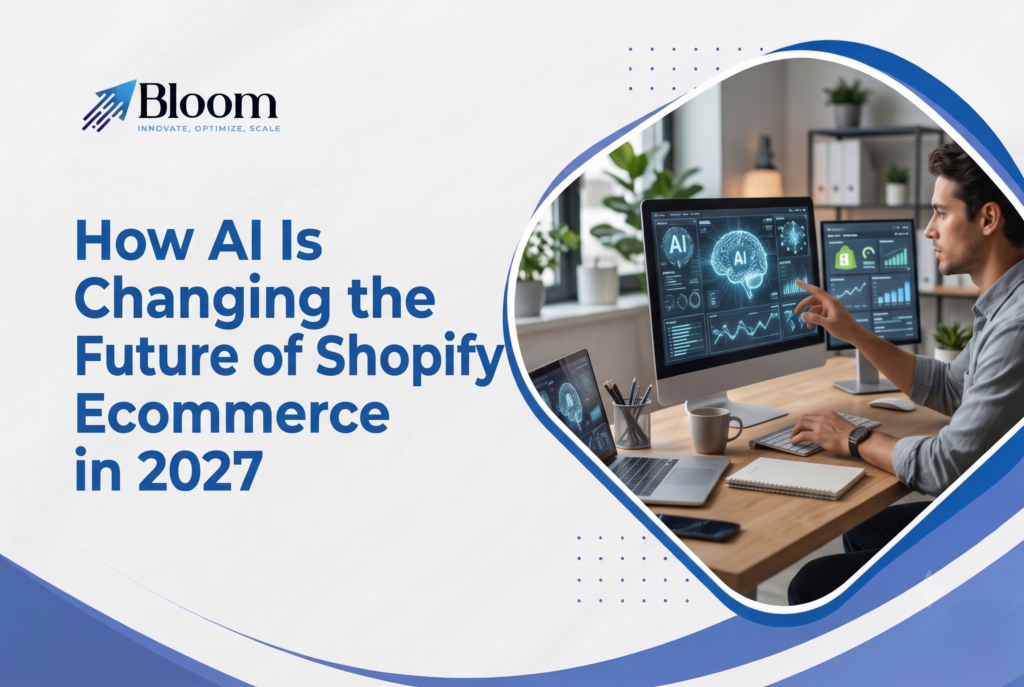
How AI Is Changing the Future of Shopify Ecommerce in 2027?
Bloom Agency specialise in helping Ecommerce businesses create, optimise and improve their Shopify stores. We offer a wide range of Shopify development, website design, technical SEO, content marketing, conversion rate optimisation and digital marketing. To run a successful online store you need a well structured website with a smooth user experience, engaging product descriptions, secure payment options and a marketing strategy. Each of these factors play a key role in helping attract potential customers and building trust.
We focus on creating easy to use storefronts, improving navigation, optimising product pages, improving search visibility and attracting quality customers. Our approach to improving your store combines technical improvements with customer focused strategies. We aim to improve your Shopify store performance by improving your search engine performance, providing a seamless experience across desktop and mobile devices. We also focus on improving any issues with your website, increasing conversion opportunities and producing content that will answer your customers questions.
As a performance driven Shopify SEO Agency, we combine our Ecommerce expertise with practical digital strategies to help brands stay ahead of evolving customer expectations and utilise new technologies. By combining our organic search optimisation, website improvements, content creation and conversion focussed marketing we help brands improve their online presence. Whether you’re looking to start a new Shopify store or improve your existing store our goal is to help your brand succeed in the long term.
Introduction
Artificial intelligence is changing the way customers find products, compare brands and shop online. In 2027 AI will become an increasingly important tool in Shopify ecommerce, helping businesses personalise their customers’ experience, automate tasks, boost product search results and help make well-informed decisions.
Shopify stores can utilise AI to boost customer engagement, automate processes and create a smoother customer experience.
1. Personalising Customer Experience
More customers are expecting e-commerce stores to know what they like. Using AI you can look at how customers browse, what they have bought previously, what they have searched for and their shopping patterns to suggest products.
For example, if a customer is browsing skincare products they can be suggested products such as moisturisers or sunscreens to go with their products. Returning customers can also be suggested products based on what they have purchased before.
This can help with:
- Personalised product recommendations.
- Personalised offers and discounts.
- Personalised email marketing.
- Suggested products based on what they have browsed.
- Personalised homepages and collections.
This can make it easier for customers to find products and encourage them to look at more products. However, you must ensure that you are using your customer data responsibly.
2. AI Product Descriptions
Creating product descriptions for hundreds of products can take a lot of time. Using generative AI you can create product descriptions, blog outlines, category information, email marketing and social media captions. AI can also help you tailor your content to your audience and marketing channels. For example, you can take your product description and turn it into a short social media caption.
However, you should never publish any AI generated content. This can cause issues with your product details not being correct, repetitive content and over the top claims. Before using AI tools ensure that you have accurate product details, brand guidelines and information about your target audience. Using human editing will ensure your content is original, accurate and keeps your brand voice consistent.
3. Intelligent Product Search
Many e-commerce stores can struggle with searching for products as customers need to know the exact name or keyword. Using AI your customers can search using natural language.
For example, if your customer is looking for comfortable shoes to walk around in they can type this into the search bar. The AI will understand what they are looking for and find products that match their search based on product descriptions, categories and attributes.
New features include:
- Image search – Customers can upload an image and find similar products.
- Voice search – Customers can search for products using their voice.
- Semantic search – Search understands what the customer is looking for.
- Intelligent filters – Customers can filter results using relevant product attributes.
To get the best out of these features you need to ensure your products have accurate titles, descriptions, categories, images and specifications.
4. AI Chatbots and Virtual Shopping Assistants
The use of AI chatbots is transforming the way ecommerce companies communicate with customers. They can provide answers to queries about delivery, returns, availability of products, payment modes, and the status of orders. Some shopping assistants have the ability to assist customers in comparing products and choosing suitable ones.
| Traditional Customer Support | AI-Assisted Customer Support |
|---|---|
| Mostly manual responses | Automated answers to common questions |
| Limited by staff availability | Can provide support around the clock |
| Often uses fixed response scripts | Understands conversational queries |
| Repetitive work for support teams | Allows staff to handle complex issues |
Businesses must ensure that the chatbots have reliable data on their stores and an option for customers to speak to a real person.
5. Predictive Analytics and Inventory Management
Inventory management is another important challenge for ecommerce companies. Excessive inventory creates additional storage expenses, whereas insufficient inventory may cause the loss of sales. AI-driven analytics can look into historical sales, seasonal demand, customers’ behavior, and product performance to detect possible patterns of demand.
For instance, an online clothing store can analyze previous festive season sales and try to estimate the categories that will require additional inventory. Merchants can use this information to plan their purchase and promotion campaigns.
However, AI can also help to find slow-selling products, unusual sales trends, and possible shortage of products. Nevertheless, all predictions should be combined with supplier information, market situation, and personal experience.
6. AI and Shopify SEO in 2027
Search behavior is changing. Customers may find products using Google, social networks, marketplaces, and AI-powered assistants. Therefore, Shopify stores should develop a good SEO strategy that will work both in case of traditional search engines and new discovery channels.
Professional Shopify SEO Agency will help businesses to increase their online visibility through:
- Keyword research according to customers’ search intent.
- Optimization of product titles and descriptions.
- Informative category pages and blog posts.
- Internal linking between related pages.
- Structured data and correct product information.
- Technical
8. Traditional Shopify Store vs AI-Enabled Shopify Store
| Ecommerce Area | Traditional Shopify Store | AI-Enabled Shopify Store |
|---|---|---|
| Product discovery | Basic keyword search | Intent-based and visual search |
| Recommendations | Manually selected products | Behaviour-based suggestions |
| Customer support | Mostly manual responses | Automated assistance with human support |
| Content creation | Written manually | AI-assisted drafts and editing |
| Inventory planning | Manual estimates | Predictive insights |
| Marketing | Broad audience targeting | More relevant customer segmentation |
AI does not replace the need for a well-designed ecommerce website. Product quality, website usability, secure payments, reliable delivery, and customer service remain essential to business success.
9. How Shopify Businesses Can Prepare for 2027
Businesses do not need to adopt every new AI application immediately. A practical approach is to identify existing challenges and introduce technology where it can create measurable improvements.
Follow these steps:
- Review product information, website speed, and mobile usability.
- Identify repetitive tasks that consume employees’ time.
- Start with one useful AI application, such as product recommendations or chatbot support.
- Review all AI-generated customer-facing content before publishing.
- Track conversions, average order value, customer satisfaction, and organic traffic.
- Expand successful applications based on performance.
This approach helps businesses avoid unnecessary technology expenses while focusing on improvements that support customers and operations.
10. How Bloom Agency Helps Shopify Businesses Grow
Whilst technology is an important aspect of ensuring success within your ecommerce business, you also need to consider your website structure, product pages, branding, technical aspects and digital marketing strategy. We provide Shopify development, SEO, keyword research, content optimisation, product page improvements and digital marketing services. Our team will help your business improve your website by identifying areas of improvement, improving your search visibility and attracting the right audience.
As a specialist Shopify SEO Agency we are focused on providing sustainable organic growth strategies rather than quick fixes or unrealistic promises. Our team will help improve your digital foundations and prepare your Shopify store for future changes within ecommerce.
Conclusion
AI will play a role in almost every aspect of your Shopify ecommerce store in 2027. From improving product discovery, personalisation, customer service, content creation and stock management. By using practical AI tools with accurate information, oversight and customer focussed strategies you can create a more efficient online store.
The future of ecommerce will still rely on having a good performing website with useful content, reliable products and an enjoyable shopping experience. Start looking into relevant AI tools for your Shopify store, track how they perform and invest in improving your store.
FAQ
1. How is AI impacting Shopify ecommerce in 2027?
AI is helping Shopify businesses by allowing them to personalise their customers shopping experience, improve product discovery, automate customer service, create content, analyse sales trends and complete regular tasks within the store.
2. Can AI help with Shopify SEO?
AI can help with keyword research, content strategy and analysing how your website is performing. However, your rankings will also rely on having good technical SEO, useful content, relevant product information and a great user experience.
3. Does Shopify have any built in AI tools?
Yes! Shopify have AI tools such as Sidekick. This can help with various tasks relating to your store. However, this will depend on your plan.
4. Will AI replace marketers in ecommerce?
No. Whilst AI can complete repetitive tasks, marketers will still be an important part of your business. They will help with strategy, creativity, brand positioning, understanding your customers and ensuring quality.
5. What is the best AI tool to use for a new Shopify store?
You could start with using AI for content creation, customer service and product recommendations. This will depend on your budget, products and business needs.
6. Why should I use a Shopify SEO Agency?
A specialist agency can help improve your technical SEO, product page optimisation, keyword targeting, content quality and organic growth strategy. They will also help your business adapt to changing search behaviours.

Neetu Wadhwa is the Director of Bloom Agency, a Mumbai-based full-service digital marketing and web development company. With a strong focus on performance, innovation, and strategy, she leads the agency in delivering SEO, web design, and growth marketing solutions that drive measurable business outcomes.






Rahul M.
B2B Service Provider