
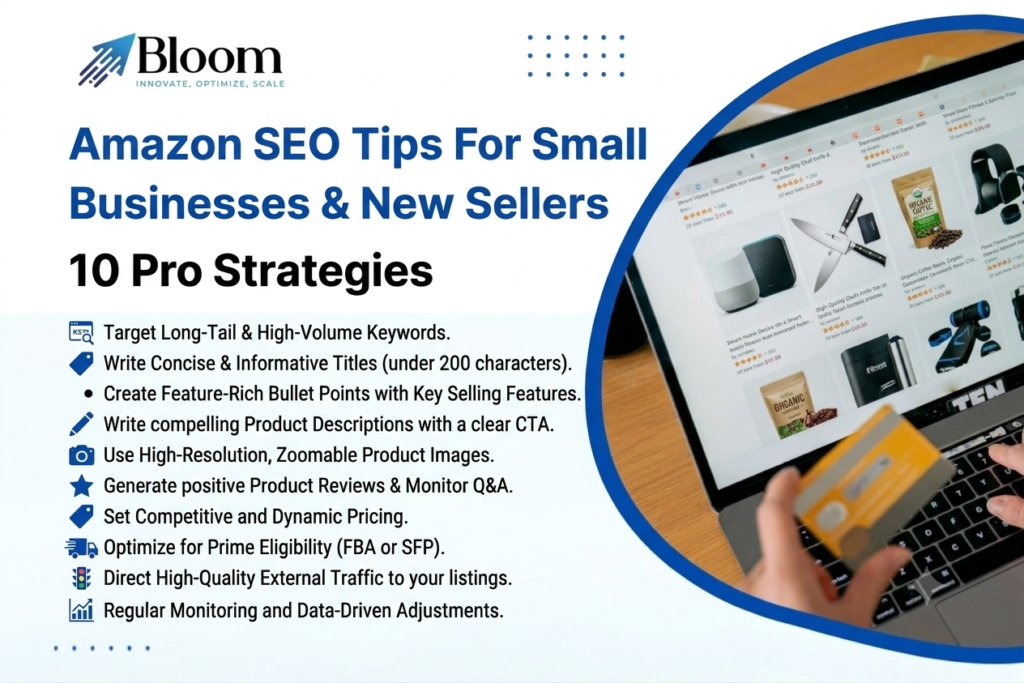
Amazon SEO Tips For Small Businesses & New Sellers: 10 Pro Strategies
Selling on Amazon is great news for small businesses and new sellers. However, it is only the beginning of the road. With thousands of competitors, you need to make your products discoverable and attractive to potential buyers. That is where Amazon SEO comes in. Amazon SEO (search engine optimization) is the art of making your product relevant and appealing to the right customers on the retail giant. Just like standard SEO, Amazon SEO involves keyword research, on-page optimization, and other techniques. However, you also need to account for pricing, availability, product detail, reviews, and more. Amazon SEO can be confusing and time-consuming for small businesses and new sellers. You probably have limited resources to sell on Amazon. Moreover, you may not know where to start with Amazon SEO. Fortunately, you can invest in expert Amazon SEO services to get actionable insights and recommendations.
In this guide, we will discuss 10 Amazon SEO tips for small businesses and new sellers. We will share practical advice on how to optimize your Amazon product listings for better visibility and more sales.
1. Conduct Amazon Keyword Research
Keyword research is the cornerstone of any successful Amazon SEO strategy. You need to identify the right keywords to target and incorporate them into your product titles, bullet points, and description. This way, your products will appear in relevant search results on Amazon.
For example, if you sell water bottles, your keywords may include stainless steel water bottle, insulated water bottle, and travel water bottle, among others. All keywords should be relevant to your product and incorporate its unique attributes and benefits.
Next, make a list of your target keywords. First, pick a primary keyword that best describes your product. Then, think about the terms that customers may use to search for your products. What keywords describe the material, size, color, intended use, and other attributes? Beside Amazon’s search bar, you can use Amazon search suggestions, competitor analysis, customer questions, and keyword research tools to find relevant keywords. When choosing keywords, focus on their relevance and search volume. Do not overlook long-tail keywords. While they may have a lower search volume, they can generate quality traffic and help you rank higher in search results. However, ensure that your keywords are relevant to your product and customers’ search intent. Avoid using keywords that may mislead customers.
Now, you can use your target keywords to optimize your product titles, bullet points, description, and backend search terms. Remember that each product has its nuances. Therefore, research keywords for each product category.
2. Optimize Product Titles
Product titles are among the most important on-page elements in Amazon SEO. A well-optimized title will help your products rank higher in search results. In addition, it will also help customers find the products they are looking for. Your product title should be scannable and informative. Incorporate your primary keyword at the beginning of the title. Moreover, you should follow Amazon’s guidelines and best practices when optimizing product titles. A typical title includes brand name, product type, key attribute or benefit, size, material, and other attributes that apply to your product category. For example, a water bottle title includes the brand name, capacity (ounces), material (stainless steel), and insulation type (insulated). By contrast, a product page for a storage organizer may include its dimensions (L x W x H), number of storage units, and the material (plastic).
When optimizing your titles, follow these Amazon SEO tips:
1. Make the most important product attributes (keywords) front and center
2. Place the primary keyword at the beginning of the product title
3. Make sure to include relevant product attributes and benefits
4. Avoid keyword stuffing and using promotional language
5. Follow Amazon’s title guidelines and character limits
As a new seller, avoid copying the titles from your competitors. Instead, you can use their titles as inspiration. First, identify the most critical product attributes and benefits. Then, create a title that includes these attributes and follows the best practices.
3. Write Product Bullet Points
Bullet points are another essential element of Amazon SEO. They provide a scannable summary of your product’s attributes and benefits. Customers often skim through bullet points and rely on them to decide whether your product is worth purchasing. Each bullet point should highlight a unique attribute or benefit. However, avoid simply describing the product. Instead, write compelling bullet points that demonstrate how your product can solve customers’ problems or improve their lives. For example, your bullet points can emphasize the product’s key features and unique selling points (USPs) such as materials, dimensions, ease of use, recommended uses, and included accessories. You can also use bullet points to incorporate keywords relevant to your product category. However, make sure not to stuff your keywords. Prioritize the most important benefits and attributes relevant to the product. Do not forget to follow Amazon SEO guidelines and avoid repeating the same words over and over again.
Moreover, sellers should use bullet points to address customers’ concerns. For example, your bullet points can describe the care and maintenance instructions if you sell clothing or a home appliance. If you sell storage organizers, your bullet points can describe the recommended uses and limitations. In short, your bullet points should help buyers make an informed decision by addressing the concerns and questions. Small businesses and new sellers can also benefit from conducting a competitor analysis and customer research. This way, you will be able to identify the most common questions and concerns regarding your product category. Then, use this information to improve your bullet points and product description.
4. Write Informative Product Descriptions
A product description is the written part of a product listing. It provides customers with additional information that may not fit in product titles, bullet points, and specifications. In short, it supplements the rest of the product listing.
A good description can help you turn website visitors into customers. Avoid using generic and vague language. Instead, use specific and descriptive language to inform customers about your product’s uses, features, benefits, and limitations. For example, if you sell home decor items, your description should specify what surfaces can support the item (e.g., tabletops) and what activities the home decor item is suitable for (e.g., indoor uses only). Do not forget to follow Amazon SEO tips and keywords guidelines. You can use keywords in your description, but avoid repeating the same words multiple times. Moreover, avoid using unsupported claims and keywords that do not describe your product accurately. The description should include the information that your customers care about.
Therefore, it is crucial to conduct customer research and competitor analysis beforehand. This way, you will be able to anticipate the customers’ questions and address them in the description. Depending on the product category, sellers may also use Amazon A+ Content to enhance their product description. A+ Content helps you expand your written description and showcase your brand value proposition.
5. Add High-Quality Images
Customers cannot touch or feel your product before purchasing it. Therefore, high-quality images are one of the most important elements of Amazon SEO. They help customers visualize the products and ensure that the products meet their expectations. As a seller, you should invest in high-quality images that showcase your products from different angles. In addition, you may want to consider using dimension photos and feature photos to demonstrate the products’ attributes and benefits. Your images should also be relevant to your product category and follow Amazon’s image guidelines. Before uploading product images, make sure they comply with Amazon’s high-resolution requirements and other guidelines. For example, if you sell bottled water, your images should showcase the product packaging. Moreover, the packaging should be clearly visible and legible. In general, your photos should provide a true representation of the products to avoid negative customer reviews. If you use graphic images (e.g., dimension photos, photos of the product packaging), make sure all the text is visible and readable. When applicable, double-check the accuracy of the product dimensions and other specifications. If you sell branded products, consider using A+ Content to highlight your brand value proposition and differentiate your products from competitors’ products. A+ Content can be used to display relevant visuals and describe your products in greater detail.
6. Optimize Backend Search Terms
Search terms are another on-page element that plays an important role in Amazon SEO. In short, optimizing backend search terms ensures that your products appear in front of the right customers. However, search terms should complement your product listing rather than replace it. Search terms are keywords entered in the search terms field in Seller Central. These keywords add context to your product listing and help Amazon understand your products better. You can use search terms to include relevant descriptors and synonyms that customers may use when searching for products on Amazon.
For example, some customers may search for stainless steel water bottle while others may use the term insulated water bottle. Make sure you include both keywords in your search terms. However, avoid using irrelevant keywords just because they are popular search terms. A good rule of thumb is to include synonyms and related terms that are relevant to your product category. When optimizing your search terms, you should also follow Amazon SEO guidelines. Make sure not to repeat the same words unnecessarily. In addition, avoid using trademarked terms and prohibited keywords. Finally, ensure that your search terms are up-to-date and relevant to your target customers.
7. Optimize Pricing & Availability
Amazon SEO is not just about keywords. Other off-page and on-page elements are equally important. For example, you should ensure that your prices are competitive and your products are in stock. Otherwise, potential customers will not be able to purchase your products. Competitor research is critical before setting the prices for your products. You need to make sure that you price your products competitively without sacrificing your profits. In addition to conducting a competitor analysis, consider your costs and profit margins. New sellers should not engage in a price war with competitors. Instead, create a pricing strategy that aligns with your overall business goals. Availability also plays an important role in Amazon SEO. Potential customers will not purchase your products if they are out of stock. Therefore, ensure that your products are in stock to avoid losing sales. Similarly, you should consider your fulfillment options and make sure that your inventory management strategy is up-to-date and effective.
8. Encourage Customer Reviews
Customer reviews help your products rank higher in Amazon search results. They also play an important role in the purchasing decision-making process. Therefore, it is critical to collect customer reviews.
As a new seller, you may not have much control over customer reviews. However, you can take advantage of Amazon’s review submission tools and programs to request reviews from your customers. Make sure not to ask customers to leave a review or offer incentives for leaving a review. Such practices are explicitly prohibited by Amazon. You can request reviews only through Amazon’s review submission tools and programs. Always follow Amazon guidelines and terms of service when asking for customer reviews. Be polite and professional when requesting a review. Customer reviews provide invaluable feedback about your products and customers’ expectations. If you receive negative feedback, take it seriously and consider whether the feedback reflects a genuine concern. You should respond to customers’ concerns and clarify any misunderstandings. For example, if you receive multiple negative reviews about the product size, you may want to revise the product description and mention the relevant dimensions.
Overall, Amazon SEO is a continuous process that requires time and effort. You need to optimize your product titles, bullet points, descriptions, and images. Equally important, you should invest in customer retention and collect honest customer reviews.
9. Leverage Amazon Advertising
Amazon advertising and Amazon SEO are two separate but interconnected practices. Amazon advertising helps you boost your products in search results and collect data about your target audience and keywords. In contrast, Amazon SEO focuses on ranking higher in organic (non-paid) search results. New sellers and small businesses should use Amazon advertising to collect data. You can use this data to optimize your product titles, bullet points, descriptions, and images. This way, you make the most of your time and resources. Before launching an Amazon advertising campaign, make sure to optimize your product listings. In other words, Amazon SEO should support your advertising efforts. You should also consider small business budget options. Advertising can be expensive, especially if you operate on a tight budget. The key is to invest in keywords that generate sales and profit. Moreover, it is essential to understand that paid advertising does not guarantee organic visibility or higher search rankings. A successful Amazon advertising campaign should be based on a set of clear goals. You should also analyze the results and continuously optimize your advertisements.
10. Analyze the Results & Optimize Your Product Listing
Amazon SEO is a continuous process that requires continuous analysis and optimization. You need to understand what works and what does not. The key is to find a balance between continuous improvement and sustainable profitability. There are several metrics that you can track to get a general idea about the performance of your product listing. First, you should take a look at your page views and unit session percentage. Both metrics give you a general idea about the relevance and performance of your product listing. In addition, you should track your sales and revenues to understand whether your efforts pay off. Second, you should review your Amazon advertising performance. In other words, make sure that your advertising budget is spent wisely. You should also track your keyword performance and periodically update your search terms.
Moreover, it is critical to listen to your customers. Pay close attention to recent questions and concerns. If your customers keep asking the same questions, it is probably a sign that your listing needs improvement. For example, you should update your product description if your customers keep misunderstanding the product purpose. Another important metric is your inventory performance. Make sure that your products are available to customers most of the time. If your inventory management is ineffective, update it. You should also update your pricing, product titles, and other listing elements if they contribute to poor performance. Some small businesses and new sellers use Amazon’s Manage Your Experiments tool to identify the most valuable A+ Content and listing elements. You can use this tool to test new elements and see which ones enhance your product listing.
Finally, make sure that you base your decisions on data rather than assumptions. You should constantly optimize your product listing and analyze the results. This way, you will be able to maximize your time and resources and make your products more attractive to your target audience.
How Amazon SEO Agencies Can Help Small Businesses with Amazon SEO?
Selling on Amazon requires time and effort. As a small business or a new seller, you probably have limited resources. Therefore, it is important to optimize your time and effort. Amazon SEO services can help you leverage Amazon’s marketing ecosystem to your advantage. An experienced Amazon SEO agency will develop an Amazon SEO strategy that maximizes your time and effort. For example, an SEO agency can provide you with actionable keyword research and product listing optimization services, including title, bullet points, and description optimization. In addition, such agencies can assist with backend search term optimization and Amazon advertising. They can also analyze your performance and recommend changes that will enhance your product listing.
Bloom Agency offers Amazon SEO services https://bloomagency.in/amazon-seo-services/to businesses that want to improve their Amazon product listing optimization and increase sales. We understand that there are no universal solutions in Amazon SEO. That is why we adopt a strategic and transparent approach to help you achieve your business goals.
Contact Bloom Agency to discuss the best Amazon SEO solutions for small businesses and new sellers. We can help you take your Amazon product listings to the next level.
Conclusion
Amazon can give small businesses and new sellers a great opportunity, but there is a catch. In addition to creating attractive offers, it is necessary to take care of the customers’ needs, reflect the key points of the product, keep the listings up to date, and constantly analyze the results.
Fortunately, the ten tips described in this guide can help increase sales and get the most out of an online store on Amazon. Understanding shopping searches, using keywords, optimizing titles and images, improving content on Amazon’s platform, analyzing the environment, and measuring the outcomes are essential for succeeding on the website. Although each method has its tactical and strategic value, it is worth remembering that the key to achieving success on Amazon lies in attracting the right customers and providing them with relevant information that will help them make the right purchase decision.
Therefore, small businesses and new sellers should begin their journey by learning the peculiarities of the store, the specifics of their products, the needs of their customers, and the strengths and weaknesses of the competition. Moreover, it is worth starting with the most promising products, those with the most extensive content for Amazon SEO and the greatest potential for increasing sales. By looking at the most critical problems and analyzing available data, regular small optimizations will create a substantial competitive advantage over other new businesses. Following the above advice and remembering the interplay between attracting new customers and maintaining customer loyalty, one can effectively perform Amazon SEO. Thus, small businesses and new sellers will be able to optimize Amazon product listings, increase their visibility, and gain more sales in both the short and long term.
Frequently Asked Questions
1. What is Amazon SEO?
Amazon SEO encompasses a set of activities aimed at optimizing the product to increase its relevance to Amazon’s searches.
2. Why is SEO on Amazon important for small businesses?
Properly optimized product content makes it easier for the right customers to find goods. In addition, Amazon SEO increases the visibility of products among the most suitable customers and provides them with the information they need to make a purchase decision.
3. How can new sellers rank products on Amazon?
New sellers can rank products on Amazon through keyword research, correct category selection, title optimization, product description creation or improvement, optimization of additional product content, and increasing the relevance of offers through advertising. However, it is critical to understand that specific positions on Amazon are not guaranteed.
4. How do I find the right keywords for Amazon products?
To select the right keywords for Amazon products, users can rely on Amazon search suggestions, competitor analysis, customer opinions, and keyword research tools.
5. How often should Amazon product listings be optimized?
Optimization is a continuous process, and changes to product listings should be made as often as necessary to maintain Amazon SEO. In addition, monitoring changes in rankings, product availability, and overall performance can help identify problems early.
6. Do Amazon product descriptions impact sales?
A quality description impacts selling capabilities, as it provides customers with important information about the product. However, it is not the only factor influencing sales; prices, product availability, and the offers provided by competitors are also significant.
7. Can small businesses use Amazon advertising and SEO together?
Amazon advertising and SEO can supplement each other, allowing small businesses to advertise on the platform and optimize their product offerings for organic searches on the site. Nevertheless, it is vital to consider the financial capabilities of the business and weigh the benefits of one method against another.
8. How can I increase my Amazon product conversion rate?
Increasing the conversion rate involves working on Amazon SEO, specifically optimizing images, titles, bullet points, and product descriptions. It is also essential to take into account the price, shipping options, and feedback from customers. Additionally, monitoring reviews and collecting data on the most frequently asked questions and desired options will allow for further improvements and a higher conversion rate.
9. What are Amazon backend search terms?
Amazon backend search terms are keywords that allow products to be found in category searches and are selected in special fields within the Seller Central. Keywords should be chosen following Amazon guidelines, reflecting the critical characteristics of the product offering.
10. How can Amazon SEO services help new sellers?
Amazon SEO services can help new sellers optimize their catalogs by conducting keyword research, improving existing product content, and providing training. In particular, these experts can offer professional advice on individual product needs and provide comprehensive solutions based on competition, cost, and the characteristics of the goods or services offered.

Neetu Wadhwa is the Director of Bloom Agency, a Mumbai-based full-service digital marketing and web development company. With a strong focus on performance, innovation, and strategy, she leads the agency in delivering SEO, web design, and growth marketing solutions that drive measurable business outcomes.






Rahul M.
B2B Service Provider