
Search is moving really fast these days. People are not just depending on classic search results anymore, they’re starting to ask conversational questions through AI powered search experiences, and they kinda expect quick direct answers that actually help. For companies, this is a fresh chance to make their websites easier for answer engines and AI systems to read, interpret, and use.
Answer Engine Optimization, or AEO for short , is mostly about how your site content is organized and refined so AI search platforms can spot what matters, get the full meaning around it, and maybe even pull it into the answers they generate. Sure, AEO brings extra angles to think about, but it doesn’t really replace traditional SEO. Instead, it widens the whole concept of search visibility, like you’re no longer aiming for one channel only.
For brands going after steady long term organic growth, pairing SEO basics with AEO centered content, technical improvements, structured data, and authority signals can build a more powerful overall search approach.
What Is On-Page AEO?
On-page AEO is kind a process of tweaking content and website pieces, so that answer engines can understand, pull out, and interpret the important information, without all that trouble. Traditional SEO mostly leans into higher rankings for search queries that are relevant. AEO however adds more weight on giving direct answers, arranging information in a way that feels obvious, defining the entities clearly, showing real expertise, and making the content easier for AI systems to handle.
So basically, a page should not just be a collection of keywords. It has to explain the topic in a clear manner , answer the relevant questions, use logical headings , link related concepts together , and include trustworthy information overall.
For instance, instead of making some huge page where the main answer shows up way down after an intro, a more AEO-friendly page can put a short answer right after a question-based heading, then continue expanding the subject with supporting details, as it goes.
Why AEO Matters in 2026
AI-powered search experiences are changing how people discover businesses, products, services, and information. Users can ask detailed questions and receive synthesized responses instead of reviewing multiple conventional search listings.
This creates a different visibility opportunity for businesses. A company may be mentioned, summarized, or referenced in an AI-generated response even when the user does not interact with a traditional search result in the usual way.
Google’s guidance for AI search experiences continues to emphasize fundamentals such as valuable content, page experience, technical accessibility, and clear information. This means businesses should not abandon SEO while adopting AEO. The strongest approach is to build on established SEO practices while making content more useful and understandable for conversational and AI-driven search.
On-Page AEO vs. Off-Page AEO
AEO involves both website-controlled and external signals. On-page optimization includes everything a business can improve directly on its own website. This includes content structure, headings, internal links, schema, entity information, author details, page experience, and crawlability.
Off-page optimization involves signals outside the website. These may include brand mentions, backlinks, reviews, industry publications, third-party references, and discussions across relevant online communities.
Both areas can contribute to a broader search presence. However, on-page optimization provides the foundation because AI systems first need to understand what a website says before external signals can reinforce that information.
A Practical On-Page AEO Checklist
A useful AEO strategy should cover content, structure, technical accessibility, entities, authority, and measurement. The following checklist can help businesses review important areas.
Provide Direct Answers
One of the simplest ways to make content more useful for answer-oriented search is to answer important questions directly.
Use question-based headings where appropriate and place a concise response immediately below the heading. Additional explanation can follow the initial answer.
For example, a page about website migration could include a heading such as “How long does a website migration take?” followed by a direct explanation before discussing factors that may affect the timeline.
This structure benefits users because they can quickly find the information they need. It also creates clearly defined content sections that can be easier for search systems to interpret.
Use a Clear Heading Structure
A logical heading hierarchy helps organize information.
The H1 should communicate the primary subject of the page, while H2 and H3 headings can divide the topic into meaningful sections. Headings should describe what each section actually covers instead of being created only to include keywords.
Clear headings also make long-form content easier to scan. Visitors can quickly identify relevant sections, while search systems can better understand the relationship between different topics.
Structure Content Into Useful Sections
Large blocks of text can make information difficult to understand. Break complex subjects into smaller sections using paragraphs, lists, tables, examples, and step-by-step explanations where appropriate.
Each section should ideally communicate a complete idea. If a paragraph is extracted from the surrounding content, it should still make sense.
Avoid starting sections with vague references such as “this process” or “these tools” when the subject has not been clearly established. Repeating the relevant entity or topic when necessary can improve clarity.
Focus on Search Intent
AEO content should address the reason behind a user’s question rather than simply targeting individual keywords.
Users may want a definition, comparison, recommendation, process, explanation, example, or solution. Understanding that intent allows businesses to structure pages around the information users actually need.
For instance, someone searching for “technical SEO audit” may want to understand what an audit includes, why it matters, what problems it can identify, and how the process works. A useful page should address those connected questions naturally.
Build Strong Entity Clarity
AI systems increasingly interpret information through entities and relationships rather than isolated keywords.
An entity could be a company, product, service, person, location, organization, or concept. Businesses should use consistent terminology when describing important entities across their websites.
If a service is described as “AI SEO Services” on one page, avoid unnecessarily changing the terminology to unrelated phrases on another page. Related terms can be used naturally, but the primary identity should remain clear.
Internal linking can reinforce these relationships. A service page can link to supporting guides, case studies, industry pages, and related services using descriptive anchor text.
Create Original, Experience-Based Content

Generic content is becoming less useful as AI systems can already generate basic definitions and broad explanations.
Businesses can differentiate their websites by publishing information based on genuine experience. Original research, customer insights, case studies, proprietary data, expert commentary, surveys, processes, and practical examples can provide information that is difficult to replicate.
For Bloom Agency, for example, useful AEO-focused content could include real campaign observations, SEO testing insights, anonymized case studies, content optimization lessons, and practical examples of how businesses can improve search visibility.
Original information gives a page a stronger reason to exist and can help establish topical authority.
Optimize Schema and Structured Data
Structured data provides search engines with additional information about webpage content. Depending on the page and eligibility, relevant schema types may include Article, Organization, Person, Product, Breadcrumb, LocalBusiness, or other appropriate formats.
Schema should accurately represent visible page information. Businesses should not add structured data simply because a particular schema type is popular.
Incorrect or misleading structured data can create confusion and may prevent the markup from providing its intended value. Regular validation is therefore important after implementation and whenever page templates change.
Make Important Content Accessible
A technically excellent page cannot contribute to search visibility if important content cannot be accessed or processed.
Businesses should ensure that essential text, links, navigation elements, and structured information are available in a crawlable form. JavaScript-heavy websites should receive particular attention because important content should not depend entirely on client-side rendering when it needs to be accessible to crawlers.
Technical SEO fundamentals remain important for AEO. Crawlability, indexability, website architecture, page speed, mobile usability, canonicalization, redirects, and XML sitemaps all contribute to the overall health of a website.
Improve Website Speed and Mobile Experience
AEO does not eliminate the importance of user experience.
Visitors expect pages to load efficiently and work properly across devices. Businesses should monitor Core Web Vitals, image sizes, server response times, unnecessary scripts, caching, and other performance factors.
Mobile usability is equally important. Navigation, forms, buttons, typography, images, and interactive elements should remain easy to use on smaller screens. A fast and accessible website creates a better experience for users while maintaining a strong technical foundation for search.
Keep XML Sitemaps Updated
XML sitemaps help search engines discover important URLs. They should contain relevant canonical pages and avoid unnecessary URLs, broken destinations, and redirect chains.
Businesses with large websites can organize sitemap files by content type, such as products, services, blogs, or other major sections.
Sitemaps should be updated as websites change. After migrations, major content updates, or URL restructuring, sitemap configuration should be reviewed carefully.
Manage AI Crawler Access
The growing number of AI systems has introduced additional considerations around crawler access.
Different AI providers operate different crawlers and may use them for different purposes, such as search discovery, retrieval, or model training. Businesses should understand which crawler policies apply to their websites and make decisions in consultation with their technical and legal teams where necessary.
Robots.txt should be reviewed regularly, particularly when a business changes its approach to AI visibility or content usage.
Crawler access should be treated as part of a broader governance strategy rather than a simple SEO setting.
Strengthen Internal Linking
Internal linking helps users move between related pages and provides search systems with contextual relationships.
A topic-cluster approach can be particularly useful. A broad pillar page can link to detailed supporting pages, while those supporting pages can link back to the main resource and to other closely related topics.
Use descriptive anchor text that explains the destination. Instead of repeatedly using generic phrases such as “click here,” use natural wording that identifies the subject of the linked page.
Demonstrate Expertise and Trust
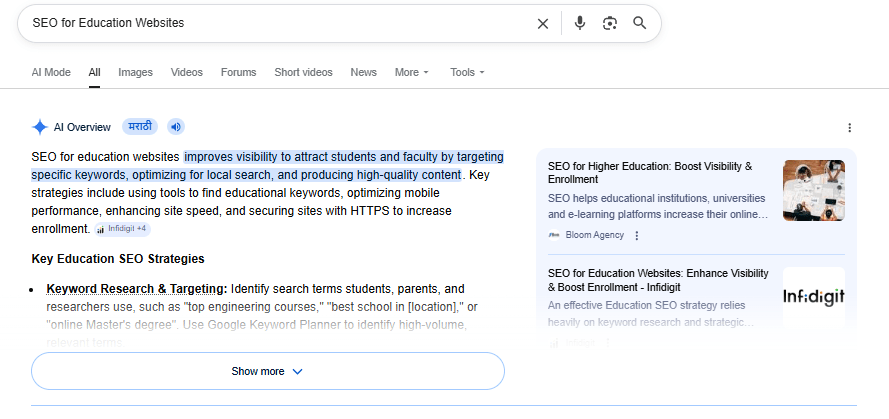
AI search visibility is closely connected with the quality and credibility of information.
Businesses should clearly identify authors where appropriate and provide relevant professional information. Author pages can explain qualifications, experience, industry involvement, and areas of expertise.
Company pages should also clearly communicate who the business is, what it does, where it operates, and what services or products it provides.
Supporting claims with reliable sources, linking to official information, and keeping factual content updated can further improve the credibility of a page.
Use External Sources Carefully
External references can add useful context to an article, especially when discussing statistics, regulations, research, technical standards, or industry developments.
Whenever possible, link to authoritative sources such as government organizations, recognized institutions, original research, official documentation, or established industry bodies.
The purpose should be to support the information presented rather than simply adding links for SEO purposes.
Keep Content Fresh
Information can become outdated quickly, particularly in industries affected by technology, regulations, products, or market changes.
Review important pages regularly. Check statistics, examples, links, screenshots, product details, service information, and references.
Content updates should improve accuracy and usefulness rather than simply changing dates. A meaningful refresh may involve adding new information, removing outdated claims, restructuring sections, and answering emerging questions.
How to Measure AEO Performance
Traditional rankings remain important, but businesses can add AI-related visibility indicators to their reporting.
Useful metrics may include:
- AI-generated brand mentions.
- Citations or references to website pages.
- Visibility across priority conversational queries.
- Brand sentiment in AI-generated responses.
- Organic rankings and traffic.
- Click-through rates and engagement.
- Growth or decline in AI references over time.
AI visibility can vary between platforms and prompts, so businesses should avoid treating a single observation as a definitive performance measurement.
Common AEO Mistakes to Avoid
One common mistake is creating content exclusively for AI systems while ignoring human readers. Content should remain useful, natural, accurate, and easy to understand.
Another mistake is relying on schema as a shortcut. Structured data cannot compensate for weak or inaccurate content.
Businesses should also avoid creating large numbers of generic AI-generated articles without adding original insight. Publishing more pages does not automatically create greater authority.
Keyword stuffing and excessive FAQ sections can also reduce readability. Questions should be included when they genuinely help users understand the subject.
Finally, AEO should not replace SEO. Traditional search continues to be an important source of website discovery, traffic, and conversions. Businesses should build a strategy that supports both conventional search and AI-powered experiences.
How Bloom Agency Can Help With AEO and SEO

Bloom Agency sort of approaches modern search optimization by mixing solid SEO basics with the newer AI-search kind of thinking, y’know. Like, we look at the fundamentals first , then we adjust for what those systems may do next.
Our strategy usually, uh includes content planning, keyword as well as search intent research, technical website review, on-page optimization stuff, internal linking, structured data, content building, entity optimization, local SEO, and then performance tracking or measurement.
For businesses stepping into the AI-search environment, the goal isn’t only to crank out more content. The point is to craft genuinely useful information that communicates expertise in a clear way, actually answers the real questions , and provides search systems with dependable context so they can understand what the site is about.
When SEO and AEO are coordinated together, businesses can strengthen their digital presence, while still keeping the website centered on human users as well as practical business outcomes.
Final Thoughts
AEO is starting to matter a lot more, especially now that search feels more like a chat and often depends on AI stuff. Businesses can get ready pretty fast, but they should make sure their content is clear, kind of structured, accurate , accessible, and actually useful not just, written for the crawler, you know.
Direct answers, logical headings, solid internal linking, and entity consistency all help a ton. Add structured data, use original research where it makes sense, show real author expertise, keep things technically accessible, and don’t forget to refresh content regularly.
Honestly the most practical route is not to pick one and ignore the other, like SEO vs AEO. Instead, brands can reinforce the core of SEO, while also tweaking content and site structure so modern search systems can understand the information the way they do now.
And if a brand keeps investing in genuinely helpful content, technical quality, credibility, and a smoother user experience, AEO can turn into a natural extension of the bigger organic search plan.
Frequently Asked Questions
What is the difference between AEO and traditional SEO?
Traditional SEO is mostly about getting a website noticed and ranked inside search engine results. AEO is more about making content… like, easy for search engines, AI systems, and answer engines to grasp, then actually use when they respond right there to user questions. In practice a solid digital strategy can kinda use both, together, so it’s not really either or, not fully.
How can businesses optimize content for answer engines?
Businesses can optimize content by directly answering the key questions customers ask, in a clear way. Also, use descriptive headings, and sort the info into logical sections so it reads well and doesn’t feel chaotic. Internal linking helps too, plus relevant structured data. And of course, keep everything accurate and updated , because stale info looks bad. More importantly the writing should show real know how and give genuinely helpful guidance, not just chase keywords like a race.
Does AEO replace SEO?
No, AEO does not replace SEO. It rather extends traditional SEO so it fits how people increasingly find information via AI powered search and these direct-answer experiences. If you mix solid technical SEO with useful content, structured information, and straightforward answers, businesses can often get broader search visibility without losing the basics.

Neetu Wadhwa is the Director of Bloom Agency, a Mumbai-based full-service digital marketing and web development company. With a strong focus on performance, innovation, and strategy, she leads the agency in delivering SEO, web design, and growth marketing solutions that drive measurable business outcomes.



Rahul M.
B2B Service Provider