
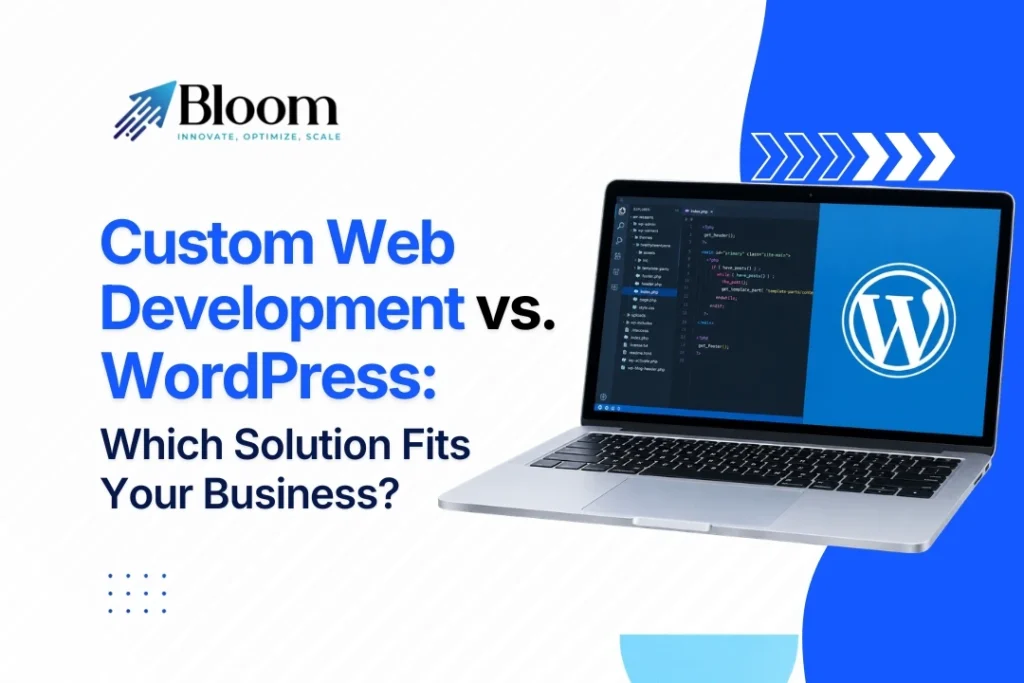
Custom Web Development vs. WordPress: Which Solution Fits Your Business?
Introduction
Selecting a particular platform for one’s business website is a challenging task that directly impacts the business’s visibility, customer experience, performance, and growth. Some companies are particularly content with a basic website that does not require advanced maintenance, while others require a more sophisticated solution that can be customized and extended to fit their unique needs.
Custom web development and WordPress are two popular options that allow businesses to build a website from scratch or choose a customizable platform. The two solutions address similar needs but involve different approaches to website building, maintenance, customization, and growth.
This essay compares custom web development vs. WordPress, discussing their benefits, drawbacks, and implications for business.
What Is Custom Web Development?
As implied by its name, custom web development is the process of building a website from scratch and programming its individual aspects according to the client’s needs. While custom website development includes the utilization of particular themes and plugins, these elements are not the primary focus of the development process. A customized website can be designed to host a wide range of functions and tools. For instance, manufacturers may benefit from having an online portal for tracking their orders, while enterprises in the retail industry may require advanced functions for configuring products before purchasing, among other features.
Key Features of Custom Web Development:
1. Functionality: Developers can program a website to include specific dashboards, portals, and advanced search options.
2. Design: The website’s design and appearance can be tailored to fit the developer’s specifications.
3. Integration: A custom-built website can integrate with other software applications and platforms.
4. Scalability: The website can be designed to support the company’s growth.
5. Control: The company can retain control over the website code and infrastructure.
What Is WordPress?
WordPress is a popular content management system (CMS) that has been utilized for years for building, editing, and maintaining websites.
This website platform is generally customizable to fit the needs of different businesses, including medium-sized enterprises.
Companies can make use of the available themes and plugins or work with developers to build a website from scratch. Therefore, businesses are not limited in terms of design and functionality. These features make WordPress a great platform for small business websites, blogs, portfolios, service pages, and even online stores.
Utilizing WordPress typically involves working with CMS to update the website’s content. In most cases, website administrators and editors update news articles, service offerings, blog posts, and other pages that do not require extensive technical expertise.
Key Features of WordPress:
1. Content management: Website administrators can update the content published on their websites.
2. Themes: WordPress allows website owners to choose a preferred theme.
3. Plugins: An extensive variety of plugins can be added to add new features and functions to the website.
4. Search Engine Optimization (SEO): Companies can optimize their web pages for search engines.
5. Developers: If the available themes and plugins do not satisfy the company’s needs, it can work with developers to create a custom theme or plugin.
Custom Web Development vs. WordPress: Key Differences
Both approaches can deliver professional websites, but the best choice depends on your business requirements.
| Comparison Factor | Custom Web Development | WordPress |
| Development approach | Built around specific requirements | Built using a CMS with themes, plugins, and optional custom code |
| Initial cost | Usually higher | Often lower for standard websites |
| Development time | May require more planning and coding | Often faster to launch |
| Design flexibility | Extensive control over the interface | Flexible, with some limits depending on the theme and implementation |
| Functionality | Can support highly specialized features | Supports many common features through plugins and customizations |
| Content management | Depends on the CMS or admin panel developed | Built-in content management dashboard |
| Scalability | Depends on architecture and implementation | Can scale with suitable hosting, optimization, and development |
| Maintenance | Requires a defined maintenance process | Requires updates to WordPress, themes, plugins, and infrastructure |
| Security | Depends on coding quality and security practices | Depends on configuration, updates, plugins, hosting, and access controls |
| Best suited for | Complex applications and specialized workflows | Business websites, blogs, service websites, and many online stores |
1. Development Cost and Budget
For many companies, the cost dictates everything else. Custom web development usually takes more time and effort as it requires designing, developing, testing, and validating the website. The final price depends on the website’s complexity, hours spent, the expertise of professionals involved, and support options. At the same time, using WordPress as a Content Management System (CMS) might be more affordable for companies that only want several basic pages, a blog, contact form, and some other standard features. One should also remember that premium themes, plugins, custom coding, e-commerce development, and maintenance might add up to a significant sum. It is essential to calculate the total cost of ownership rather than the cost per se as hosting, security, content maintenance, performance optimization, and other expenses should also be taken into consideration.
Overall, WordPress is more cost-effective for smaller businesses with basic requirements. At the same time, custom web development might be more affordable when specialized solutions are critical for one’s business model.
2. Design Flexibility and Branding
A company’s website is its digital face. It should look attractive, communicate the brand message clearly and guide the customer to the desired action. When it comes to design, custom development offers more flexibility as designers and developers can build a unique experience based on one’s customer journey. It is perfect for businesses that want to wow their clients with custom animation, interactive elements, data dashboards, or other unique features. By contrast, WordPress is also quite flexible, though it depends on themes, plugins, coding, and other factors. With a little effort, one can build a sophisticated website using blocks or custom code. It is hard to say which platform is better when it comes to design flexibility as both solutions can offer excellent results. A company should choose the website type based on its needs.
For example, a small local bakery might not need a custom design, but a technology company might want to offer a unique experience to its customers.
3. Website Performance and Speed
Website performance and speed are critical for a good user experience. Browsing speed affects everything from conversion rates to search engine optimization (SEO). A slow website turns customers away as nobody wants to wait for a webpage to load. A custom website can be built in such a way that it performs optimally no matter the traffic, coding complexity, or other factors. It depends on a developer’s experience, but the custom solution should offer better performance than a standard CMS.
At the same time, a WordPress website can also be optimized so that it reaches the best performance for its traffic and coding. There is no doubt that WordPress website performance depends on a hosting provider, code optimization, themes, plugins, image sizes, and other factors.
Overall, both solutions can be quick and efficient if they are properly maintained. A company should analyze Core Web Vitals, performance on mobile devices, server response time, and other factors to define the best option for a particular business.
4. SEO Capabilities
SEO refers to a set of strategies that help a website show up in search engine results for relevant search terms. In other words, SEO helps customers find a business online. When it comes to SEO, both solutions offer many benefits.
A custom website can be built using the best practices, so that its URLs, pages, metadata, internal linking, and other elements are SEO-friendly. However, it requires extra work and knowledge from developers. By contrast, WordPress is easy to optimize as it has many built-in tools and SEO-friendly coding. One can also add external SEO tools to measure one’s positioning, track keywords, monitor backlinks, and do other useful things.
For both solutions, good content, proper keyword research, increased domain authority, enhanced user experience, high-quality backlinks, and continuous improvement play a significant role. For instance, a company that offers web development services in Mumbai should have relevant pages for services, blog articles, and other materials so that it appears in search results for web development companies in Mumbai. It also has to ensure that the website is easy to navigate, has a mobile-friendly design, and offers an overall positive experience.
5. Scalability and Future Growth
As a company grows, its website should also evolve. It is essential to choose a solution that offers scalability and flexibility so that the website continues to meet the business needs and serves the customers well. With customone can build a solution around unique requirements, current and future traffic, specific pages, extended functionality, and other factors.
For instance, a custom solution is better for SaaS, marketplaces, portals, and other platforms. It also depends on the company size, but most custom websites scale better than WordPress websites. By contrast, WordPress is great for smaller businesses with standard requirements. It can also be scaled if one chooses the right components, hosting plan, database, and other settings. It is impossible to say which solution is better for scalability as it depends on the company’s requirements.
The website owner should define the company’s requirements in 2-3 years and then analyze if WordPress or custom web development will allow the website to grow with the business. One should also consider such factors as additional services, a higher number of users, new markets, more features, and improved personalization.
6. Security and Maintenance
Website security is critical for a company website as it protects the data, privacy, and overall safety of the website. Both solutions offer security features that should help prevent unauthorized access, hacking attempts, and other attacks. For custom websites, security is dictated by coding, server setup, access control, permissions, and other factors. One should always update the website and follow the best practices for maintenance and security.
On the other hand, WordPress security depends on regular updates, themes, plugins, user permissions, and other factors. One should also pay attention to the maintenance schedule and update WordPress versions, themes, and plugins. Both solutions are secure, but only if they are updated on time and relevant security measures are taken.
When comparing WordPress vs. custom development, one should analyze the security practices and update schedule. It is also essential to keep track of website backups, vulnerabilities, and other factors that might affect the website’s security.
7. Ease of Content Management
Many businesses update their websites regularly, publish news, blog posts, modify pages, and make other changes. In that case, it is essential to choose an option that is easy to manage. WordPress has a user-friendly interface that allows publishing and modifying content with ease. One can also delegate some tasks to employees so that they update the website independently. By contrast, a custom solution might have a steeper learning curve as it all depends on the development team. If a business wants to update the content on a custom website, it might have to rely on the developer.
A custom content management system can also be built so that it is easier for clients to manage. It is a great option for businesses with extensive content management needs. In that case, the company should invest more effort and money into a custom solution. Overall, WordPress is more beneficial for businesses that actively update their content, whereas custom development is a worthwhile investment for companies with advanced content management requirements.
8. Ecommerce and Third-Party Applications
Many businesses sell physical and digital products online. That is why they need an e-commerce website with shopping cart, inventory management, customer accounts, discounts, payment system, shipping options, and other features. WordPress offers a wide range of plugins that allow building an e-commerce website and managing products, inventory, orders, and other aspects. It can be a viable option for small businesses with average requirements. By contrast, custom web development offers more flexibility and unique features such as special pricing, account management, accounting system, advanced shipping options, and other benefits that are not available in WordPress.
At the same time, one should also evaluate the complexity, maintenance, and security of a custom e-commerce solution. Ultimately, both solutions can work for small businesses, but custom development is worth considering when one needs unique features and a highly specialized e-commerce solution.
9. Time To Launch
A company should also think about the time it takes to launch a website. It depends on the solution’s complexity, the amount of content and design, the number of third-party applications or inventory, and other factors. However, WordPress can be a faster solution as it has many built-in features. The CMS also allows quicker prototyping and website development. For instance, a website built in WordPress is likely to launch faster than a similar custom solution because many elements are already available.
By contrast, building a website from scratch takes more time and effort. That does not mean that custom development is always slow, but it has to go through the discovery phase, development, and validation. All of that requires more time. At the same time, rushing into a website launch can lead to many issues with performance, accessibility, validation, or other problems for both solutions.
10. Long-Term Ownership and Flexibility
A website is an asset, and it is essential to think about its long-term value. The company should have full control over the website code, content, domain, and other elements to ensure there are no restrictions or hidden fees in the future. When it comes to WordPress, one can host it anywhere and manage the content independently. However, it is essential to take licensing agreements, support options, and other factors into consideration.
By contrast, when a company opts for custom web development, it is even more important to discuss the terms and conditions. One should know if the source code is available, if there are any third-party licensing agreements, how documentation looks like, what domain and hosting are used, and other factors. Ultimately, both solutions are a safe long-term investment, but the company should learn about the support options and handover process in advance.
Which Businesses Should Choose WordPress?
- WordPress is appropriate for organizations that do not want to rely solely on a third-party website builder. However, it can be a good choice for:
- businesses that want to create their first website;
- service providers that need to introduce their services, collect their client data, and offer contact details;
- companies that want to maintain blogs, resources, and news sections;
- marketers that need to frequently update landing pages;
- ecommerce organizations that want to use its built-in Woocommerce solution;
- startups that want to test their idea before investing in a full-scale development.
However, WordPress is not the only option as it allows developing more involved solutions with the help of additional themes, plugins, customization, and professional programming. The most critical consideration when choosing between WordPress and custom web development is whether the former will be sufficient to address your specific needs or not.
Which Businesses Should Choose Custom Web Development?
- Custom web development may be a better choice in some particular cases. It is better to consider this option if you need:
- a product that will address several complicated technical or functional requirements;
- a SaaS-based solution with subscriptions;
- an enterprise-level portal with unique permissions policies;
- a marketplace with complex seller and buyer relationships;
- CRM, ERP or other system-specific software;
- a custom booking engine, configurator or other tools;
- high-end performance, compliance, or infrastructure.
However, custom development is not always the best option as it involves significantly higher costs and time investment. Therefore, it is better to choose it only in the cases when WordPress or other CMS will not be sufficient.
How to Choose the Right Website Development Solution
Before choosing a platform, evaluate your website requirements against your business goals.
| Decision Factor | Consider WordPress When | Consider Custom Development When |
| Budget | You want to manage initial costs | You have budget for specialized functionality |
| Website purpose | You need a company website, blog, or standard store | You need a complex application or business platform |
| Content updates | Your team regularly publishes and edits content | Content requires specialized workflows |
| Features | Plugins and existing integrations meet your needs | You need functionality that standard tools cannot support adequately |
| Growth | Your expected growth fits the platform’s capabilities | Your future plans require a specialized architecture |
| Maintenance | You prefer a familiar CMS and established update process | You can support a tailored technical environment |
| Time frame | You want to launch a standard website efficiently | You can invest time in detailed planning and development |
The most suitable choice is the one offering the best balance in terms of functionality, usability, performance, budget, and future requirements.
Before engaging a development partner, prepare a clear list of necessary pages, features, integrations, content management needs, security requirements, and anticipated traffic. This will allow the development team you have hired to identify the most relevant solution instead of suggesting unnecessary features and tools.
Why Work With a Professional Web Development Company?
Selecting the right framework is only one aspect of creating a website worth investing in. The same goes for the quality of planning, design, development, optimization, and ongoing support services.
A professional web development company can analyze your project requirements and advise you on the pros and cons of WordPress versus custom web development. In addition, the company can help you prioritize features, develop your website structure, optimize the website for mobile devices, integrate business tools, and prepare your website for SEO purposes.
When comparing a web development company in Mumbai, remember that the project cost is only one criterion among others. Check the company’s experience with similar projects, communication policy, technical expertise, live examples of websites, ownership, and post-launch support policy.
A competent development partner should discuss the benefits and drawbacks of the options at hand in sufficient detail and explain how their technical and strategic choices can benefit your business objectives and bottom line.
Conclusion
The choice between custom web development and WordPress typically depends on the current requirements and long-term objectives of your business.
WordPress is often the preferred solution for business websites, blogs, service providers, and many ecommerce stores due to its content management features, ease of customization, and relative speed of development. At the same time, WordPress websites have the potential to serve as a solid foundation for more ambitious projects if the requirements are properly prioritized and additional custom development work is considered.
Custom web development tends to be more beneficial in cases when the project requires a specialized approach, extensive third-party integrations, unique user experience design, or a distinct technical foundation. While such an approach usually requires a larger initial investment, it can be the most cost-efficient solution in the long run.
There is no doubt that both options have their strengths and weaknesses. Make sure to analyze the specific requirements of your project, budget, timeline, functionality needs, and maintenance capacity before making a final choice. Turning to a professional development team can help you identify the most suitable solution in terms of financial investment, performance, SEO friendliness, flexibility, and ongoing maintenance.
Frequently Asked Questions (FAQs)
1. Is custom web development better than WordPress?
Custom web development is technically better than WordPress in cases when the project requires a specialized approach, extensive third-party integrations, or a unique user experience design. At the same time, WordPress is more efficient when it comes to standard business websites, blogs, or service directories with relatively standard features.
2. Is WordPress suitable for business websites?
WordPress is a great choice for company websites, service pages, blogs, portfolios, and many ecommerce stores. It offers CMS-like convenience, flexibility, and reliability while still allowing businesses to customize their website in accordance with their specific requirements.
3. Is custom web development more expensive than WordPress?
Custom web development usually requires a larger initial investment due to the higher complexity of most custom projects. At the same time, WordPress-based solutions tend to be more budget-friendly in cases when a small business only wants to use a few additional features.
4. Which option is better for SEO?
Both custom and WordPress-based websites have the potential to rank in the search engine results pages (SERPs) for targeted keywords. However, SEO success depends on many factors, including the technical optimization, quality of content, website performance, mobile-friendliness, backlink profile, and many other considerations.
5. Can a WordPress website handle high traffic?
A WordPress-based project has the potential to handle high levels of traffic with the help of the right hosting provider, caching tools, optimized code, databases, and selective use of plugins. The actual loading speed depends on the technical implementation and server resources.
6. Is custom web development more secure than WordPress?
In most cases, security is not a matter of a CMS being intrinsically more secure than a custom framework or vice versa. Both options require due diligence, including secure coding practices, proper maintenance, comprehensive security audits, reliable hosting, and many other considerations.
7. Can I switch from WordPress to custom web development later?
Many businesses successfully migrate their content, features, plugins, and other elements from a WordPress-based website to a custom website. Such an approach allows companies to gradually replace WordPress-specific functions with their custom alternatives. Migrating from WordPress to a custom framework can be expensive and time-consuming in some cases, depending on the amount of data and the technical complexity of the project.
8. Which option is faster to develop?
WordPress is easier to develop because most of the CMS-specific elements have already been created by the development team. A custom approach requires more coding and therefore takes more time to build a website from scratch.
9. Can WordPress support ecommerce websites?
WordPress can support most ecommerce websites with the right combination of plugins, themes, and custom development. It is a great option for small online stores selling non-complex products, as well as more feature-rich websites selling unique items with complex product configurations.
10. How do I choose a web development company in Mumbai?
Choose a web development company in Mumbai that has relevant experience, technical expertise, and a competent team of developers and designers. Understand the company’s policies regarding project ownership, maintenance, and support after the launch of your project. Ask the company to describe the benefits and drawbacks of WordPress versus custom web development and how the selected solution will help you achieve your specific objectives.

Neetu Wadhwa is the Director of Bloom Agency, a Mumbai-based full-service digital marketing and web development company. With a strong focus on performance, innovation, and strategy, she leads the agency in delivering SEO, web design, and growth marketing solutions that drive measurable business outcomes.



Rahul M.
B2B Service Provider