
A hallmark of search engine optimization has always been its favoring of the patient. Where an ad will act as a light switch and turn on and off with ease, giving immediate presence upon demand, search engine optimization more closely relates to planting a tree. You feed it before you have ever enjoyed its shade. You have written an article weeks before it reached its peak search position. You resolve an error today with hopes for next month.
It usually leads people to wonder if their SEO is working. That’s why SEO ROI knowledge becomes imperative. It shifts focus from pointless measurements and helps you make decisions based on data that mirrors business growth. When viewed from an appropriate perspective, it illustrative ROI shows your strategy and money leaks as well as areas within your SEO strategy that should be given more gas.
A primer on computing SEO ROI, what constitutes cost and revenue, and why, even with its burn rate, SEO will frequently beat short-term acquisition methods.
SEO ROI: Uncovering Its True Meaning

SEO ROI calculates a search engine optimization return on investment based on income generated compared with expenses. At a very basic level, what it all boils down to is: Is your investment worth it compared with how much you bring in as a result?
Reports on traffic, impressions, and rankings can be useful indicators, but no single source would ever be enough on which to base your overall marketing budget. ROI should be directly tied to actions and actual outcomes. As long as your organic search plan can generate income, then so be it. Otherwise, there’s room for adjustment.
The formula itself is simple:
ROI SEO = [(La revenu des recherches organiques – Coût total SEO] / Coût total SEO]× 100
A positive result shows that your SEO ROI efforts are making money. A negative result shows you are spending more than your earnings. A value close to zero shows you are breaking even.
However, while the numbers are easy math, getting an accurate count requires nuanced cost consideration and a method for tracking organic revenue.
Step 1: Calculate the True Cost of Your SEO
Since there’s no clear single line item that represents SEO spendin, a large number of businesses underestimate what they’re really spending on SEO because they are strictly looking at outside dollars, agency costs, copywriters, and so on. But SEO encompasses tools, people, and effort. To get an ROI there, you have to factor it all.
Cost classifications typically include:
1. Labor: You can assign a value based on your internal rate as well because if you or someone from your team is spending efforts on writing blogs, optimizing product pages, metadata reviews, and working on site problems, there’s value associated with it.
2. Content Creation: Quality content doesn’t magically appear. A cost may be associated with creating blog articles, product descriptions, landing pages, comprehensive guides, illustrations, or even content briefs.
3. Technical advancements: Whether it is being done internally or externally, it will cost resources to achieve things such as speeding up your site, making it mobile-friendly, and correcting crawl errors.
4. SEO tools and software: The cost of subscription services for keyword tools, tracking dashboards, site crawlers, and reporting tools will add up.
5. Link Building Tactics: Guest posting, outreach, PR, and link acquisition campaigns may be expensive based on scale and approach. For instance, if your business is an online boutique, you could be spending your money on:
- Rs. 30,000 per month on a Content Writer
- ₹15,000 for SEO tools
- 20 hours of personal time at ₹1,000 per hour
- ₹25,000 on technical updates
Your overall monthly investment isn’t ₹30,000. It’s ₹30,000 + ₹15,000 + ₹20,000 + ₹25,000
Effective SEO ROI calculation requires an understanding and recognition of all parties contributing to SEO success.
Step 2: Calculate Your Revenue From SEO
Once you have an understanding of your total cost, your next task would be to determine how much money your revenue contributes from organic search. Fortunately, it is not as difficult as it once was.
The best tracking method would be tracing back purchases, leads, or conversions. So if someone searches on Google and purchases from you, Google will record that sale under “organic search.”
Google Analytics 4 (GA4), or tools like it, make it easier to track which source your purchases and leads are coming from. But if you want more behavioral data, for instance, data on how many people viewing your site organically add items to cart, sign up for a newsletter, or complete a form, Google Tag Manager (GTM) will allow you to track micro-conversions.
The reason it matters is that not all SEO victories start with a sale. Sometimes, the first signs are very subtle: “This might be an indication that there’s” a visitor views three pages of your blog.
- A user clicks on “Add to Cart” but does not proceed with checkout.
- A person subscribes to your list, and then they convert after being nurtured.
By monitoring these efforts, you will be better aware of the role that organic search plays within future revenue, as opposed to sales. It presents a clearer picture regarding what SEO efforts are working on.
Once your GA4 or analytics platform is set up, you will be able to see:
- Total Sales via Organic Search
- AOV (Average Order Value)
- Conversion rate (This indicates how many users complete a desired action.)
- Organic Lifetime Value
- Organic Med LTV
Behavioral traits indicating potential for income generation. You now have the two numbers that you need: Total Cost and Total Revenue.
Step 3: Apply SEO ROI Formula
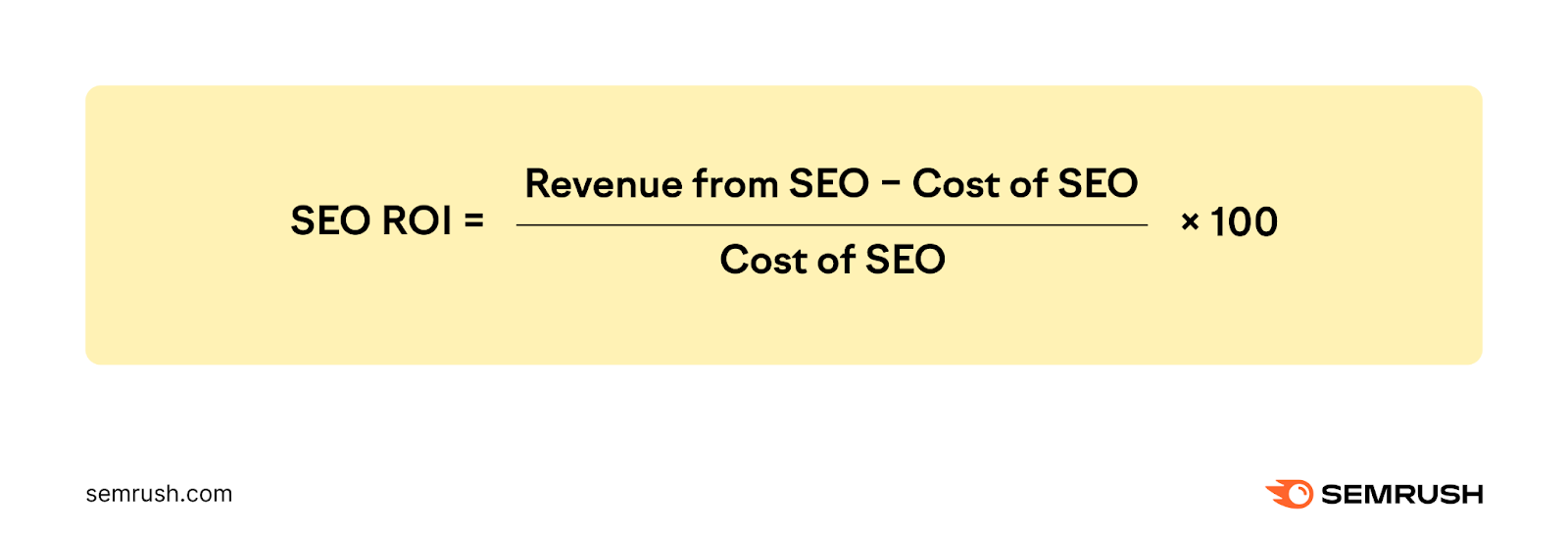
SEO ROI Formula includes several factors
When cost and revenue values are known, they can be substituted into the equation:
SEO ROI = ((Organic Revenue – SEO Cost) / SEO Cost) 100
Suppose that your expenditure on SEO for last month is ₹90,000. With organic search traffic, your store generated sales worth ₹3,60,000.
Your ROI will be:
[(3×60,000 – 90,000) /
= (2,70,000/90,000)
= 300% ROI
Which meant your SEO ROI brought back ₹3 for every single ₹1 you spent.
A high ROI doesn’t have to be visible in the first month. It’s the compounding nature of SEO that is so attractive. As opposed to an ad campaign, which will end as soon as you stop paying for it, the traffic will just keep flowing.
Why SEO ROI Improves with Time
There can’t be one of the most powerful benefits of SEO is its compounding momentum. A well-optimized article can rank for several years. A good category page can continue to attract buyers without spending money on ads. The more your site authority increases, the quicker new pages rank and old pages rank higher..
A consequence of this compounding impact is that SEO, given several years, usually ends up outperforming paid media dramatically.
Paid Advertising:
- Paid ads spike → decline immediately when paused.
- SEO keeps on growing → reaching levels → again growing with every optimization.
Those brands that focus on SEO will develop a cost per acquisition that decreases with the passing of time and a revenue per visitor that increases.
To get an idea of how long it will take before you can break even on your expenditure, you can calculate your payback period. Your payback period will indicate when your SEO efforts will be giving you more value than they cost.
Forecasting Future SEO ROI

A forecast isn’t an exact science, but a good approximation can be made with traffic potential, conversion rate, and average order value.
For instance:
“If optimizing for a keyword cluster could attract 10,000 monthly visitors, and you know that:
-
It costs $1.00 to deliver
2% will convert into paying customers.
Buyers pay Rs.2,000 per order
Therefore, the potential revenue per month = 10,000 x 0.02 x 2,000 = ₹4,00,000
Assuming that the cost to target that cluster is ₹1,00,000, it becomes easier for SEO ROI prediction.
Forecasts enable justification of spending and listing the most valuable keywords.
How Often Should You Measure SEO ROI?
A quarter would normally offer the best big picture. SEO moves very slowly and may be affected by changes in algorithms, seasonal patterns, and competition. Monthly reports are good for identifying trends but will be misleading if used as a benchmark for tracking progress.
You can evaluate:
- Quarterly reviews allow you to understand long-term SEO performance rather than getting distracted by short-term fluctuations.
- Organic revenue growth represents the amount of revenue that is garnered from organic search. It will become more and more evident as your SEO strategy builds on itself.
- You can use seasonal cycles to grasp fluctuation patterns based on times of the year.
- N-gram performance shows how sets of related keywords are working as a group.
- Keywords with Stopwords, Stopwords are insignificant words within a keyword that typically do not impact ranking.
- Impact on conversions – Content focuses on the role your pages have in influencing actions like sign-ups, purchases, and inquiries. It allows your team to focus on your road ahead instead of your present surroundings because it focuses on strategy and not noise.
Conclusion
Therefore, SEO ROI isn’t just a figure that will wow your stakeholders—it’s more like a compass. It will assist you in identifying if your efforts are converting into business value, if your content strategy deserves scaling, and even if your time can be better invested. When done properly, SEO ROI will show that search engine optimization and organic search engine traffic continues to be among the most powerful and cost-effective acquisition methods.
As an aspiring entrepreneur or a brand expanding your presence, knowledge about ROI will turn SEO from an educated guess into an engine driving predictable revenue. The next logical step after understanding ROI measurement would be learning about ways and means to optimize it, which would entail optimizing content, optimizing technical factors, and then looking at high-value keyword clusters.







Rahul M.
B2B Service Provider