
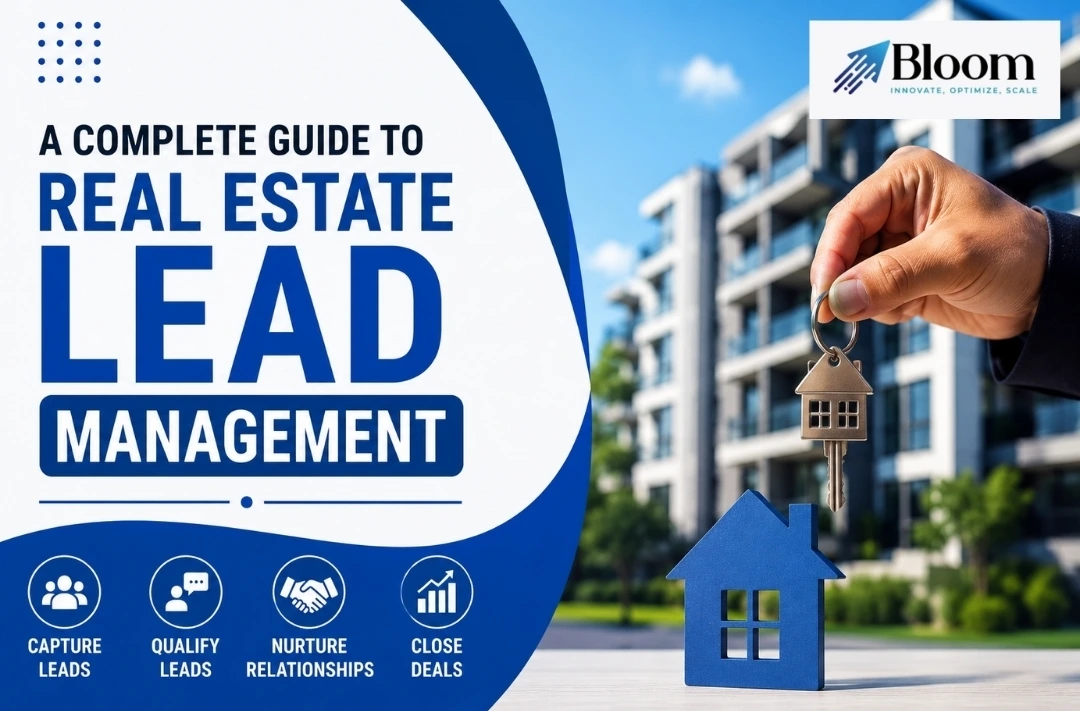
Real estate industry has changed a lot over the last few years, like dramatically. Buyers and sellers no longer just rely on newspaper listings, cold calls , or even walk in visits to find properties. These days, almost every real estate journey starts online. Prospective buyers search for properties on Google, browse listings on portals, explore neighborhoods on social media, and compare a few choices before they even contact an agent.
Because of that, real estate businesses now generate and manage leads in a totally different way. Having listings is fine, but it is not enough. Agencies basically need a more structured lead management system, one that helps them attract inquiries, sort conversations, nurture prospects, and then convert them into real paying clients.
At Bloom Agency, we help real estate businesses build scalable strategies for lead generation and lead management that boost conversions, add credibility to the brand, and support long term growth. In this guide, we explain how real estate lead generation services works, why many agencies end up losing leads, and how to set up a system that keeps producing better results, over and over again.
What is real estate lead management?
Real estate lead management is the process of capturing, organizing, tracking, and nurturing potential buyers, sellers, renters, or investors during the whole decision phase.
A lead is anyone who shows interest in a property or in your real estate services. This could be someone filling out a contact form, clicking on an advertisement, requesting a brochure, downloading a property guide, or just messaging your agency on social media.
Lead management starts the second a prospect enters your system, and honestly every interaction matters. How fast you respond, the quality of your communication, whether your recommendations match what they actually want, and how consistent you are with follow ups… all of that decides whether the lead becomes a client or disappears.
Without a proper system, inquiries get scattered everywhere—spreadsheets, emails, WhatsApp chats, missed calls, and so on. Over time opportunities just fade away because nobody followed up in the right moment , or because the prospect loses confidence in the agency.
A strong lead management process makes sure no inquiry gets ignored, and every potential customer receives the right message, at the right time.
Why Most real estate businesses lose leads
Honestly, one of the biggest headaches in real estate marketing is that delayed response time, and yeah buyers basically expect to hear back… like now. When someone sends an inquiry online, theyre usually talking to a few agencies at the same time. So the business that replies first, kind of wins the whole conversation, and conversion gets way more likely.
A lot of agencies lose leads because they stay stuck on manual operations. Agents end up slammed with site visits, back-and-forth negotiations, and meetings, so online inquiries start piling up, unanswered in the background. Even a few hours of lag , can quietly kill the conversion chance, like it was never there.
Another thing that shows up often is generic outreach. Sending the exact same message to every prospect feels unhelpful. A first-time homebuyer hunting for affordable apartments needs a different tone, and different details than someone looking at luxury properties as an investment. Same script, different people , not really the move.
Then there is lead qualification, and if that part is weak, conversions drop fast. Not every inquiry means the person is ready to buy today. Some are just exploring, some are comparing options , while others already plan to decide within days. If you dont get buyer intent right, you can end up wasting effort on low priority leads while the higher-value ones slip away.
And yes, follow-up consistency matters a lot. Most real estate lead generation services buyers dont decide instantly. Usually it takes weeks, or even months, of thinking. Agencies that go quiet after one or two chats, often lose to competitors who keep the relationship alive and consistent.
Understanding the real estate lead management process
A solid lead management plan should feel structured, because each step nudges the prospect closer to conversion. It is not just “collect leads and hope”.
Lead capture
The start is getting lead details through different routes. This could be search engines, social media campaigns, landing pages, property portals, referrals, and email campaigns.
At this point, the goal is clean and accurate info like name, phone number, email address, preferred location, budget range, and property type.
When lead capture is smooth, conversion rates usually rise. Complicated forms often scare people off. Simplicity, plus clarity, keeps them moving.
Lead qualification
After leads enter the system, they need screening. This helps the agency figure out if the person is serious, what their budget looks like, and when they want to decide.
Qualification also helps teams focus on higher-intent prospects, instead of treating every inquiry like its equally ready.
Key qualification points usually include:
- Budget range
- Preferred location
- Timeline for purchase
- Investment or residential purpose
- Financing readiness
- Property preferences
When qualification is done right, teams stay productive, because they spend time where conversion is most likely.
Lead nurturing
Not every lead becomes a “yes” immediately. Many prospects need ongoing communication before they make a final call. Lead nurturing is basically staying in touch using personalized emails, WhatsApp messages, property alerts, educational content, and market updates.
This keeps the agency on top-of-mind during the buyer journey, and it slowly builds trust.
Common nurturing strategies include:
- Sharing matching property recommendations
- Sending market updates
- Providing financing guidance
- Giving neighborhood insights
- Following up after site visits
- Answering questions quickly
When nurturing is consistent, long-term conversion tends to improve.
Lead conversion

Conversion shows up when the prospect takes a meaningful action: booking a visit, signing paperwork, or scheduling a final consultation. At this stage, communication should be much more tailored. Buyers want clarity, fast replies, and real guidance.
Strong conversion workflows often include:
- Quick scheduling for property visits
- Clear help with documentation
- Negotiation support
- Professional property presentations
- Responsive communication
If you make the buying flow easier, your conversion rate usually rises.
Post-sale relationship management
Lead management should not stop after the transaction. Happy clients can become a long-term source for referrals. Staying connected after closing also helps generate repeat business. Post-sale engagement can include anniversary messages, market updates, investment recommendations, and referral incentives. Long-term relationships also help strengthen brand reputation, and that can reduce customer acquisition costs later.
How SEO helps generate real estate leads
Search engine optimization is a major piece of modern real estate marketing. Buyers search online every day for properties, agents, and local area information. When your site appears in the right search results, you bring in more targeted traffic—people who already want to buy or sell, so the leads are more relevant. At Bloom Agency, we focus on SEO tactics that support lasting visibility, plus lead generation that keeps working over time.
Local SEO builds visibility
Local SEO helps your business show up in searches tied to specific places, like:
- Luxury apartments near me
- Commercial office space for sale
- Best real estate agency in downtown
- 2BHK apartments for sale
When you optimize for local intent, you reach buyers actively looking in specific neighborhoods or cities.
Content marketing improves trust
Educational content can attract prospects, while also building authority.
Helpful content ideas include:
- Neighborhood guides
- Market trend reports
- Property investment insights
- Home buying tips
- Mortgage advice
- Commercial real estate trends
High-quality content supports better search ranking, while also building confidence with prospects.
Technical SEO improves user experience
Technical SEO affects both rankings and engagement. Things like site speed, mobile optimization, and overall technical structure matter a lot. CRM Software is important for any company.
In a growing real estate company, dealing with leads manually is becoming tougher. Agencies receive requests from a variety of sources such as websites, property portals, paid advertising, social media, referrals and direct calls. A good system is in place or helpful leads will be lost or not followed up on.
Current CRM system also boosts teamwork in sales. Agents will have access to leads in real time, be able to update interactions in real time, and ensure continuity across the customer lifecycle. This makes it easier for prospective buyers and sellers.
CRM systems are even more valuable for the real estate industry with features like integration with WhatsApp, automated reminders, email workflows, reporting dashboards, and mobile access. Agencies can streamline their processes and avoid the use of spreadsheets or disjointed notes by developing a process they can scale with their business.
How automation improves lead management.How automation helps you in lead management. Automation plays a tremendous role in today’s lead management strategies. Today’s buyers are looking for quick response times and regular communication. Failure to respond in a timely fashion means that you may miss out on the opportunity because prospects move on to other agencies.
Businesses can quickly follow up on new leads and stay connected with customers throughout their purchasing process with automated workflows. Instant confirmations, follow up reminders, personalized email sequences and automated lead assignments, all contribute to streamlining agency operations and upholding high communication standards.
Automation also eliminates repetitive manual activities for sales teams. Agents can spend more time on building relationships and closing deals since they no longer have to spend hours follow up or send repetitive messages. This helps companies manage more leads at a higher volume without compromising on quality, while also boosting productivity.
Personalization is important even when there is automation. It is not about replacing but rather enhancing human interaction. Automated systems should engage in communication, but do not sacrifice building a true connection with a prospect.
When real estate companies integrate automation with a personalized customer experience, they tend to see higher conversion rates and customer satisfaction.
The Importance of Data and Analytics

Data analysis plays a crucial role in successful lead management. Without tracking and reporting, agencies have no way to know which marketing is working, and which is not.
Data gives agencies the information they need to make decisions, not assumptions. The data derived from tracking the behavior of leads, response rates, campaign conversion rates, and performance can help businesses optimize their marketing and sales strategies.
The metrics that are valuable to know about overall business performance are lead response time, cost per lead, conversion rates, site visit bookings and customer acquisition costs. Agencies that pay attention to these metrics constantly will have a better advantage to enhance their efficiency and get maximum return on investment.
Another benefit of analytics is that they enable agencies to better comprehend customer preferences. Understanding how users behave and engage with a website can help businesses tailor their marketing strategies and messaging.Analyzing user behavior and engagement patterns can help businesses make informed decisions about their marketing strategies and messages.
Today’s competitive real estate landscape is a big advantage to making decisions based on data. Companies that embrace analytics to boost performance tend to outperform those that are just engaging with “old school.Organizations that look to analytics to make better decisions tend to outperform those that do so intuitively or with outdated methods.
How Real Estate Agencies Can Improve Conversion Rates
Lead generation isn’t necessarily the most important step in real estate lead generation. It’s also crucial to turn those leads into paying customers. There are many agencies that pay only attention to growing leads without worrying about conversion optimization.
Better conversion rates can yield better results over time, than just more inquiries. Quick response times, tailored messages and more effective follow-up systems are crucial for increasing conversions.
Buyers can anticipate proactivity and pertinent assistance throughout the entire process of making a purchase decision. Agencies that grasp client needs and offer insightful information create greater trust and credibility.
Another important factor for landing page optimization is conversion rate. If advertising campaigns are effective, but the landing page is poorly designed, it can still have a negative impact on the number of inquiries received. The inclusion of clear calls to action, user-friendly forms, mobile responsiveness, and engaging content enhances user interaction and encourages action.
Today, social proof has added a new dimension to influencing buyers’ choices. Client success stories, project showcases, and positive testimonials build trust and confidence in clients.
Follow up is also essential. Generally, many buyers need more than one touchpoint in order to make a buying decision. Agencies who keep a steady touch with their clients without getting too aggressive are able to establish better relationships and have more success at converting.
Creating a Real Estate Lead System for the Long-Term.
For real estate to grow sustainably, it is essential to create systems for generating leads, not relying on quick get-rich schemes. The most effective agencies use a variety of marketing channels to develop a multi-channel and stable lead pipeline.
SEO is a strategy that brings in the long-term organic leads from buyers that are actively looking for property online. Paid ads offer more immediate leads and higher visibility. Social media is essential for creating engagement and brand awareness. Email marketing continues to help cultivation of existing prospects, and referrals keep building the high quality leads with trust.
Bigger visibility can be gained through property portals and content marketing. Diversifying leads helps agencies minimize their reliance on one platform or marketing tactic.
One of the most crucial elements to long term growth is consistency. Over time, real estate companies that consistently enhance their marketing efforts, improve the way they communicate with customers, improve brand awareness and build their sales processes will get more powerful and more sustainable businesses.
Final Thoughts
In the age of technology, real estate lead management has evolved into a much more sophisticated process. When customers are buying, they want to communicate with the seller faster than they can, want their interactions to be personalized, and want the seller to be more knowledgeable about the product or service. If you are still using legacy systems, it can be difficult for your agency to keep up with the competition in today’s market.
To be successful today, must have technology, strategy and relationships to develop lead generation and management systems. By prioritizing effective communication, automation, CRM systems, and data-driven marketing, businesses set themselves up for sustainable success.
Bloom Agency’s team of experts specializes in creating scalable digital marketing and lead management solutions tailored for real estate companies, fostering sustainable growth. Whether it’s optimizing your website for search engines, running targeted ads, optimizing your CRM system, improving your conversion rate, or engaging in social media marketing, having the right strategy can completely revolutionize the way agencies attract and convert leads.
In the future, the real estate marketing landscape will be dominated by companies that are quick, effective and have a good relationship with the audience.

Neetu Wadhwa is the Director of Bloom Agency, a Mumbai-based full-service digital marketing and web development company. With a strong focus on performance, innovation, and strategy, she leads the agency in delivering SEO, web design, and growth marketing solutions that drive measurable business outcomes.



Rahul M.
B2B Service Provider