
In today’s hyper connected digital marketplace, a website is way more than some simple online business card, it’s often like the first real touch point that a prospective client customer or partner gets with your brand. And in that tiny window of time , visitors usually decide pretty fast about how professional you look, how trustworthy you seem, and whether you feel like an authority. There’s also a stat often referenced from Stanford University that says basically three quarters of consumers decide a company’s credibility based straight on the website design and performance. So whether you’re an emerging startup trying to plant your flag, a growing small-to-medium business widening your presence, or a bigger enterprise modernizing things across your digital setup, your site becomes the anchor of your growth plan.
But here’s the thing, making an exceptional digital marketing is not just about picking bold brand colors, writing sharper headlines, or dropping in those obvious call-to-action buttons. Under the shiny visual side of things, there’s a key technical choice that really drives how your online presence behaves when it matters: do you go with a static website, or do you go with a dynamic website?
This choice isn’t only a back end concern SEO tends that lives in some developer’s world, it’s a strategic move that impacts your page loading speed, your user experience, your data security posture, how much maintenance you’ll deal with, how visible you’ll be in search engines, how easily you can scale, and what kind of return on investment you’ll actually see over time. And since the world already has nearly two billion active websites out there, it’s hard to win unless you’re deliberate about the architecture under the hood.
In this guide, Bloom Agency breaks down what you really need to know about static and dynamic web architectures. Once you understand how they work internally, plus what they do well, what they struggle with, and how they show up in real life examples, you’ll be able to align your technical decisions with your actual business goals, your budget, and what your audience expects.
The Technical Lifecycle of a Web Request
To really get the difference between static and dynamic web structures, it helps to picture what’s happening behind the curtains when someone lands on your web address. At a basic level, a website is an organized collection of digital assets, things like markup documents, stylesheets, scripts, images, and video files. Those are stored on an internet-connected server, then they get rendered by a client-side browser—think Google Chrome, Apple Safari, Mozilla Firefox, or Microsoft Edge.
It starts when someone types your web address into their browser bar, or they click a link from a search result. The browser quickly asks the Domain Name System, which is sort of the internet’s address book. It turns your human readable domain name into an IP address, that numeric identifier that points to the server where your web files live. After that, the user’s browser sends a request to the host server, asking for the page files and assets it needs.
From there, what happens next depends on the kind of setup you chose. In a static environment, solar marketing the server just finds the pre-built, ready to serve files for that request and sends them straight back to the user’s device. The browser then receives those raw assets and renders the full page layout on screen pretty much immediately, like it’s almost instant.
In a kind of fast moving setup, the server kinda has to do a lot of heavy lifting before it even thinks about sending anything back. Instead of holding fully assembled web pages sitting there ready, the server keeps separate layout parts, shared global templates and then one central database loaded up with the actual material. When your browser asks for a page, the server runs server-side scripts, looks up the needed information in the database, stitches the pieces together into a brand new markup document in real time, then and only then pushes the final page back to your browser. Sure, both approaches can feel quick in milliseconds when everything is perfect,but the added compute work on the dynamic side leads to different performance patterns and operational vibes.
Exploring Static Web Architecture: Simplicity, Speed, and Stability

A static website is basically a set of fixed, pre-compiled web pages made with the core building tools of the web, like plain HTML for structure, CSS for presentation, and a bit of client-side JavaScript when you need small interactions. Every person who opens a static URL gets the exact same file content, straight from the host server, with no real-time background logic and no database lookups happening mid-flight. Those files sit on the server already “finished,” so the content basically stays the same until someone edits the source code and re-uploads the updated files.
The Power of Instantaneous Load Times
One big reason static web setups win is sheer speed, without ceremony. Since the server is not running application logic, not interpreting complex decision rules, and not waiting for database results, it can start sending bytes to your device almost as soon as the request shows up.
In today’s digital world, page speed often maps to earnings. People’s patience is really low , and a lot of industry research suggests more than half of mobile users simply leave if a page takes over about three seconds. Also, search engines tend to reward fast sites in their ranking systems. When you remove server-side rendering delays, static pages can transition almost instantly, which keeps visitors happier and can improve your organic visibility.
Ironclad Security with Minimal Attack Surface
Security is always a concern for businesses online. If a platform uses active databases plus more complicated server software, bad actors often look for openings—things like injection weaknesses, cross-site scripting issues, or attempts at breaking in.
Static websites lower those risks a lot because they remove the backend database and the whole server application processing pipeline. With no interactive tables to query and no server scripts sitting there waiting to be tampered with, there’s basically little attack surface for criminals to aim at. For companies that mainly need straightforward publishing or ecoomerce SEO, static hosting can feel like a calmer, more stable arrangement, with less worry about breaches or exploit chains.
Cost-Effective Hosting and Maintenance Simplicity
From an operations angle, static websites are usually cheaper and easier to keep running. Dynamic sites need stronger server setups, database engines, backend libraries, and enough capacity to survive traffic spikes without falling over. All of that usually means higher ongoing hosting costs and constant management time.
Static files, on the other hand, need very little computing power and memory to deliver. They can live on simple hosting plans or get distributed through global Content Delivery Networks. Platforms such as Netlify, Vercel, or GitHub Pages cache static assets at many edge locations, which keeps your files geographically closer to users. So whether it’s ten visitors or ten thousand, the infrastructure is already set up to absorb the load, without turning your bill into a small disaster.
The Operational Drawbacks of Static Frameworks
Even though static architecture is great for speed, security, and cost control, it brings real limits for teams that keep growing. The most obvious pain point is content management. Since each page is its own separate code file, even tiny changes—like editing a paragraph, posting a quick update for company news, or tweaking office hours—often require direct source changes. Unless you have developers on hand, or at least someone comfortable with deployments, non-technical staff usually can’t update content on their own.
Also, static sites can feel awkward when you have a lot of content. If your business site has hundreds of pages and you want to update a menu item or footer link, you may need to modify lots of individual HTML documents, unless you adopt specialized build pipelines typical of static site generators.
Finally, static architecture does not easily support deeper personalization, real-time accounts, interactive search filters, or native payment flows out of the box. To get that kind of functionality, you usually lean on third-party integrations and external services, sometimes heavily, to fill in what static hosting can’t do by itself.
Static vs Dynamic : At a Glance— Feature vs Feature
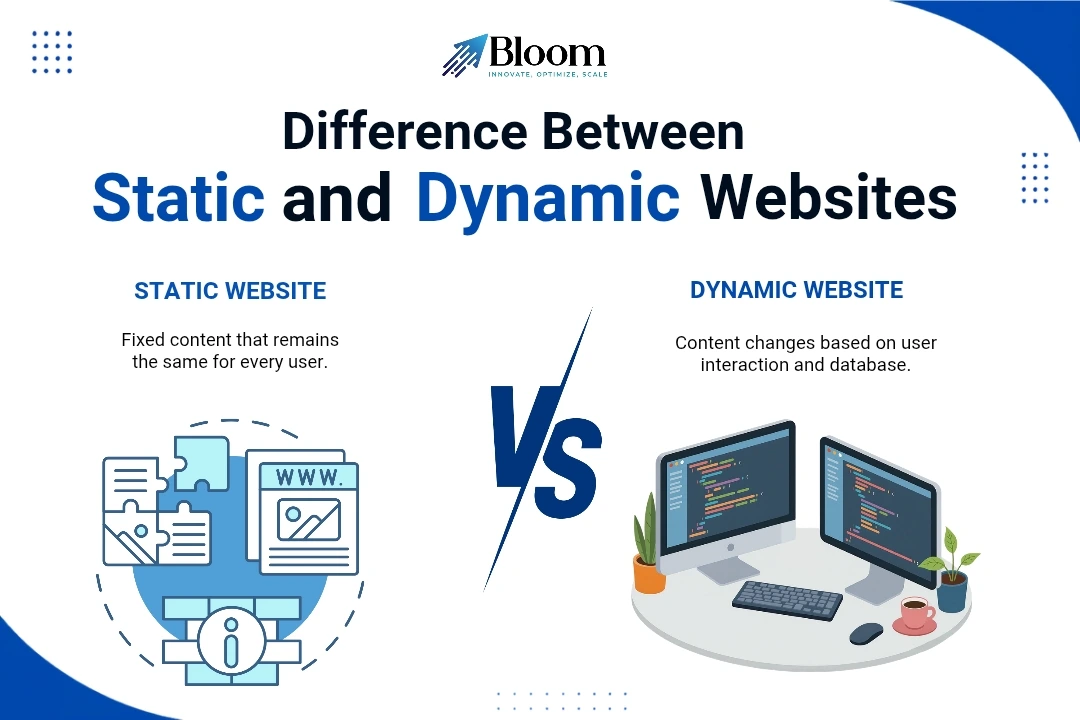
- Static Website: content is kinda fixed, the same for everyone unless you go in and manually update it, usually through code.
- Dynamic Website: content changes on the fly, like real time, it’s influenced by databases, user behavior, location and all that.
What is a Static Website?
A static website is made from web pages with fixed content, built with standard code like HTML, CSS, and a bit of simple JavaScript. The pages are already prepared, then sent directly from the host server to the user’s browser, without needing to query a database or run heavy backend scripts each time.
Pros
- Cost Effective Development: lower cost at the beginning since there’s no complex backend database architecture.
- Faster Load Speed: usually loads quickly because the content is basically delivered as files. This matters, because Google research highlights that 53% of mobile users bounce if a page takes longer than 3 seconds to load.
- Enhanced Security: with no active databases or server-side scripting, the attack surface is smaller against common threats like SQL injection.
- Low Cost Hosting: you can host it on lightweight platforms or CDNs, with minimal server overhead.
Cons
- Manual Updates: to edit content, add pages, or swap messaging, you often need to touch the source code.
- Limited Scalability: once you have many pages, managing all those updates manually becomes kind of a mess.
- Low Interactivity: things like logins, shopping carts, or comment systems are harder to implement directly.
What is a Dynamic Website?
A dynamic website builds pages during request time, using backend technologies such as PHP, Node.js, ASP.NET, or Python, and it’s connected to a central database. So what a person sees can shift based on interaction, device type, geographic area, or account status.
Pros
- Highly Interactive and Personalized: delivers custom experiences, tailored recommendations, user profiles, and live-ish feeds.
- Simplified Content Management: many setups connect to a CMS like WordPress, Drupal, or Webflow, so non-technical teams can publish and update posts or products with less friction.
- Built to Scale: when you add thousands of product pages or articles, you don’t usually rewrite pages one by one, templates pull the data automatically.
- Advanced SEO Capabilities: easier to keep content fresh, update metadata automatically, and add schema markup so search engines stay interested.
Cons
- Higher Development Costs: you’re paying for database design, backend programming, and custom logic up front.
- Maintenance and Security Needs: active databases and plugins need ongoing patching, software updates, and server monitoring to avoid vulnerabilities.
- Requires Optimization for Speed: server-side database processing may slow things down unless you add caching, CDNs, and performance tuning.
Which One Should You Choose?
Picking the right approach usually comes down to four core items:
- Budget: if you’re a small business and you want a low-cost, low maintenance online presence, a static site gives strong value.
- Functionality: if you need carts, user accounts, search filters, or interactive forms, you’ll want a dynamic site.
- Update Frequency: if you’re posting weekly, launching new collections, or adjusting offerings often, then a dynamic site plus a CMS is a better fit.
- Growth Strategy: if you expect fast growth in products or users over the next 12 to 24 months, starting with something scalable helps you avoid a full rebuild later.
Build Your Dream Site with Bloom Agency
At Bloom Agency, we design custom web platforms matched to your business goals. Whether you’re aiming for a blazing-fast static brochure site, or you need a feature-rich dynamic platform that can scale, our team builds secure, search-optimized, and user-friendly digital experiences that actually fit how you work.

Neetu Wadhwa is the Director of Bloom Agency, a Mumbai-based full-service digital marketing and web development company. With a strong focus on performance, innovation, and strategy, she leads the agency in delivering SEO, web design, and growth marketing solutions that drive measurable business outcomes.



Rahul M.
B2B Service Provider