
Sometimes, it is the little things that amount to a mountain of difference in the virtual space. One of those little things is the URL itself. Of course, businesses would understandably be hung up on content, design, and broader digital marketing campaigns, but how a brand presents its links can silently affect perception, memory, and even trust. This quiet influence becomes even more relevant when there is tough competition for visibility on the SERP, where clarity and credibility matter upon first glance. This is where the vanity URLs come into effect. What seems simple on the surface often carries much more strategic weight underneath.
This article is a detailed guide to understanding the concept of vanity URLs, examples of how they are used, and the best practices for using them.
What Is a Vanity URL?
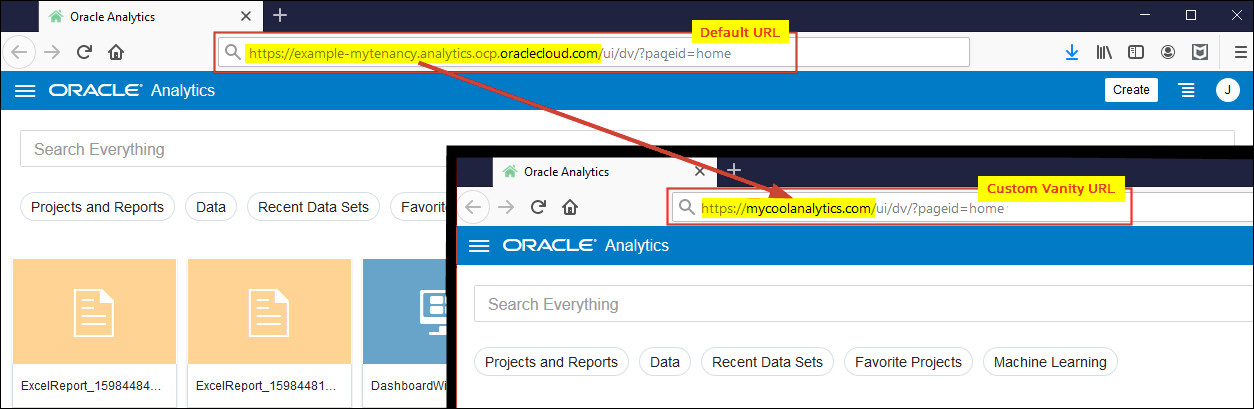
A vanity URL is a short, customized, and branded web address that is designed to be easy to read, remember, and share. Unlike long, technical URLs filled with random characters, parameters, or tracking codes, vanity URLs are intentionally created for humans rather than machines.
For example:
A standard URL might look like:
https://www.example.com/products/category?id=4587&utm_source=campaign
A vanity URL version could be:
https://example.com/summer-sale
Both links might go to the same place, but the latter is, in an instant, much clearer, much more memorable, and more trustworthy.
Vanity URLs are widely used in marketing campaigns, offline promotions, social media, and branded communications where clarity and recall matter more than technical detail.
Why Vanity URLs Matter in Digital Marketing
Vanity URLS are important because they are the intersection of branding, usability, and human psychology. People prefer the simplest solutions. A clean and obvious link is more likely to be clicked and shared by people.
In terms of marketing, a vanity URL is very effective at building identity. Every time you view a clean and descriptive URL with your brand name or keyword, your brand is remembered. From an usability perspective, vanity URLs help avoid confusion. A person is able to view the destination of the URL just by reading the URL.
In terms of marketing, vanity URLs also work well. They can be easily advertised using print media, billboards, podcasting, and videos when the lengthy URL is difficult to remember.
Vanity URLs vs Regular URLs
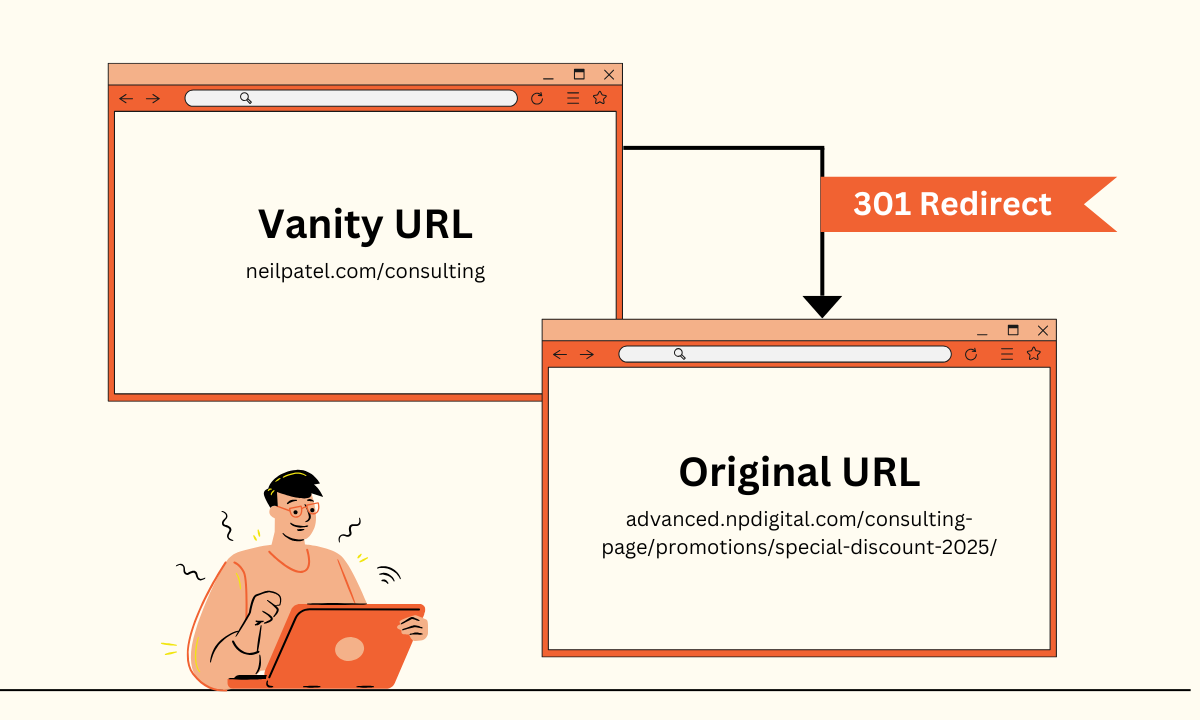
“Vanity URL” vs. “Regular URL”) A vanity URL and a regular URL are differentiated only in terms of looks.
A regular URL is frequently generated automatically by the system. A regular URL is used mainly in database, tracking, and organizational purposes by the system and organizations. A vanity URL, however, is carefully created and is used publicly.
One URL favors structure and data. One favors simplicity and semantic value. The goal may be the same, but the results are worlds apart.
This becomes even more crucial if the brand has its presence on many channels. A link that looks great on a browser might not work at all on an image advertising on a poster, radio, and/or Instagram bio if it is too long.
Common Use Cases for Vanity URLs
Vanity URLs may appear in more situations than one can imagine. They appear each time an URL has to be memorized, verbally spelled out, and read quickly to recognize the URL.
Marketing campaigns often make use of Vanity URLs to measure the results with a clean look. It may be something like this- a launch website could be launched as brand.com/launch.
Social media profiles may use vanity URLs to point fans or followers to a designated landing page or provide them with a special offer or resource. Print ads use them because it is easier to type them in accurately.
Vanity links are useful even for internal communication. The sales teams, partners, and affiliates will be more eager to use and share links that are intentionally looking.
Examples of Effective Vanity URLs
Strong vanity URLs follow a simple rule: they communicate purpose instantly.
A fitness brand might use fitbrand.com/join for membership signups.
A software company could promote a free trial with softwarename.com/free.
An event organizer might share details at eventname.com/register.
In each case, the URL acts like a headline. It sets expectations before the page even loads.
Poor vanity URLs, by contrast, try to cram too much information into a single link or use vague words that mean nothing on their own. Clarity always wins.
Are Vanity URLs Good for SEO?
Although vanity URLs could be effective in regard to SEO, relying on them for ranking purposes is no “magic.” Search engines would rejoice to discover content that is relevant, clear, and consistent. When vanity URLs are informed by proper keyword research, they can improve click-through rates from the SERP, thereby indirectly contributing to effective SEO outcomes.
These shorter and more readable URLs are also easier to crawl and understand by search engines. This removes the issue of duplication and internal connections, which are made easier.
There are, nevertheless, Vanity URLs where the structure must never be compromised. The random modification of the structure of the URL without appropriate redirecting could lead to a negative consequence of rankings. This is supplemental, as opposed to a substitute of optimization, if carried out effectively.
Best Practices for Creating Vanity URLs
A vanity URL must be created in a way that exercises control and craftsmanship. “Simplicity is not something that happens by itself, it’s something
First of all, make them short. The fewer words, the better. Each word should be there for a reason. Vanity URLs that are too long will cancel out their own point.
Secondly, make them readable. Avoid using numbers and symbols unless they are commonly understood. A URL should be easy to read and pronounce aloud.
Third, integrate them with your brand voice. If your brand voice is playful, then the URLs can use colloquial language. However, for a business URL, keep the URLs clean and simple.
Fourth, use lower case letters. This will prevent confusion as it will avoid the breaking of links due to case sensitivity.
Fifth, there must be the right redirects. If the vanity URL redirects to another URL that is either longer or changes from time to time, there must always be permanent redirects.
Lastly, consider vanity URLs as long-term resources. Even when they are shared publicly, it is vital to keep them active. It will be detrimental to reputation and frustrating to break a vanity URL.
Vanity URLs and Tracking Analytics
One common misconception: Vanity URLs kill tracking. In reality, they often enhance it.
Vanity URLs can mask and reroute to URLs that contain tracking parameters, while still providing capabilities for marketers to track source traffic, conversions, and campaign performance, without the user ever seeing a messy link.
This separation of appearance and analytics is one of the biggest advantages of vanity URLs. Users see something clean. Marketers see detailed data. Marketers see detailed data—critical for refining digital marketing and SEO strategy.
This can be managed using URL shorteners, custom redirects, and campaign management tools.
Mistakes to Avoid with Vanity URLs
The most common mistake associated with vanity URLs is overusing them. Not every page needs a vanity URL. They are most effective when reserved for big campaigns, core actions, or high-visibility content.
Another error is made when Vanity URLs are changed too frequently. Stability is important: a Vanity URL that disappears after a campaign has ended may confuse users who revisit it.
Using an even vaguer word like “click-here” or “page” also weakens effectiveness. A vanity URL should, but not tell people what to do; it should be indicative of value.
Finally, forgetting mobile users can be expensive. Vanity URLs should be easy to type on a phone keyboard, with minimal risk of errors.
Vanity URLs in the Future of Digital Branding
The more crowded the digital ecosystem becomes, the more simplicity will become a valued currency. The trend of vanity URLs is part of seamless experiences for end-users. The seamless the experiences get, the more everyone will crave them.
With increased voice search, audio content, and offline-to-online conversion, the need for speakable and memorable URLs will be greater than ever. A clean link is not a mere usability issue, but it’s a design problem.
In other words, those brands that treat URLs not as an afterthought of technology, but rather as an asset, will find a way to make their differentiation both subtle yet very strong.
Final Thoughts
Vanity URLs are quietly complicated. At first glance, they are just short links. Behind that façade, they are tools of branding, usability, and communication.
Vanity URLs, when designed with intent, can strengthen the marketing campaign, the brand itself, as well as the user experience. Vanity URLs understand the human brain’s affinity for meaning and clarity, which is what well-designed digital experiences are based on.
“In a noisy environment, the most effective connection may be the cleanest.”











Rahul M.
B2B Service Provider