
AI search has quickly become part of the way people discover businesses, compare products, research services and find answers online. Like, platforms such as ChatGPT, Google AI features , Perplexity, Gemini and other ai-powered search experiences are kinda reshaping how information gets put in front of users.
And honestly this creates a new question for businesses: is AI SEO actually worth paying for, like for real? The answer tends to depend on the business itself, its audience , how solid its current SEO foundation is, the quality of the content being published, and also where its customers are looking for info in the first place.
In most cases, AI SEO should not be treated as a replacement for traditional SEO. Rather, it can extend an existing search strategy toward AI-generated answers and conversational discovery. So it’s more like an add-on or an extra lane, not the whole highway.
For companies thinking about AI SEO services, the key question isn’t only whether AI is popular. It’s whether AI visibility can actually help bring in qualified traffic, improve brand awareness, generate leads, or drive revenue.
What Is AI SEO?
AI SEO kinda refers to the practice of improving a website’s visibility across AI powered search and answer platforms while still keeping solid performance in regular search engines, you know the usual stuff.
Traditional SEO mostly concentrates on boosting rankings for searches that are relevant. AI SEO kind of adds another layer though: it helps the search systems get a clear read on a brand, its know how, services, products, and content well enough to maybe mention or use that material when an answer is being generated.
That can touch technical SEO, content fine tuning, structured data, entity understanding, topical authority and brand mentions too, plus digital PR, and generally making the site content more dependable and useful in practice.
AI SEO is also closely tied with phrases like Generative Engine Optimization (GEO), Answer Engine Optimization (AEO), and AI search optimization. Even if agencies use different wording, the overall goal stays pretty similar: raise the chances that a company is found or referenced when people search through AI driven experiences.
Why AI Search Matters to Modern Businesses
Search behavior is shifting. People are asking more or less whole questions instead of typing brief keyword bits, and it’s kind of noticeable lately.
Like if someone wants a digital marketing company, they might not just punch in “digital marketing agency Mumbai” and call it a day. Instead they’ll ask an AI platform something closer to:
“Which digital marketing agencies in Mumbai work with B2B companies and provide SEO, paid advertising, and website services?”
That kind of question pushes search systems to read between the lines—context, services provided, actual know-how, where the company operates, and what’s relevant overall. So yeah, the game changes a bit.
And for businesses, this is a chance. Especially for those with websites that are clearly organized, and with content that is actually helpful, not just a bunch of words placed around.
But “AI SEO” doesn’t mean you just publish hundreds of AI-generated pieces and assume they’ll show up in every single answer. Search visibility still depends on quality, relevance, authority, technical accessibility, and what the wider web is already saying and linking to.
AI SEO and Traditional SEO Work Together
One of the biggest misunderstandings about AI SEO is that businesses need to abandon traditional SEO.
They do not.
A strong technical foundation remains important. Search engines and AI systems still need to discover, crawl, interpret, and understand website information.
Traditional SEO activities such as keyword research, technical optimization, internal linking, content development, page experience, schema implementation, local SEO, and authority building can support AI visibility as well.
The difference is that AI-focused optimization considers how information can be understood and retrieved in conversational search environments.
For example, a traditional SEO strategy may target a page around “SEO company in Mumbai.” An AI-focused strategy can expand the content around related questions, services, industries, processes, use cases, pricing considerations, and business outcomes.
This creates a deeper information ecosystem rather than relying on a single keyword.
What Do AI SEO Services Actually Include?
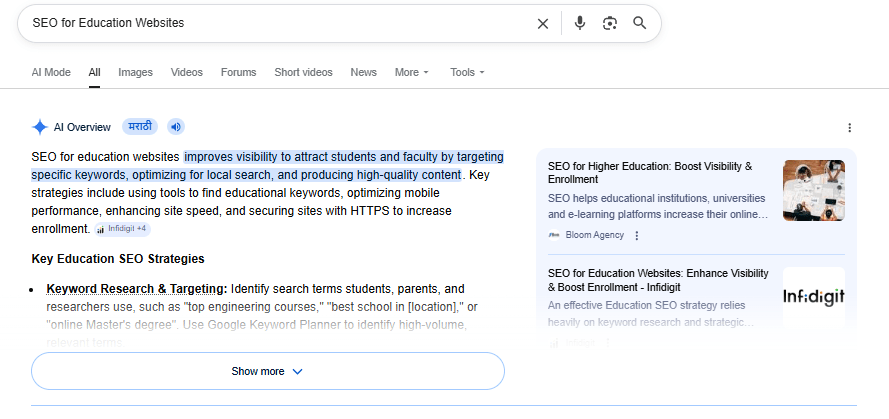
The exact scope varies between agencies, but a comprehensive strategy can include several connected activities.
Technical SEO
AI visibility starts with a website that search systems can access and understand.
Technical work can include improving site architecture, crawlability, page speed, mobile usability, indexing, canonicalization, structured data, and Core Web Vitals.
If important information is difficult for search engines to access, AI-focused optimization will not solve the underlying problem.
Content Optimization
AI systems need useful information to understand a business.
Content should answer real questions clearly and provide sufficient context around the subject. This can involve improving existing service pages, developing detailed guides, creating FAQs, publishing comparison content, and strengthening topical coverage.
The objective is not simply to increase word count. It is to make information more complete, accurate, useful, and easy to interpret.
Entity and Brand Optimization
AI systems increasingly need to connect information about organizations, people, products, services, locations, and industries.
Consistent business information across the website and relevant third-party sources can help establish clearer brand context.
This is particularly important for businesses operating in competitive categories where multiple companies offer similar services.
Generative Engine Optimization
GEO focuses specifically on visibility within generative AI experiences.
The strategy can involve identifying questions customers ask, understanding how AI platforms formulate answers, improving supporting content, strengthening authority signals, and monitoring whether a brand is being mentioned or cited.
Answer Engine Optimization
AEO focuses on making content useful for direct-answer searches.
Well-structured explanations, concise answers, FAQs, definitions, processes, and supporting evidence can make content easier for search systems to interpret.
How to Know Whether AI SEO Is Relevant to Your Business
Not every business needs the same level of investment in AI SEO.
A B2B software company with customers researching complex solutions online may have different opportunities from a local business whose customers primarily search for opening hours, directions, or immediate services.
Before investing, businesses should evaluate their current situation.
Look at:
- Where customers currently discover the business
- How much organic traffic the website receives
- Whether AI platforms already mention the brand
- Which competitors appear in AI-generated answers
- What questions potential customers ask before purchasing
- How strong the website’s content and technical foundation are
- Whether conversions can be attributed to organic and AI-assisted visits
This information provides a much better basis for investment decisions than simply following the latest AI marketing trend.
Why Content Quality Matters More Than AI-Generated Volume
AI tools have made content production faster, but publishing large quantities of generic material is not the same as building search authority.
Businesses should be careful about creating pages that repeat the same information with slightly different keywords.
Useful content should demonstrate experience, answer genuine questions, explain complicated subjects clearly, and provide information that is difficult to replace with generic summaries.
Human editorial review is also important.
AI can assist with research, outlines, content analysis, keyword clustering, and optimization, but businesses should still verify facts, add relevant expertise, maintain brand accuracy, and ensure that published content provides genuine value.
What to Look for (and Avoid) in an AI SEO Agency
If you are considering AI SEO services, choosing the right agency is just as important as choosing the right strategy. A reliable AI SEO agency should combine AI-focused optimization with strong technical SEO, content strategy, authority building, and measurable reporting.
| What to Look For | What to Avoid |
| AI Search Visibility — Look for an agency that understands how brands can improve visibility across AI-powered search and answer platforms. | Guaranteed AI Citations — Avoid agencies promising guaranteed ChatGPT, Gemini, Perplexity, or other AI placements because AI-generated results can change dynamically. |
| AI SEO + Traditional SEO — The agency should integrate AI SEO into your existing SEO strategy rather than treating it as an isolated service. | AI SEO as a Completely Separate Shortcut — Be cautious if an agency presents AI SEO as something that eliminates the need for technical SEO, content, authority, or traditional search optimization. |
| Multi-Platform Monitoring — A capable agency should consider relevant AI search environments and monitor brand mentions, citations, and visibility where appropriate. | One-Platform Strategy — Avoid strategies built around a single AI platform when your customers may use several search and answer experiences. |
| Query and Topic Analysis — The agency should understand the questions, related topics, and search journeys that influence how users discover your business. | Keyword Stuffing With AI Content — Producing large volumes of repetitive AI-generated pages without meaningful research, editing, or optimization can weaken content quality. |
| Human Content Review — AI can support research and content workflows, but experienced human review should remain part of the process. | Fully Automated Content — Be cautious of agencies that rely entirely on automated content generation without fact-checking, editorial review, or subject-matter input. |
| Transparent Reporting — Look for reporting that connects AI visibility with organic traffic, brand mentions, citations, engagement, leads, and other meaningful business metrics. | Vanity Metrics Only — Avoid reports that focus only on impressions or the number of pages published without showing whether the work is improving visibility or business outcomes. |
| Strong Technical Foundation — AI SEO should include attention to technical SEO, site structure, indexing, page performance, schema, and other foundational elements where required. | Ignoring Technical SEO — An agency should not promise AI visibility while overlooking crawlability, indexing, site architecture, performance, or other technical issues. |
| Documented Strategy and Results — Ask the agency to explain its methodology and provide relevant examples of previous work where possible. | Unverifiable Claims — Be cautious of agencies making impressive AI SEO claims without explaining the methodology, timeframe, metrics, or business context behind them. |
| Customized Strategy — The approach should reflect your industry, audience, competitors, website maturity, and customer journey. | One-Size-Fits-All Packages — Avoid agencies that apply exactly the same AI SEO process to every business regardless of industry or search behavior. |
| Clear Communication — A good agency should explain what it is changing, why the changes matter, and how progress will be measured. | Unclear Methodology — Avoid providers that use complicated AI terminology but cannot clearly explain what work will actually be performed. |
| Conversion-Focused SEO — AI visibility should ultimately support useful website visits, enquiries, sales, or other business goals. | Visibility Without Business Goals — Ranking or being mentioned is not the only objective. Avoid strategies that never connect visibility with actual business performance. |
Questions to Ask an AI SEO Agency
Before choosing an AI SEO agency, businesses can ask:
- How will AI SEO integrate with my existing SEO strategy?
- Which AI search platforms are relevant to my target audience?
- How will you monitor AI visibility and brand mentions?
- How will you improve my existing content?
- What technical SEO improvements are required?
- How will you measure leads, conversions, or revenue from search?
- How often will I receive performance reports?
- Can you explain your AI SEO methodology in simple terms?
- What results can realistically be measured during the first few months?
- How does your approach combine AI tools with human expertise?
These questions can help businesses distinguish between a genuine SEO services strategy and a traditional SEO package simply marketed with AI terminology.
Can Small and Local Businesses Benefit From AI SEO?
AI SEO is not limited to large technology companies.
Local businesses can also prepare their websites for AI-driven discovery.
A local healthcare provider, real estate company, educational institution, professional service provider, or ecommerce business can build content around the questions customers commonly ask.
For example, a local service company could create useful content covering pricing factors, service areas, preparation requirements, common problems, timelines, and comparisons.
Local SEO remains important as well. Consistent business information, Google Business Profile optimization, reviews, location pages, citations, and relevant local content can support broader search visibility.
The key is matching the investment to the actual customer journey.
How AI SEO Can Support Lead Generation
Visibility alone is not enough.
A business ultimately needs qualified visitors, enquiries, purchases, registrations, or other meaningful actions.
AI SEO can support lead generation by helping businesses appear during earlier stages of customer research.
Someone may discover a company while asking an AI platform for:
- Service recommendations
- Product comparisons
- Industry solutions
- Pricing information
- Vendor alternatives
- How-to guidance
- Local providers
- Software comparisons
If the business has useful content addressing these questions, it has more opportunities to become part of the customer’s research process.
This is why AI SEO should be connected to conversion optimization rather than treated as an isolated visibility exercise.
How to Measure AI SEO Performance
Businesses should establish measurable objectives before investing in an AI SEO campaign.
Useful metrics can include AI-referred sessions, brand mentions, citations, organic traffic, rankings, assisted conversions, lead volume, engagement, and revenue attributed to search-assisted journeys.
It is also useful to monitor visibility across different platforms because AI search experiences can vary.
For example, a business may appear frequently in one AI environment while receiving little visibility in another.
Reporting should therefore focus on trends and business outcomes rather than promising a fixed number of AI citations.
No legitimate agency can guarantee that an AI system will mention a particular business for every query.
Common AI SEO Mistakes to Avoid

Businesses considering AI SEO services should watch for several warning signs.
Treating AI SEO as a Shortcut
AI SEO cannot compensate for a poor website, weak content, technical problems, or a lack of authority.
Publishing Low-Quality AI Content
Automatically generated content without meaningful review can create repetitive and unhelpful pages.
Ignoring Traditional SEO
AI search and traditional search are connected. Technical SEO, content quality, authority, and website usability still matter.
Chasing Every New AI Platform
Businesses do not necessarily need a separate strategy for every new AI product. Start with the platforms and search behaviors that are relevant to the target audience.
Measuring Only Impressions
Visibility is useful, but businesses should ultimately connect search activity with engagement, enquiries, sales, or other meaningful outcomes.
Choosing an AI SEO Agency
When evaluating an AI SEO agency, businesses should look beyond marketing terminology.
Ask how the agency approaches technical SEO, content, authority, AI visibility, reporting, and conversion optimization.
A good agency should be able to explain:
- How AI search fits into the existing SEO strategy
- Which AI platforms are relevant to the business
- How AI visibility will be measured
- How content will be researched and reviewed
- Which technical improvements are required
- How competitors will be analyzed
- How results will be connected to business objectives
The agency should also be transparent about what it can and cannot control.
AI-generated answers can change, and no agency can guarantee permanent placement in an AI response.
Why Businesses Should Start With an AI SEO Audit
Before committing to a major AI SEO campaign, an audit can reveal where the actual opportunities exist.
An audit can examine the website’s technical health, existing content, topical coverage, brand mentions, traditional search performance, competitor visibility, structured data, and potential AI search gaps.
The results can then be used to prioritize actions.
For one company, the biggest opportunity may be improving service pages. For another, technical SEO may need attention first. Another business may already have strong content but lack authority and brand visibility.
This approach makes AI SEO more strategic and prevents businesses from spending money on tactics that do not address their actual search problems.
How Bloom Agency Approaches AI SEO
At Bloom Agency, AI SEO can be approached as an extension of a broader search strategy rather than a disconnected marketing service.
The process can combine technical SEO, content strategy, keyword research, on-page optimization, authority building, structured information, and AI-focused content improvements.
The goal is to create a website that is useful for both human visitors and modern search systems.
For businesses entering AI search, the focus should be on building a strong foundation first and then identifying the opportunities where AI visibility can contribute to discovery and growth.
Bloom can also align AI-focused optimization with broader digital marketing activities, helping businesses avoid treating search visibility, content, website performance, and lead generation as completely separate activities.
Is AI SEO Worth Paying For?
AI SEO can be worth investing in when it connects to a genuine customer search opportunity.
Businesses with complex products, professional services, B2B offerings, ecommerce products that require research, or information-heavy customer journeys may have particularly strong reasons to investigate AI search visibility.
But the decision should be based on evidence rather than hype.
Start by measuring current visibility, identifying customer questions, analyzing competitors, checking the website foundation, and determining whether AI search can realistically contribute to business objectives.
For some businesses, the right approach may be a dedicated AI SEO campaign. For others, integrating AI-focused optimization into an existing SEO program may make more sense.
The important point is to build a strategy around the audience and business model rather than simply adding “AI” to an existing SEO package.
Frequently Asked Questions About AI SEO Services
Is AI SEO the Same as Traditional SEO?
Not exactly. AI SEO builds on many traditional SEO fundamentals but places additional emphasis on visibility within AI-generated answers and conversational search experiences.
What Are AI SEO Services?
AI SEO services can include technical SEO, content optimization, entity optimization, structured data, topical authority development, AI visibility monitoring, and strategies designed to improve the likelihood of being referenced in AI search results.
Is AI SEO Necessary for Every Business?
The level of investment should depend on the business, audience, search behavior, competition, and existing digital presence. Not every business needs the same AI SEO strategy.
Can AI SEO Replace Google SEO?
AI SEO should generally complement traditional SEO rather than replace it. Search engines remain an important source of discovery, while AI search adds another layer to the evolving search ecosystem.
Can AI SEO Generate Leads?
It can contribute to lead generation when AI visibility brings relevant users into the business’s research journey. Performance should be measured through traffic, engagement, conversions, and revenue rather than visibility alone.
How Long Does AI SEO Take?
There is no universal timeline. Results can depend on the website’s existing authority, content quality, technical condition, competition, industry, and the amount of work required.
Should Businesses Use AI to Write SEO Content?
AI can assist with research, ideation, analysis, and drafting, but published content should be reviewed and improved by people. Accuracy, originality, expertise, and usefulness remain important.
What Should I Ask an AI SEO Agency?
Ask how the agency measures AI visibility, integrates AI SEO with traditional SEO, improves content, monitors competitors, reports results, and connects search performance with business outcomes.
Final Thoughts
AI search is changing the way people find information, businesses, products, and services. It still does nt mean classic SEO is disappearing, no not really. But now companies need to pay attention to visibility in a wider search environment, like more places at once.
A practical AI SEO services approach kinda starts with solid technical ground work, relevant content , clear brand context, topical authority , and objectives you can actually measure. Not just “reach more folks” and done.
If you’re thinking about AI search optimization, the smartest beginning is to check where you are today, where competitors are showing up, what customers are really asking for, and which chances can support growth without getting too fantasy like.
Bloom Agency can assist businesses in building an SEO and AI search strategy that ties technical improvements, content, authority, and digital discoverability together with broader marketing goals.

Neetu Wadhwa is the Director of Bloom Agency, a Mumbai-based full-service digital marketing and web development company. With a strong focus on performance, innovation, and strategy, she leads the agency in delivering SEO, web design, and growth marketing solutions that drive measurable business outcomes.




Rahul M.
B2B Service Provider