
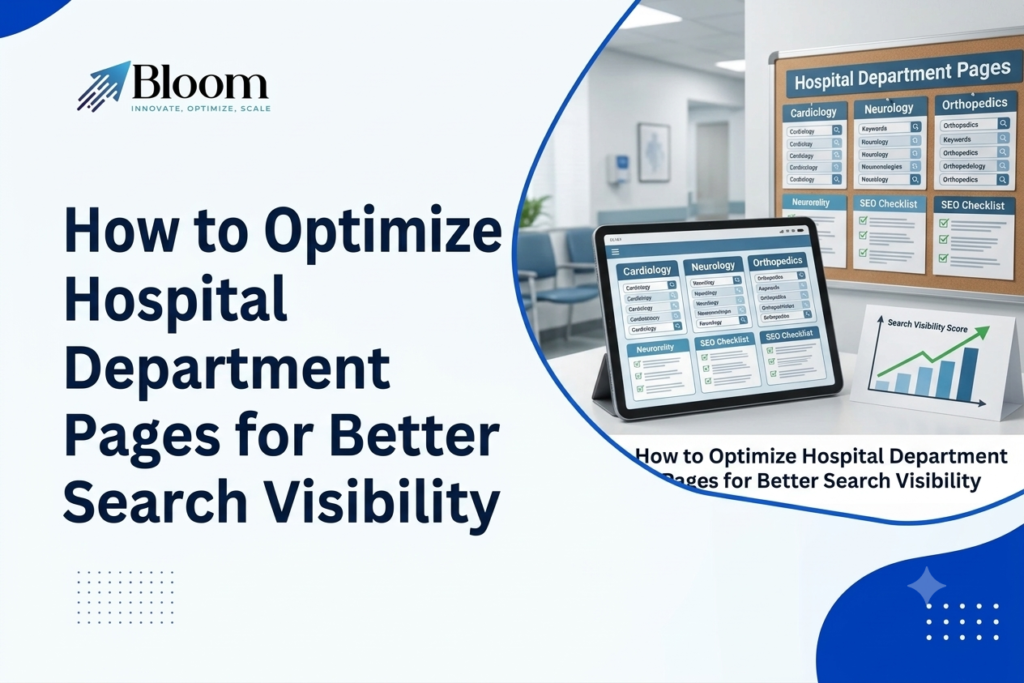
How to Optimize Hospital Department Pages for Better Search Visibility
Introduction
When researching for medical services, patients often search specifically for a type of medical aid or a medical specialty rather than a standalone hospital service. Someone with joint pain may research the orthopedic department, while someone else may research the cardiology department or another medical specialty. If a hospital’s webpages related to specific medical departments are not optimized correctly, patients may not be able to research particular departments and their offerings directly through Google.
Healthcare SEO services can help to optimize hospital department webpages: this way, hospitals improve the visibility of each department, inform the patients about the services offered and the specialists employed, and help patients make appointments directly through Google. An optimized department page also helps search engines to understand which services, locations, and specializations are related to the hospital.
SEO for the healthcare industry involves researching the best practices, suggesting technical improvements, optimizing content, organizing the website’s logic for better navigation, and providing the necessary information to patients searching for medical services. Since medical services’ webpages often provide the basis for medical decision-making, optimization should focus on medical accuracy and a strong patient experience.
This article will discuss twenty tips on optimizing hospital department pages to rank higher in search engine results and become more helpful to patients.
1. Conduct Keyword Research for Each Department
Conducting keyword research is an integral part of any SEO campaign, and hospital or clinic SEO is not an exception. Individual pages should be created for each medical department at the hospital, as patients usually search for specific departments rather than a general list of services offered. Since each department will have its page, each should be optimized for keywords relating to that specific department.
For instance, the cardiology department will have to be optimized for keywords relating to heart conditions and treatment, and the orthopedic department will have to use keywords relating to joints and bones.
Researching the search volume and trends for specific keywords and keyphrases will help the hospital or clinic to understand what terms to use for department pages.
Hospitals should also consider the following keyword research practices:
-
Analyze search intent: Identify whether patients are looking for medical information, a specialist, a specific treatment, or an appointment.
-
Target long-tail keywords: Use specific phrases such as “pediatric cardiologist in Navi Mumbai” rather than relying only on broad terms.
-
Avoid keyword cannibalization: Assign different primary keyword targets to relevant department pages and specialist profiles.
-
Review competitor keywords: Analyze competing hospital websites to identify relevant search queries and content gaps.
The keyword research tool included with Google Search Console and other SEO tools can help with keyword research to find popular terms and see trends.
Each page created for a specific medical department should have one primary keyword to rank for and a set of related secondary keywords. However, one should avoid overusing keywords on a single page, as this may raise the risk of penalty from search engines. Instead, keywords should be placed naturally in the headings, page titles, meta description, and body of the optimized page. Professional SEO services will help to choose the necessary keywords for each department and build optimization strategies without overlapping keywords from similar departments.
2. Create Separate Pages for Each of the Major Medical Departments
The most common mistake in hospital or clinic SEO is creating one webpage with lists of services provided. It is much better to create a separate page for each of the major medical departments, such as cardiology, orthopedics, neurology, gynecology, pediatrics, dermatology, oncology, gastroenterology, and others. That way, each department will be able to provide more information for patients searching for specific services.
A well-optimized department page should include:
-
A clear introduction explaining the department’s purpose.
-
A list of medical conditions and treatments offered.
-
Profiles of qualified doctors and specialists.
-
Information about available diagnostic equipment and facilities.
-
Consultation timings, contact details, and appointment options.
-
Links to related departments and medical services.
Each of the pages created for a certain medical department will have to provide the necessary information for patients searching for that particular department. The information may include the services provided, the medical conditions treated, the specialists available for the treatments, equipment available for diagnostics, and details about scheduling an appointment. It may be better to provide genuinely useful information rather than simply rewriting the same text with different headings for each department. If the hospital has multiple branches offering essentially the same set of services, separate landing pages for each location may be created. Each separate landing page should contain the necessary location-specific information rather than simply using the same information with different keywords.
3. Optimize Title Tags, Meta Descriptions, and Headings
On-page SEO is essential to indicate to search engines what each page is about and what information it provides. Each page, including hospital and clinic department pages, should have a unique title tag, with the hospital or clinic name and the specific services provided.
An example of an optimized title tag can be ‘Cardiology Department in Navi Mumbai | Hospital Name’.
Each page should also have an optimized meta description, usually containing a brief summary of the information provided on the page to encourage would-be visitors to actually visit the page. For instance, the meta description for the cardiology department page can be ‘All about the cardiology department in Navi Mumbai, including information about the services, specialists, equipment, and consultations available’. The heading of the page, usually marked as H1, should also be optimized to indicate what the page is about. Other headings, marked as H2, H3, and so on, can be used to highlight frequently asked questions, list the services provided, and other informative topics. Correct and optimized headings will allow both search engines and patients to find the necessary information faster and easier. Avoid using similar title tags and headings for different department pages, as it may actually hurt the optimization by making different pages seem similar to search engines.
4. Publish High-Quality Content That Actually Helps People
Content is one of the most important aspects of SEO, and hospital or clinic SEO is not an exception. The content on each page should be high-quality and genuinely helpful to people rather than simply trying to attract more visitors through clickbaiting means. SEO-friendly content should also be optimized for search engines, which involves keyword research and using the discovered keywords and keyphrases in the body text.
Content-specific tips for optimizing hospital, clinic, or department pages can include:
- To improve the quality of healthcare content, hospitals should:
- Use simple language to explain medical terms and procedures.
- Include answers to common patient questions.
- Display the author’s credentials or medical reviewer’s qualifications where appropriate.
- Cite reliable medical sources when discussing clinical information.
- Review outdated statistics, treatment descriptions, and medical recommendations.Avoid guaranteed recovery claims and misleading statements about treatment outcomes.
Indicating the instances when the patient should seek help from a particular department at the hospital.
As an example, a cardiology department page can list what medical conditions are treated at the cardiology department, what diagnostic procedures are used, and what specialists work at the department. Healthcare SEO should make sure that the medical information provided is accurate, and it may be necessary to work with medical professionals to ensure that the information is up-to-date and accurately reflects the services provided. Mentioning the credentials of medical professionals, such as years of experience, medical background, and other relevant information, can improve the optimization, as can indicating the date of the last update.
It is necessary to avoid simply listing keywords on the page, and claims such as ‘we are the best hospital for all diseases’ should also be avoided, as applicable.
5. Build More Internal Links
Internal links are hyperlinks pointing from one page on a website to another page on the same website. Building more internal links, especially on hospital or clinic webpages, will increase the visibility of different departments and services to both search engines and patients. Internal links also help both patients and search engines to navigate the website and discover more information. Department pages can be linked to the services, specialists, facilities, equipment, and appointment pages relevant to the particular department. For instance, the cardiology department page can be linked to the cardiac diagnostic services, the specialists’ webpages, and the appointment page. Other pages, such as the obstetrics and gynecology page, can be linked to the maternity wing, relevant equipment, and other services and facilities. Anchor texts for internal links should be optimized, both for patients and search engines. Avoid using the same anchor text for different links, and do not use simple phrases such as ‘click here’. Internal links also help to increase the page authority of different webpages, which in turn improves their visibility and search engine ranking. Make sure that the website’s navigation is set up in a way that makes it easy for patients to reach the necessary information. Avoid having to make multiple clicks from a landing page to get to the necessary information, and use internal links to make the navigation intuitive and straight forward.
6. Focus on the Local Search
Patients often search for medical services locally. This is why local SEO is often an important aspect of SEO for clinics and hospitals. When optimizing the website for local searches, make sure to use location-specific terms and information, such as the address, phone number, directions, and other location-specific information. If the hospital has multiple locations, each should be optimized for the local search in that area. Make sure to set up and maintain a Google Business listing for the hospital, where applicable. Listing the hospital in local business directories will also improve the local search optimization. Information on individual locations should reflect the actual services provided, so that the patients searching for particular services can find the hospital location that offers those services. Avoid claiming to provide services that the hospital does not actually offer at a particular location. Healthcare SEO companies will ensure that the local SEO, including the use of location-specific keywords, is handled correctly. Multiple locations and their optimization will require a complex strategy, including working with local directories, maintaining consistent NAP (name, address, phone number), managing reviews, maintaining location landing pages, and more.
7. Optimize for Speed and Mobile Viewing
Many patients use their mobile devices to research medical services before contacting the hospital or clinic. Optimization for mobile devices is essential these days, which means ensuring that images are not too large, the website’s design is fluid and responsive, unnecessary scripts are removed, and more. Google will penalize websites that provide a poor mobile experience, which will affect the search ranking and, ultimately, the visibility of the website. Patients will also have a better experience on a responsive, easy-to-use, and optimized mobile website, which will encourage them to revisit the website, share their experience, and recommend the hospital or clinic. Hospitals and clinics should ensure that the cardiology, orthopedic, and other department pages are optimized for mobile devices, with easy-to-find contact information, the ability to make appointments from mobile devices, and more. Avoid having small buttons that are difficult to tap with a mobile device. Google’s PageSpeed Insights can help to test the speed of the website and discover optimization opportunities, such as compressing larger images that slow down the loading process. A great mobile experience also means that patients can accomplish their tasks without double or multiple clicks. They should be able to reach the contact information, learn about the specialists, the equipment and facilities, and make an appointment with ease.
8. Implement Structured Data, Where Applicable
Structured data plays an important role in how search engines actually interpret the information provided on webpages. Some of the most common markups used for hospitals and clinics may include MedicalOrganization, Hospital, MedicalClinic, and other relevant structured data markups. Implementing structured data is an important step in SEO, as it will allow search engines to better understand the content and provide a richer snippet in the search results. Each hospital department page should be analyzed to determine what markup can be implemented on that particular page. Information such as organization information, addresses, contact details, and others can be added, where applicable. Remember that structured data should reflect the actual information on the website. Any claims that are not supported by factual information on the page should be avoided, as they may cause penalties. The presence of structured data will not guarantee that the search engine will display enhanced rich results or that the page will begin to rank higher in search results. However, implementing the correct markup will help both patients and search engines to better understand the content and obtain more information from the website. Google’s Rich Results Test and Schema Markup Validator can help to implement the correct markup and ensure that there are no errors.
9. Leverage Trust and Expertise
Most patients will want to learn more about the medical professionals providing the services before actually contacting the hospital or clinic. Creating informative webpages about the specialists and their areas of expertise will both improve the optimization of the webpage and improve the patients’ trust. Each specialist’s bio should highlight the areas of expertise, years of experience, and other relevant information. Mention that the specialist can provide consultations in languages other than English, where applicable. When possible, provide more information about the credentials and actual medical background of the specialists. Patients will want to know what they are getting into before actually visiting the hospital or clinic. Providing answers to the most common questions and honest information regarding the potential outcomes of the treatment will help to improve the optimization and build trust with the patients. Make sure to cite the actual sources of information when applicable, rather than making unsubstantiated claims. Avoid using patient testimonials as trust-building elements when there are no official patient testimonials available, and always comply with advertising and healthcare regulations.
10. Measure Results and Keep Department Pages Up to Date
SEO is an ongoing process, and it is essential to measure the performance of hospital department pages regularly. Google Search Console will show what queries lead to the department pages, how those pages rank for particular keywords, and how many impressions and clicks they receive. Analytics will show how many patients actually reach the department pages, which of them perform better, and how the patients interact with the content.
Some essential metrics will include impressions and clicks for the department pages, their ranking for particular keywords, click-through rates, the number of organic visits to the department pages, the number of appointment inquiries and bookings, and more. Monitoring the performance of the department pages is essential to understand what works and what needs improvement.
Updating department pages is also essential, as it shows search engines that the website is actively maintained and the information is up to date. Make sure to update the pages if any new departments are opened or any new services are introduced. Update the contact information if it has changed, the hours of operation are modified, or any other updates affecting the patients’ experience are made.
Using an SEO agency will allow the hospital or clinic to develop an ongoing optimization strategy that actually works, rather than guessing blindly at what may or may not work. Pages that have impressions but do not get enough clicks may need optimization, such as an update to the title tag and meta description to entice more patients to actually visit the webpage. Pages that get many impressions and visits but do not result in appointment inquiries may need optimization, such as better organization and an update to the contact information.
FAQs
1. Why is SEO important for hospital department pages?
SEO ensures that patients can find the specific services and departments that they need and are able to access the information that they are looking for.
2. How can healthcare SEO services improve the ranking of hospital and clinic pages?
Healthcare SEO services can improve the rankings of hospital and clinic pages for relevant keywords to help patients find the information and schedule appointments.
3. Should every hospital department have its own page?
Yes, as long as the pages have unique and relevant information.
4. How often should hospital department pages be updated?
Department pages should be updated when new information becomes available or when changes are made.
5. What keywords should be used on hospitl department pages?
Keywords may include the names of the specific medical departments, questions relating to the symptoms and conditions treated, the names of the medical professionals, and the names of the locations served, among others.
6. How long does hospital SEO take to show results?
SEO takes time and there are no definite results or timelines, as it depends on the competition, location, technical aspects, and many other factors.

Neetu Wadhwa is the Director of Bloom Agency, a Mumbai-based full-service digital marketing and web development company. With a strong focus on performance, innovation, and strategy, she leads the agency in delivering SEO, web design, and growth marketing solutions that drive measurable business outcomes.





Rahul M.
B2B Service Provider