
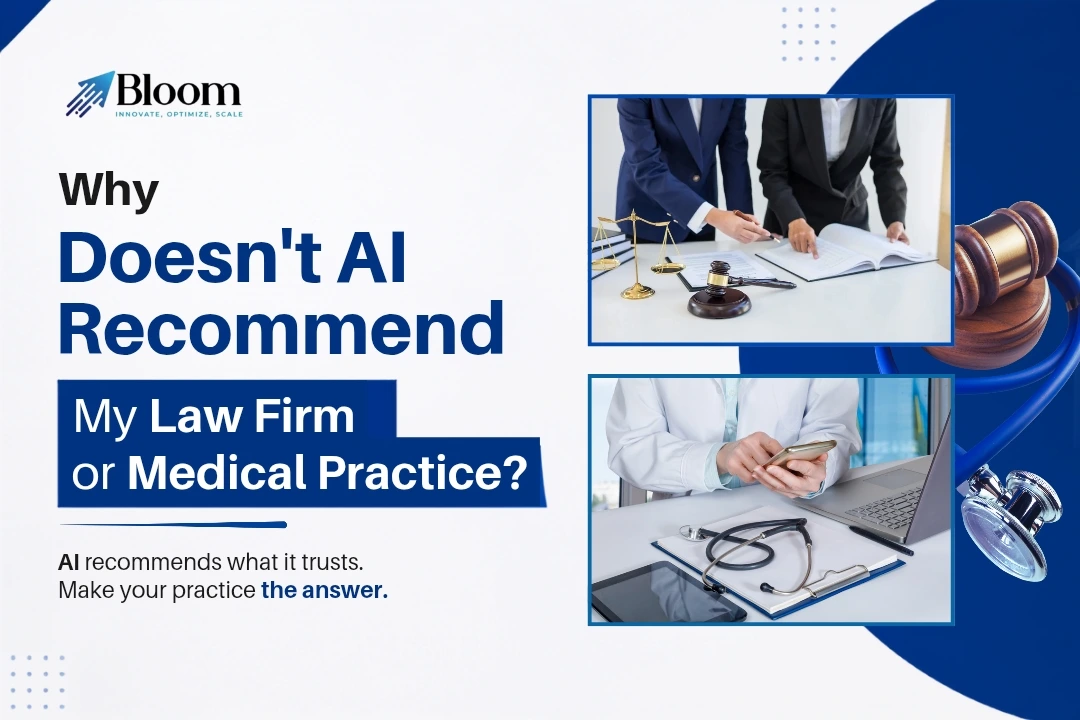
Artificial intelligence is changing the way people find professional services. Instead of opening multiple websites , checking directories, and comparing providers by hand, users can more and more just ask an AI system a direct question and get back a short list of recommended businesses or maybe even individual professionals.
But this shift makes a big challenge for law firms and medical practices. A company might have years of experience, solid credentials, lots of positive reviews, and profiles across well known directories, and still, it could just not show up when someone asks an AI platform for a recommendation.
And the real issue is not always that the business lacks expertise. In many cases, it’s basically a visibility problem, like it gets hidden in the background, even when it’s actually good.
The Difference Between Being Listed and Being Recommended
Traditional online visibility really used to hinge on showing up in spaces where customers already felt safe, you know. Lawyers could put themselves forward via bar associations and legal directories, and medical professionals often gained traction through healthcare platforms, plus those specialist directories, it depends.
And yeah these profiles still matter, even now. They kinda lock in the basics like professional identity, where they’re located, the credentials, specialties, and a straightforward way to contact them.
But AI recommendation systems can sniff around for a wider range of signals. So when someone asks which lawyer or doctor they should consider for a specific issue, the system may need evidence that’s more than just a directory listing.
In practice, it might pull from interviews, articles, professional publications, conference appearances, research, reviews, news coverage, podcasts, educational videos, plus other third party mentions. Not just “who is there,” but also “what else is said about them.”
So there’s this noticeable split between being online somewhere and being represented as an authority online.
Why Legal Businesses Face a Unique Challenge
Law firms often have strong individual professional identities. A senior attorney may have appeared in news articles, written legal commentary, participated in conferences, or been mentioned in court-related material.
But that visibility does not automatically transfer to the law firm.
An AI SEO may recognize the attorney’s name while having weaker associations with the organisation they represent. This can create a gap between individual authority and firm-level visibility.
For example, a prospect may ask an AI platform to identify experienced attorneys for commercial litigation in a particular city. The system could recognize a partner because that person has accumulated years of public references. Yet the firm itself may not have enough independent signals connecting its brand to that area of expertise.
This is why law firms should think about their digital presence at two levels: professional authority and organisational authority.
The two should support each other.
Medical Practices Have a Different Visibility Challenge
Medical practices have benefited from an extensive ecosystem of healthcare directories and professional databases. These platforms can provide valuable information about physicians, specialties, locations, appointments, and professional backgrounds.
However, healthcare is also a category where information quality matters considerably.
AI systems must deal with questions involving medical conditions, treatments, symptoms, and specialist recommendations. This means that credibility and context can be particularly important.
A practice may appear in a directory when someone searches for “dermatologist near me,” but a more specific AI query might ask for a specialist who treats a particular condition or works with a particular patient group.
The second type of query requires a deeper understanding of expertise.
This is where medical practices can benefit from creating authoritative educational resources, participating in professional discussions, earning credible media coverage, and developing content that clearly explains their areas of expertise.
The Importance of Third-Party Recognition
One of the most important differences between traditional medical SEO services and AI-driven discovery is the role of external sources.
A company can describe itself as experienced, specialised, trusted, or highly qualified. However, independent references can provide additional context.
For law firms SEO, useful third-party signals might include legal publications, professional associations, conference websites, industry interviews, news coverage, academic references, and reputable business publications.
For medical practices, relevant sources may include professional organisations, healthcare publications, research references, conference materials, specialist interviews, and reputable media outlets.
The objective should not be to create artificial mentions. Instead, businesses should build genuine expertise that naturally earns references from credible sources.
Build Content Around Real Questions
One of the most practical ways to improve authority is to answer the questions potential clients and patients actually ask.
A law firm could create detailed resources explaining the stages of a commercial dispute, considerations before signing a business agreement, or questions companies should ask when dealing with a regulatory issue.
A medical practice could publish educational resources about preparing for a consultation, understanding a procedure, or knowing when a patient should discuss a particular concern with a qualified professional.
The content should be informative rather than promotional.
AI systems need context. A page that simply says “we are experts in this field” provides less useful information than a detailed resource demonstrating knowledge about the subject.
Build Individual and Brand Authority Together
Professional service businesses should avoid treating personal branding and company branding as completely separate activities.
For a law firm, an attorney’s article can clearly identify the attorney’s position within the firm. A podcast appearance can mention the firm and its relevant practice area. A conference profile can connect the professional to the organisation.
Medical professionals can follow a similar approach. Interviews, educational videos, professional articles, and conference participation can identify both the practitioner and their practice.
Over time, these connections can create a stronger digital association between the individual, organisation, expertise, and location.
Your Website Still Matters
AI visibility does not make traditional website optimisation irrelevant.
A clear website provides an important source of structured information. Every important service or specialty should have a dedicated page with accurate information about expertise, location, professionals, and the type of clients or patients served.
For law firms, practice-area pages should clearly explain the matters handled and the jurisdictions or locations served.
For medical practices, specialty pages should explain services and provide appropriate professional information without making unsupported medical claims.
The website should also make it easy for visitors to verify information elsewhere. Links to professional profiles, publications, memberships, awards, and relevant external resources can help create a more complete picture.
Reviews and Reputation Still Have a Role

Online reputation is another component of digital visibility.
Reviews can help prospective clients and patients understand other people’s experiences. However, professional practices should approach reviews ethically and in accordance with applicable professional and regulatory requirements.
The goal should be to make legitimate feedback easier to find rather than manufacture positive sentiment.
Businesses should also monitor their information across major platforms. Incorrect names, outdated addresses, inconsistent specialties, or duplicate profiles can make it harder for users and digital systems to understand the organisation.
Structured Information Can Reduce Confusion
Law firms and medical practices often have complex information structures.
A single practice may have multiple professionals, offices, specialties, services, and professional credentials. Making this information clear and consistent across the website and external profiles can improve discoverability.
Businesses can use appropriate structured data and consistent business information to help search engines interpret key details.
This does not guarantee AI recommendations. Instead, it helps create a clearer digital footprint.
Think Beyond Traditional Search Rankings
A major change in AI-powered discovery is that users may not always visit a search engine results page and click the first result.
They may ask a conversational system a question and receive a synthesized response.
That means businesses need to think beyond traditional rankings.
Instead of asking only, “What keyword do we rank for?” organisations can also ask:
- What questions should our expertise be associated with?
- Which independent sources mention our professionals?
- Is our organisation clearly connected with our areas of expertise?
- Can a prospective client or patient easily verify our credentials?
These questions encourage a broader approach to online authority.
Monitor What AI Systems Actually Say
Businesses should periodically test how their brand appears in AI-powered search.
Queries should cover different situations rather than just the business name.
For example, a law firm could examine searches involving specific practice areas, locations, and client problems. A medical practice could test queries involving specialties, treatment areas, locations, and patient needs.
The objective is not to manipulate the system into producing a desired answer. It is to understand what information is currently visible and identify factual gaps.
If an AI system incorrectly identifies a professional’s specialty, location, or business affiliation, the organisation can investigate the underlying sources and work toward correcting the information.
Avoid Treating AI as a Traditional Ranking System
AI recommendations are not necessarily a simple ranking where the company with the most keywords automatically appears first.
Different systems may use different sources, models, retrieval methods, and criteria. Their outputs can also change over time.
For that reason, businesses should avoid relying on a single AI platform as the definition of success.
A more durable strategy is to build a broad and credible digital presence that remains useful regardless of which platform a prospect chooses.
The Role of Expertise in AI Visibility
The underlying principle is relatively straightforward: expertise needs to be visible.
A highly experienced attorney who rarely publishes, participates in industry discussions, or receives independent coverage may have less visible digital authority than their real-world experience suggests.
Likewise, an excellent physician may have strong credentials but limited online content explaining their areas of expertise.
AI cannot directly observe everything that happens inside a law firm or medical practice. It works with information available through digital sources.
That makes publishing and earning credible information an important part of modern professional visibility.
From Directory Presence to Digital Authority
Directories are still valuable. They can establish identity, professional information, and basic credibility.
But businesses should avoid treating directory presence as the entire strategy.
A modern authority-building approach can include:
- Detailed expertise-focused website content
- Professional interviews and podcasts
- Contributions to reputable publications
- Conference and speaking appearances
- Original research and commentary
- Accurate professional profiles
- Consistent business information
- Legitimate customer or patient reviews
- Educational videos
- References from relevant third-party sources
Each element contributes a different piece to the overall digital footprint.
A Practical Starting Point
Law firms and medical practices do not need to transform their entire marketing strategy overnight.
Start by auditing the existing presence.
Search for the organisation by name. Search for senior professionals by name. Test queries involving specific services or specialties. Review which external sources appear. Check whether information is accurate and consistent.
Then identify the biggest gaps.
If the professionals are visible but the organisation is difficult to identify, focus on firm or practice-level references.
If directory listings are strong but there is little evidence of expertise elsewhere, develop a thought-leadership and earned-media strategy.
If the website contains generic service pages, create deeper resources around genuine customer and patient questions.
The Bigger Picture
AI powered search is starting to, honestly, change how people find professional services, but the basic principle that drives visibility is still pretty familiar: credible information matters.
Law firms and medical practices already have something real and useful—professional knowledge and experience. The tricky part is not having the expertise, it’s making it understandable, and then discoverable, across the whole digital ecosystem, like everywhere at once.
A directory can help people see who you are. A professional profile can help clarify what you do. And then a well developed body of independent and helpful information can add all that extra context, not just the basics, but also why your expertise fits in the first place.
The future of AI discovery will keep evolving. Platforms will likely change the way they retrieve information, how they assess sources, and how they actually present recommendations.
Businesses can’t control everything in that chain, not even close. But they can control the accuracy of what they share, the quality of their content, the consistency of their digital identity, and also how much effort they put into showing genuine expertise, not just saying it.
For law firms and medical practices, that is where the opportunity hides: not trying to force an AI system to recommend you, but building a digital presence that communicates clearly who you are, what you know, and where your expertise truly applies.

Neetu Wadhwa is the Director of Bloom Agency, a Mumbai-based full-service digital marketing and web development company. With a strong focus on performance, innovation, and strategy, she leads the agency in delivering SEO, web design, and growth marketing solutions that drive measurable business outcomes.





Rahul M.
B2B Service Provider