
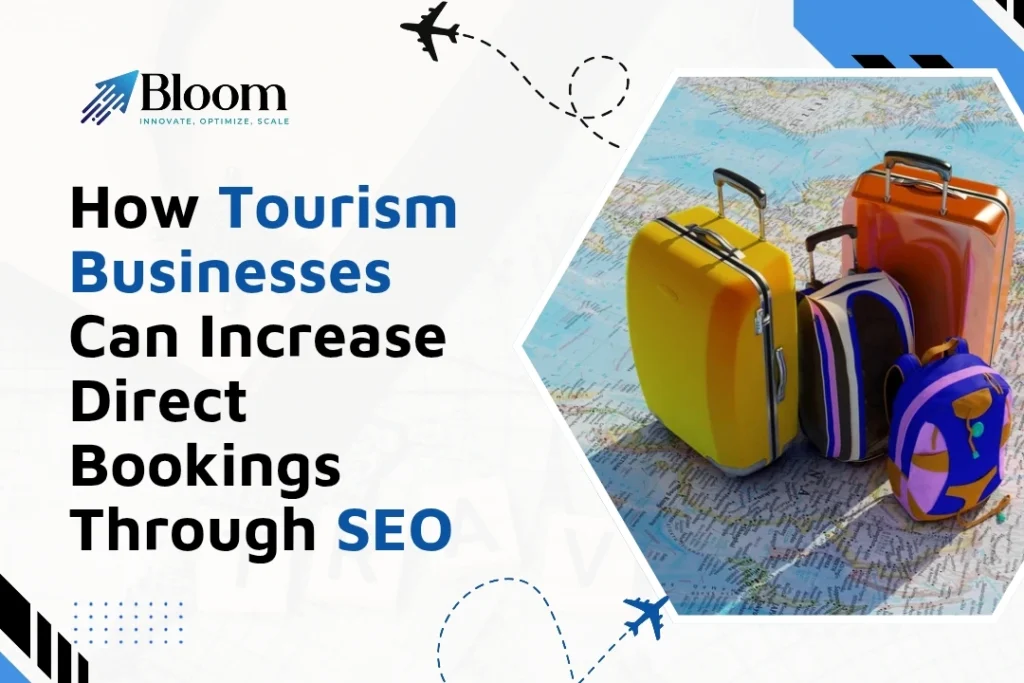
How Tourism Businesses Can Increase Direct Bookings Through SEO
The way people research and book their holidays has changed considerably. Travellers often turn to the internet well before choosing a holiday destination, accommodation, tour, or travel agency. This represents an opportunity for tourism businesses to engage with potential customers and encourage them to make direct bookings with them – rather than through online travel agencies or third parties.
While getting people to visit your website is one thing, businesses tend to rely on online platforms and third parties to make actual reservations for them. However, search engine optimisation can help tourism organisations create alternative booking channels for themselves.By investing in travel SEO services, tourism businesses can improve their Google ranking and attract web surfers looking to compare destinations and packages. Here are some of the ways that SEO can help increase direct bookings with your tourism business.
Why Direct Bookings Matter to Tourism Businesses
Direct bookings typically refer to any type of booking a tourist makes through a channel controlled by your business. This may include bookings on your own website or direct communication with you, rather than going through a third party.One of the simplest reasons to encourage direct bookings is that these remove the need to pay a commission to a third party for a customer. While direct bookings may still involve some costs over and above advertising, websites, and marketing, they can significantly reduce expenses for businesses that rely on third-party bookers.Direct bookings also help tourism businesses engage more closely with their customers. Hotels can contact guests about their accommodation preferences, tour operators can recommend tailored experiences, and travel agencies can suggest packages for future holidays.SEO can help tourism businesses build direct relationships with their customers. Rather than relying solely on advertisement dollars to acquire customers, businesses can use organic search results to acquire new customers and encourage them to book directly with them.
1. Target Keywords That Signal Booking Intent
As any SEO professional will tell you, keyword research always forms the backbone of any successful SEO strategy. Businesses need to understand what potential customers may search for when looking to book their travel or holidays. You need to consider what different people may search for at different stages in their booking process.While some people may search for ‘holiday packages’, others may look for ‘Kerala tour packages for families’, ‘Kerala honeymoon packages from Mumbai’, or ‘seven-day Kerala tour with accommodation’. Keywords that include specific destinations, experiences, or travel-related criteria tend to yield better results, with searchers often being more specific about what they are looking for.Hotels can target location-based searches such as “boutique hotel near Jaipur City Palace,”, while adventure tourism companies might look at keywords around trekking, safaris, or river rafting. Whatever vertical you work in, it is a good idea to tailor your SEO to individual search terms that relate to your offerings. This increases the likelihood of potential customers finding what they need on your page.It is also important to remember that certain keywords are more likely to result in a booking being made. For instance, someone searching for ‘Kerala tour packages for families’ is more likely to want to enquire or book directly with you than a general search for ‘holiday packages’.While businesses need to invest sufficient time and effort in targeting and optimising for informational keywords, it is important to ensure that the keywords you target actually lead to a booking being made.
2. Create Destination Landing Pages and Dedicated Packages
One of the most common mistakes tourism businesses make is to use the same page to talk about multiple destinations, tour packages, or holiday experiences. While this makes good sense in terms of website design and navigation, it can hurt your SEO performance.It is always a good idea to create separate pages for different destinations, tour types, and even travel-related experiences. This means that a business targeting the Kerala market can create separate landing pages for, say, the Jaipur, Udaipur, and Jaisalmer circuits.Each page should ideally highlight what potential customers can expect from their holiday and what you are offering in terms of holiday packages. You can also highlight what the trip entails and how customers can make a booking for these packages.Hotels and resorts can take inspiration from this by creating relevant landing pages for specific room types, wedding venues, and conference halls. Every page should ideally provide more information than generic overviews and always offer helpful tips for making travel plans with you.
Your website should always strive to give visitors enough information for them to make an informed decision about making a booking or enquiring with you.
3. Optimise for Local Searches
Local SEO is critical for hotels, travel agencies, tour operators, and other tourism-related businesses. Travellers often search for services based on their proximity to a particular place, such as a railway station, airport, city, or another tourist destination. By optimising for local searches on Google, you can attract customers searching for tourism-related services in your area.Start with optimizing your Google Business Listing to appear in local search results and attract the attention of potential customers. Make sure your website displays accurate addresses, numbers, and operating hours, and list relevant categories for your business on Google. Always ensure that your website contains high-quality images and other information, such as booking details.Encourage genuine customers to leave reviews on your Google Business listing, and always respond professionally to each critique. Your website should also reflect this by displaying helpful location-specific information, including travel itineraries, and experiences available for travellers in that region. A tour operator based in Goa, for instance, could highlight excursions, sightseeing options, and water sports in that region.Tourism-related businesses that operate out of multiple destinations should always strive to create genuinely helpful local content rather than publishing generic location-based web pages.
4. Optimise Your Website for Conversions and Mobile Users
Travellers increasingly turn to their mobile devices to conduct their research and shortlist destinations and travel experiences. As such, it is critical to optimise your website for mobile users and ensure that it loads faster on these smaller screens.Mobile optimisation always involves ensuring your site contains relevant content and has a shorter, simpler navigation menu. It is also a good idea to make sure that your booking options are prominently displayed and make the life of your customers as easy as possible.You should always be mindful of the amount of multimedia content, such as images and videos, on your website. Larger file sizes can hurt your loading speed on mobile devices, especially 4G connections. Your website’s call-to-action buttons should also be large enough and easy to locate on a mobile screen.Make sure that your website’s booking process is optimised for mobile users as well. Avoid asking for too much information before displaying your packages or allowing first-time visitors to make a booking. Use calls to action such as ‘Check Availability’, ‘Explore Packages’, ‘Book Your Stay’, or “Request a Custom Itinerary.” in your mobile content.Always test your website’s mobile-friendliness before launching it and make any necessary tweaks to improve its overall look and feel.
5. Publish Travel Guides and Destination-Specific Content
Anyone who has browsed the internet for holiday ideas will tell you that not every search is aimed at finding a tourism business. Many travellers are in the ‘research’ phase and want to gather more information before finalising their decisions and talking to tourism businesses. SEO can help you attract these potential customers by publishing helpful content about your local destinations and experiences.Hotels, for instance, might publish guides of local experiences in the area so that guests can make informed choices about their accommodation. Similarly, trekking companies might publish helpful information about the level of fitness required, equipment needed, and the weather conditions in the area before the start of the trek. Travel agencies might publish guides to help their customers understand what to pack, how much it will cost, and how to make the most of a family holiday. These tips will always be useful to a customer looking to make a booking with you.It is also a good idea to use internal links to connect relevant informational articles to commercial pages. For example, a blog about the best time to visit Kerala could be internally linked to your list of Kerala holiday packages.Avoid creating generic destination articles just for the sake of SEO. Always ensure that your articles contain genuinely helpful information that potential customers will find useful.
6. Showcase Reviews, Original Photos, and Helpful Information
Any booking always involves a degree of risk because the customer entrusts their money and time to another person or organisation. As such, you need to give your website visitors enough reasons to make a booking with you rather than a competitor. Always make sure that your website contains genuine reviews from satisfied customers to give new visitors a reason to feel confident about choosing you.Your website should always feature original images. Make sure to provide honest descriptions of what is on offer and give customers enough details so that they can make an informed choice. Always highlight cancellation and refund policies so that customers know what to expect if they decide to make a booking with you.Hotels should always update their room descriptions and amenities to reflect the actual on-ground offering. Similarly, tour operators should provide honest information about meeting points, duration of the tour, level of difficulty, and safety standards.Travel agencies should always update their website to reflect what is included in their holiday packages and any relevant terms and conditions. If your organisation has any certifications, accreditation, or awards, make sure to mention them and provide supporting documentation.You should always encourage honest customer reviews and avoid incentivising customers to share positive feedback exclusively with you.
7. Fix Technical SEO Issues
Having compelling content is not enough. You also need to ensure that Google can actually find and index individual web pages so that they appear in search results and drive traffic to your website.Technical SEO should always be the backbone of any larger SEO strategy that a tourism business implements. Conduct regular technical SEO audits to fix issues such as duplicate content, broken links, redirects, canonicalisation, and crawlability. Make sure that Google can actually crawl your most important destination and package pages and index them so that they appear in search results. Always use XML sitemaps to ensure that search engines can discover all the important pages of your website.Landing pages, especially those with dynamic filters or calendars, require careful technical SEO reviews to ensure that search engines can discover them. Always ensure that your website’s structured data uses appropriate schema, such as Organisation, LocalBusiness, and Hotel, to provide additional information to search engines. Structured data cannot magically boost your search rankings, but it is always a good idea to utilise this extra information when it is relevant to your business.
8. Make the Booking Process Simpler and More Conversion-Friendly
SEO ultimately exists to drive traffic to your website. Now that you have the right traffic, it is a good idea to focus on tweaking your booking process to encourage first-time visitors to make a direct booking with youIt is always a good idea to review your booking process from the customer’s point of view. Can they see the cost? Are the packages clearly stated? Can they view the available slots and make a commitment? Can they ask questions before making a final commitment?
Hotels, for instance, should always highlight the room, its cost, and availability so that customers can make an informed choice. Tour operators should provide clear information about the kind of tour, its duration, and any additional requirements. Similarly, travel agencies offering customised holiday packages should have a simple online enquiry process so that visitors can provide their requirements without being overwhelmed by the experience.Whenever possible, always give your customers the option to compare relevant offerings and go back to the booking page. Always provide confirmation steps so that your customers know what to expect when they make a booking enquiry or actually complete a booking. You should always review your website analytics to see where in the booking process your customers are giving up and look at ways to tweak the booking process so that it is less intrusive and more intuitive.
Remember that SEO ultimately exists to drive traffic to your website. Now that you have the right traffic, it is a good idea to tweak your booking process to encourage customers to make a direct booking with you.
9. Use Internal Links To Drive Traffic to Commercial Pages
Internal linking always refers to links within your own domain that connect different web pages. Internal links are useful because they help drive traffic to specific landing pages, such as individual destination or tour operator pages.Internal links also help search engines understand the contextual relationship between different web pages. For instance, you can use internal links to connect a general article about the wonderful beaches of Goa to your page of Goa holiday packages.Always try to use descriptive anchor text, such as ‘explore our Rajasthan tour packages’, rather than ‘click here’. Your website’s navigation should always make it easy for your customers to discover related content. Always ensure that your customers can find your most important web pages with minimal effort. Older blog posts can always be edited and updated to include more internal links so that they drive additional traffic to your most important web pages.A good internal linking strategy always ensures that your customers can discover different destination pages, tour packages, and other relevant content rather than browsing around aimlessly.
10. Measure Direct Bookings and Organic Growth
Remember that SEO ultimately exists to drive traffic to your website. You also need to measure the impact of your SEO efforts on actual business goals, including direct bookings. Always track organic sessions, pageviews, destination-specific impressions, enquiry clicks, booking engine impressions, actual reservations, and revenue (if available).
Google Analytics and Google Search Console can help you discover which web pages have the most search impressions and which keywords drive the most traffic to your website. You can then use booking system analytics, where available, to see how these sessions, impressions, and pageviews translate into actual business goals. As an example, you will want to review why a certain destination page was viewed extensively but failed to generate any enquiries or direct bookings.Where possible, always try to measure the lifetime value of a customer acquired through organic search. You should always compare seasonality to see how traffic, impressions, enquiries, and actual bookings are varying throughout the year. This will always give you a much better sense of the true ROI of SEO for your tourism-related business.
How Bloom Agency Helps Tourism Businesses Grow Through SEO?
Tourism businesses need to utilise a search strategy that understands their destinations, audiences, and booking funnel. A hotel, adventure tourism operator, and travel agencies all have different SEO requirements even though they operate within the same sector. Bloom Agency offers SEO-based digital marketing services and can help you devise an effective online marketing strategy to grow direct bookings with your tourism business.Through its tourism SEO strategy, Bloom Agency can help businesses focus on keywords, destination landing pages, local searches, website performance, content creation, and other relevant areas to improve the discoverability of your tourism-related business.Learn more about [Bloom Agency’s SEO Services for Tourism Businesses]to understand how a tailored search marketing strategy can help your tourism-related business.Whether you run a hotel, travel agency, resort, tour operator, or any other type of tourism business, SEO can help you acquire customers looking to make direct bookings with you rather than use a third-party OTA or booking channel.
Conclusion
Increasing direct bookings is never going to be easy. Businesses need to understand search intent, create destination landing pages, utilise local SEO, tweak their website for faster loading speeds and mobile users, and make the booking process as simple and intuitive as possible.By combining these factors, businesses can ensure that their tourism-related website is in a position to capitalise on the right traffic and encourage more first-time visitors to make a direct booking with them.By investing in travel SEO services, tourism businesses can create an effective organic acquisition channel that helps them grow their direct bookings with time. This visibility can be further enhanced by creating a seamless booking process and ensuring that customers feel comfortable making a direct booking with your business. These factors ultimately combine to give your business an unfair advantage over competitors who overlook the importance of SEO in their marketing mix.
Frequently Asked Questions
1. How can SEO help tourism businesses increase direct bookings?
SEO helps tourism businesses appear in organic search results when potential customers are searching for destinations, accommodations, tours, or holiday packages. By providing relevant landing pages, local search optimisation, content marketing, and a simple booking process, SEO can ultimately help tourism businesses increase their direct bookings.
2. What are travel SEO services?
SEO services are designed to help businesses optimise their online presence so that they appear in relevant organic search results. Travel SEO can involve a range of tactics, including keyword research, destination landing pages, local search optimisation, technical SEO audits, content marketing, and conversion rate optimisation.
3. Why are destination-specific landing pages important?
Destination-specific landing pages help tourism businesses serve as a point of reference for potential customers researching a particular travel destination. This encourages these customers to consider making a direct booking with you rather than going through a third party.
4. How long does tourism SEO take to increase bookings?
SEO ultimately depends on the competitiveness of keywords, the quality and quantity of content, technical optimisation, website authority, and seasonality. Some factors will have an almost-immediate impact on your SEO performance, while others might require more time and effort to bear fruit. Businesses should always measure the lifetime value of customers acquired through SEO rather than focusing exclusively on short-term gains.
5. Can small tourism businesses compete with large booking platforms?
Small tourism businesses have to adopt a different strategy to large-scale players. While big players might target popular holiday destinations and generic travel-related keywords, smaller players can compete by catering to more specific needs and experiences. SEO can help these businesses capitalise on long-tail keywords, location-based searches, and content marketing to acquire customers looking for more specific travel needs and are more likely to make direct bookings.
6. What should tourism businesses track to measure SEO success?
Organic impressions, pageviews, enquiry clicks, booking clicks, direct bookings, and revenue (where available) should always be tracked to measure the impact of SEO on your direct bookings. This will help you understand whether your efforts are having an impact on actual business goals.

Neetu Wadhwa is the Director of Bloom Agency, a Mumbai-based full-service digital marketing and web development company. With a strong focus on performance, innovation, and strategy, she leads the agency in delivering SEO, web design, and growth marketing solutions that drive measurable business outcomes.



Rahul M.
B2B Service Provider