
Search engines are changing, like beyond those old school lists of blue links. Google AI Overviews show AI-made summaries that help people grasp a topic, compare what’s what, and get answers sooner, without bouncing between a bunch of websites. And yeah, these overviews can include links to relevant sources which kinda opens fresh chances for businesses to get noticed, even if they are not the top result in the classic sense.
For companies putting real money into digital marketing, this turns into a pretty specific question: how do you get your website cited inside AI Overviews?
Honestly, it’s not just about tossing a few keywords onto an existing page. What you usually need is a mix: genuinely helpful content, plain explanations that actually make sense, a site that’s technically easy to crawl, credible references, and strong topical alignment. Traditional SEO still matters, sure, but the content also has to answer the exact questions people ask in a format that search systems can understand and later reuse.
At Bloom Agency, we see how the play is shifting, and we think it’s about pairing standard search optimization with AI-oriented tactics. In this guide we’ll break down how AI Overviews work, what factors go into picking sources, and which practical moves can help your business earn more citations.
What Is a Google AI Overview Citation?
A Google AI Overview citation happens when Google mentions a website as a source inside an AI-made search summary. Usually the citation includes a link, so people can click through and look at the information more closely, or in a different way, you know.
Like, if someone is searching for website development costs they might get an AI explanation that talks about the pricing drivers, the build time, and also typical inclusions. Then Google may point to sites with cost checklists, deeper technical breakdowns, or supporting research that backs up the claims.
For companies, getting these citations becomes another kind of chance to show real know-how, and to attract prospective customers while they are still browsing and comparing options.
But it is important, citations are not guaranteed, even if a site ranks well in regular search results. Google decides what to use based on what the query needs, and what kind of data it has to include to support the response.
So the goal, overall should be to publish pages that are accurate, genuinely helpful, and easy to navigate, with clear organization too, while still sticking to the usual SEO best practices.
Why AI Overviews Visibility Matters for Businesses
AI-powered search is changing how users discover information and evaluate businesses. Instead of clicking through several pages immediately, users may first read an AI-generated summary before deciding which websites deserve further attention.
This creates both challenges and opportunities for companies.
Reach Customers During Early Research
Potential customers often begin their buying journey with informational questions. They might want to understand a service, compare solutions, estimate costs, or identify common mistakes before contacting a provider.
When a relevant website appears as a cited source, it can introduce the brand to users who may not have discovered it through a conventional search listing.
Strengthen Brand Credibility
Being referenced alongside a useful AI-generated answer can help users discover a business in a relevant context. The value depends on the quality of the page, the search intent, and whether users consider the cited information trustworthy.
Consistently publishing helpful resources can also reinforce a company’s reputation as a knowledgeable participant in its industry.
Support Organic Search Performance
AI Overviews do not replace every traditional search result. Conventional listings, local results, product listings, and other search features continue to play important roles.
Businesses should treat AI citations as an additional visibility opportunity rather than a substitute for traditional SEO. Strong technical foundations, relevant content, and a good user experience remain essential.
Where Does Google Find Sources for AI Overviews?
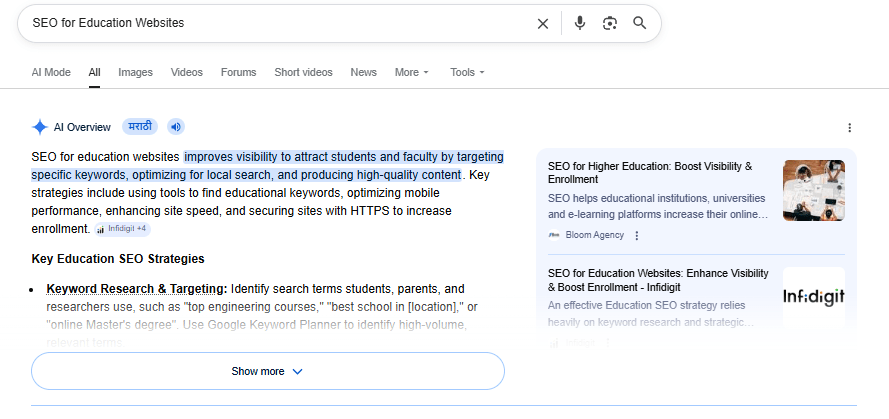
Google can draw on web pages that help answer the user’s query and support the information presented in an AI Overview. The specific sources may vary depending on the topic, search wording, available information, and the search experience being used.
A page does not necessarily need to hold the first organic position to be considered as a source. Equally, achieving a high ranking does not guarantee inclusion in an AI-generated summary.
Google may need information from multiple sources to answer a complex question. For instance, a search about improving ecommerce conversions could involve website usability, product descriptions, page speed, checkout design, and analytics.
This means businesses should build useful coverage around the topics their customers care about instead of focusing exclusively on one primary keyword.
Third-party publications, professional communities, industry websites, and authoritative resources can also contribute to the broader information environment in which brands are discovered. A business should build a credible presence across relevant channels without treating any external platform as a guaranteed route to AI citations.
How to Get Your Website Cited in AI Overviews
Improving your chances of appearing in AI Overviews requires a coordinated approach to content, technical SEO, authority, and performance measurement.
1. Understand the Questions Your Audience Asks
Start by researching the questions customers ask before making a purchase or contacting a service provider.
Traditional keyword research remains useful, but it should be expanded to include informational needs, comparisons, practical problems, and follow-up questions.
For example, a company offering search engine optimization services might identify questions such as:
- What does an SEO campaign include?
- How long does SEO take to produce results?
- How much do SEO services cost?
- What is the difference between SEO and paid advertising?
- How can a business measure organic search performance?
These questions can become dedicated sections within a comprehensive article or separate pages when the topics require substantial explanation.
Google’s People Also Ask results, related searches, customer conversations, sales enquiries, and website search data can help identify relevant opportunities. The goal is to understand the complete search journey, not simply collect a long list of keywords.
2. Use Clear, Answer-First Content
Readers and search systems benefit when important information appears near the beginning of a section.
After an H2 or H3 heading, provide a concise answer before introducing supporting details, examples, or qualifications.
For example, a section titled “What Is Technical SEO?” should begin with a straightforward definition explaining that technical SEO improves a website’s crawlability, indexability, structure, and technical performance.
The following paragraphs can then discuss XML sitemaps, canonical tags, redirects, mobile usability, and other relevant considerations.
This structure makes individual sections easier to understand independently. It also helps users find the information they need without reading an entire article.
Avoid unnecessary introductions, repeated statements, and vague language that delays the main answer. Direct writing should not come at the expense of accuracy or meaningful context.
3. Organize Content With Descriptive Headings
Use a logical heading hierarchy to explain the subject in manageable sections. Your H1 should identify the main topic, while H2 and H3 headings should describe the questions and subtopics addressed on the page.
For example, an article about ecommerce SEO might include sections on product page optimization, category page structure, internal linking, structured data, and technical issues.
Each section should deliver on the promise made by its heading. Avoid using headings solely to insert keywords when the section does not provide relevant information.
A well-organized page supports accessibility, improves the reading experience, and makes relationships between topics easier to understand.
4. Create Comprehensive, Original Content
Longer articles can cover complex topics thoroughly, but word count alone does not determine whether a page will receive an AI citation.
Instead of expanding content simply to reach a target length, answer the important questions your audience has and provide the context necessary to understand the subject.
Include practical examples, relevant explanations, original observations, and useful recommendations. If your business has conducted research or completed projects, consider publishing case studies that describe the starting situation, work performed, and measurable outcomes.
For example, a web development company could publish a guide explaining how site architecture affects navigation, crawlability, and conversion paths.
Original information gives readers a reason to consult your page rather than several similar articles. It also helps distinguish your content from generic material available across the web.
5. Support Claims With Reliable Sources
Credible content should distinguish between verified facts, expert opinions, estimates, and recommendations.
When making factual claims, link to relevant primary sources whenever possible. These might include official documentation, original research, government publications, recognized industry studies, or company data that can be substantiated.
Explain the context behind statistics and avoid repeating figures simply because they appear in competing articles.
For example, if you discuss the relationship between page speed and user experience, refer to relevant Google documentation and explain what the measurements mean.
For company-specific claims, publish accurate case studies and identify the metrics used. Obtain appropriate permission before sharing client information.
Reliable sourcing improves the usefulness of your content and gives readers a way to verify important statements.
6. Strengthen Your Technical SEO Foundation
Search engines need to discover, crawl, and process your content before it can be considered for search features.
Review your website for crawling problems, blocked resources, incorrect canonical tags, redirect chains, broken internal links, and accidental noindex directives.
Ensure that important pages are accessible through crawlable internal links and return the appropriate HTTP status codes. Submit an accurate XML sitemap and use Google Search Console to monitor indexing and technical issues.
Your website should also work well on mobile devices, load efficiently, and provide a stable browsing experience.
Technical SEO does not guarantee AI Overview inclusion. However, fixing accessibility and indexing problems helps ensure that valuable content has the opportunity to be discovered.
7. Implement Relevant Structured Data
Structured data helps search engines interpret specific information about a page, organization, product, article, or other supported entity.
Depending on the content, relevant schema types may include Organization, Article, Product, BreadcrumbList, and LocalBusiness.
Use structured data that accurately reflects the visible content on the page and follows Google’s documentation. Validate the implementation with appropriate testing tools and correct any errors.
It is important to understand that schema markup is not a direct guarantee of AI Overview citations. Its primary purpose is to clarify information for search engines and support eligible search features where applicable.
Do not add unrelated or misleading schema simply to make a page appear more authoritative.
8. Build Brand Authority Beyond Your Website
Search visibility is influenced by more than on-page optimization. Businesses should develop a credible reputation through useful contributions to their industry and consistent information across relevant platforms.
Consider publishing expert commentary, contributing original research, participating in professional discussions, and earning editorial mentions from reputable publications.
For example, a digital marketing agency might share findings from a campaign analysis, explain a change in search behavior, or provide practical advice to an industry publication.
Maintain consistent business information across important directories and professional profiles. Encourage genuine customer reviews where appropriate and respond professionally to feedback.
Avoid mass-producing forum posts, buying manipulative links, or publishing promotional comments solely to influence AI systems. Sustainable authority comes from genuine expertise and useful contributions.
9. Improve Your Website’s Entity Clarity
Search engines need to understand who is responsible for the content and what a business does.
Provide clear information about your company, its services, team members, experience, and areas of expertise. Maintain an accurate About page, accessible contact information, and relevant author details for expert content.
For service businesses, create focused pages explaining the services offered, intended customers, processes, and relevant experience.
For example, Bloom Agency’s website can connect its SEO services with related resources covering technical optimization, content strategy, digital marketing, and website development.
A coherent website structure helps visitors understand the business and makes relationships between relevant topics clearer.
10. Keep Important Content Accurate and Updated
Content freshness matters when information changes, but updating a publication date alone does not improve its usefulness.
Review important pages regularly to identify outdated statistics, broken links, obsolete recommendations, changes in services, and new developments that affect the reader.
Update the substance of the page when necessary. Remove information that is no longer accurate and add relevant explanations where they improve completeness.
Evergreen content should remain useful over time, while time-sensitive articles need closer monitoring.
Maintain a realistic editorial schedule based on the importance of each topic rather than changing every page simply to make the website appear active.
How to Measure AI Overview Visibility
AI SEO services can be difficult to measure because citations may vary across queries, locations, devices, and search experiences. Businesses should combine several sources of evidence rather than relying on a single metric.
Monitor Google Search Console
Google Search Console helps track search impressions, clicks, click-through rates, and average positions for eligible search traffic. Review changes for relevant queries and landing pages to understand how conventional organic visibility is evolving.
AI Overview-specific performance may not always be separately identifiable in standard reporting. Avoid assuming that every change in impressions or clicks is caused by AI-generated results.
Check Relevant Search Queries
Test a representative set of important queries periodically to see whether your website appears as a cited source. Record the query, page cited, date, and observed competitors.
Because results can vary, use repeated observations rather than drawing conclusions from one search.
Track Qualified Traffic and Conversions
Evaluate whether organic visitors complete meaningful actions, such as submitting an enquiry, requesting a proposal, or purchasing a product.
Traffic quality and conversions help connect search visibility to business objectives.
Review Brand Mentions and Referral Data
Monitor relevant brand mentions, referral traffic, and changes in audience engagement. These indicators can provide additional context about how people discover your business, although they do not independently prove that AI Overviews caused the change.
Common Mistakes to Avoid When Optimizing for AI Overviews

One common mistake is thinking that posting longer articles by default means more citation opportunities. Like, comprehensive coverage is only useful when it actually answers the relevant questions correctly, no shortcuts. Another thing people do wrong is stuffing keywords, or going through the same explanation again and again across multiple pages. That makes the material feel less helpful, and it also builds up unnecessary, almost redundant, copies.
Businesses should also steer away from fabricated statistics, claims from “experts” that are not backed up, troublesome or misleading schema markup, and low-grade backlinks from everywhere.
And finally, don’t fully abandon traditional SEO services just to chase AI visibility. Crawlability still matters, useful content stays useful, website structure should stay solid, relevant links are still part of it, and a positive user experience remains a key component too, not an afterthought.
How Bloom Agency Can Help Improve AI Search Visibility
Bloom Agency helps businesses, kind of uh, strengthen their online presence via search engine optimization digital marketing and website development.
An effective AI-focused SEO plan kinda starts with getting a feel for the audience, checking how the existing website is really performing, and spotting content that can genuinely answer the important customer questions.
That whole workflow can involve keyword and intent research, technical SEO audits, content enhancement, internal linking tweaks, structured data implementation, and also authority-building tasks that feel more natural than forced.
The goal is to build a website that gives clear information, shows real know-how, and supports the business’s wider marketing aims.
AI search optimization should sit alongside a proven SEO strategy, not fully take its place. When you combine helpful content with technical upgrades and keep watching results over time, businesses can create a stronger base for visibility across changing search experiences.
Take a look at Bloom Agency SEO services or learn more about its digital marketing offerings to find opportunities for your site.
Frequently Asked Questions About AI Overviews
1. How do I get my website cited in Google AI Overviews?
Create accurate, helpful content that answers specific user questions, improve technical SEO, use descriptive headings, support factual claims with reliable sources, and build genuine website authority. These practices can improve your chances of being considered, but citations cannot be guaranteed.
2. Do I need to rank number one on Google to appear in AI Overviews?
No. A page does not always need to rank first in traditional organic results to be cited. However, strong organic visibility and a technically accessible website can support broader search discoverability.
3. Does schema markup help with AI Overview citations?
Structured data can help search engines interpret page information, entities, and relationships. However, schema markup alone does not guarantee inclusion in AI Overviews. It should accurately reflect visible page content and follow Google’s guidelines.
4. How long does it take to appear in AI Overviews?
There is no fixed timeline. Results depend on factors such as indexing, content relevance, competition, website authority, and the query being searched. Continue improving content and monitoring relevant search results over time.
5. Is AI SEO different from traditional SEO?
AI SEO focuses on improving visibility in AI-driven search experiences, including citations and generated answers. Traditional SEO focuses on broader search visibility and organic performance. The two approaches overlap in areas such as content quality, technical accessibility, user intent, and website credibility.
6. Does every blog post need to be 2,000 words?
No. Content length should reflect the topic and the user’s needs. A concise page can perform well when it answers a specific question completely, while broader subjects may require more detailed coverage.
7. Can small businesses appear in AI Overviews?
Yes. Small businesses can create useful, focused resources that address relevant customer questions. Industry-specific knowledge, accurate service information, strong local SEO, and helpful content can support discoverability without requiring the same publishing volume as a large company.
8. How can I track whether my website appears in AI Overviews?
Monitor relevant queries manually, record cited URLs over time, review Google Search Console data, and analyze organic traffic and conversions. Combine these signals to understand performance rather than relying on a single metric.
Conclusion
Getting your website cited in Google AI Overviews is kind of like a marathon not a quick sprint , because it needs a long-term commitment to really useful content , technical accessibility , solid and credible information and also a presence people can actually recognize online.
For businesses, the better path is to focus on answering customer questions in a clear way , back up statements with dependable evidence, sort your pages in a logical manner, and keep everything updated and accurate. Technical SEO plus structured data can help with discoverability, and honestly sharing real contributions in your industry tends to build credibility faster than fluff.
No guaranteed formula will automatically earn an AI Overview citation. Still, a balanced strategy that mixes established SEO practices with audience-first writing gives your site a stronger base as search experiences keep evolving.
If you want to boost visibility, the best starting point is to figure out what customers actually need, publish the most useful answers you can , and keep improving the website based on evidence and performance signals too.

Neetu Wadhwa is the Director of Bloom Agency, a Mumbai-based full-service digital marketing and web development company. With a strong focus on performance, innovation, and strategy, she leads the agency in delivering SEO, web design, and growth marketing solutions that drive measurable business outcomes.



Rahul M.
B2B Service Provider