
The proper definition of a Google penalty services should be explained before assessing its potential impact. Google imposes a penalty on websites which breach its webmaster guidelines through their entire site or selected content. The guidelines exist to deliver search results which give users the most relevant and highest quality and most reliable information.
A penalty presents serious difficulties for your SEO work because it disrupts your ongoing progress. Your website may experience three negative outcomes which include a decrease in search rankings and a complete removal from search results. The process appears to create an impossible situation but recovery becomes achievable through proper methods.
Website owners need to learn about penalties which apply to their online platforms. An algorithmic penalty typically shows itself through a sharp decrease in website traffic which happens after an algorithm update. Manual penalties happen when Google reviewers find specific violations which include using spam techniques and implementing deceptive SEO methods.
The process requires the recovery request submission as the next vital activity. Many website owners overlook this, even though it plays a vital role in regaining rankings. The process of correcting the problem through formal reconsideration request demonstrates to Google that your organization completed all necessary corrective actions.
In this guide, Bloom Agency breaks down the complete list of Google penalties and provides actionable solutions to help you recover effectively.
Google Manual Penalties You Should Know
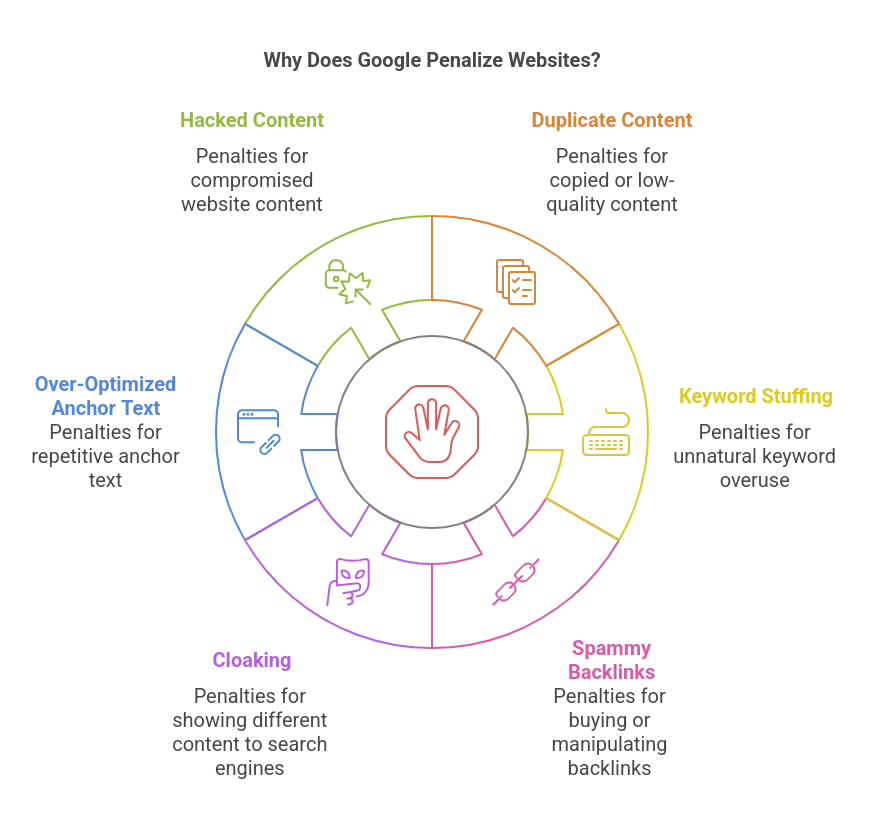
Google reviewers directly apply manual penalties whenever they find violations of the rules. The penalties can affect either specific pages or the complete website depending on their level of severity.
AMP Content Mismatch
The AMP version of a page shows substantial differences from its canonical version which creates this problem. Google wants both versions to deliver an identical user experience.
The two versions need to provide identical content and functionality to create a seamless user experience across all devices.
Cloaked Images
Cloaking involves showing different images to search engines and users. The process creates a false user experience which results in penalties against the website.
The solution requires that users and search engines should see the same images without any changes to the visible content.
Cloaking and Sneaky Redirects
The practice violates Google guidelines because your website shows specific content to search engines while users experience different content through redirection.
The technical audit needs to discover all incorrect content relationships and remove all misleading redirection methods which send users incorrect content.
Hidden Text and/or Keyword Stuffing
The practice of using hidden text together with excessive keyword repetition for ranking control leads to penalties which search engines impose. The hidden content should be deleted from the document while maintaining natural keyword use which improves both reading comprehension and user interaction with the material. Pure Spam This penalty represents the harshest punishment which affects websites that employ intense spam methods through the use of automated content and content scraping. A website needs complete content removal before it can start recovery through Google trust-building which requires high-quality operations.
- Pure Spam
The practice of redirecting mobile users to irrelevant and spam-related destinations results in penalties which websites face from search engines. The mobile experience of your website should match user expectations according to search results while you should remove any deceptive redirects from your site. Spammy Free Hosting Your site risks problems because your hosting service operates multiple spammy websites which include your own. The solution requires you to migrate from your current hosting partner to a trustworthy service while you need to supervise all aspects of your operational space. Structured Data Issues The use of structured data leads to penalties because it provides false information to users and falsely improves search engine rankings. All structured data must adhere to Google standards while it should precisely represent your actual website content.
- Sneaky Mobile Redirects
Thin Content Pages that contain minimal worth through duplicated content together with shallow material face penalties from search engines. The recovery process requires organizations to eliminate their poor content while they should develop new material that contains original and valuable content. News and Discover Policy Violations Google enforces penalties for any content that violates its News and Discover policies which include misleading content and harmful content. The maintenance of transparent operations together with accurate information delivery protects your organization from these penalties.
- Spammy Free Host
Algorithmic penalties function as automatic penalties which Google applies according to its established ranking procedures. Panda: Content Quality Issues Through its algorithm the Panda system assesses the overall quality of website content. Websites that contain duplicate content and shallow content needs plus poorly written articles will experience a decrease in their search engine ranking. The recovery process requires organizations to enhance content quality while they need to update outdated web pages and deliver value to users.
- Structured Data Issue
Unnatural Backlinks Penguin targets websites with spammy or unnatural backlinks. This category includes links of low quality together with excessive link building and links which develop through unnatural methods. The process of restoring rankings requires you to remove harmful links while you need to establish a natural backlink network.

How to Recover from Google Penalties
The penalty recovery process requires different steps based on penalty type and severity level. The process begins with identifying the issue and fixing all violations thoroughly. The process of handling manual penalties requires you to submit a reconsideration request through Google Search Console. The report must explain the problem while providing details about the solution and showing proof of progress. The process needs organizations to improve their content quality together with their backlink network. Google conducts site assessments during its crawling process to evaluate your implemented changes.
Recovery Timelines Vary
Simple issues can resolve within a few days but complicated problems require multiple months to repair. Your online visibility together with your visitor count and revenue will experience a decline because of a Google penalty. The process of fixing issues requires more time because delays lead to additional revenue losses which extend recovery times. The process of monitoring needs to be done proactively together with continuous SEO audits for effective results. The process of finding problems early prevents substantial failures which help maintain your websites search engine performance stability.
NEW: Google News and Discover Policy Violations
In February, Search Engine Land reported that Google published a new set of manual actions focused on Google News and Google Discover. This expands the SEO Google penalties list, which was previously aimed at Search alone.
Below, you will find each manual penalty related to both Google News and Discover:
- Dangerous Content
- Harassing Content
- Hateful Content
- Manipulated Media
- Medical Content
- Sexually Explicit Content
- Terrorist Content
- Violence and Gore Content
- Vulgar Language and Profanity
- Discover Policy Violation
- Adult-Themed Content
- Misleading Content
- News Policy Violation
- Transparency
Note: Fixing each manual penalty Google assigns to you can be time-consuming, especially with the recent addition of News and Discovery actions. What is a Google penalty services recovery service provider for, if not to make life easier for you? For starters, search for a reputable digital marketing agency with integrated Google penalty recovery services.
Now that we’ve covered every manual penalty from Google, it’s time to delve into the algorithmic penalties.
Google Panda Penalty Removal
The Panda penalty affects your complete website because it evaluates the entire website content quality. You must find and resolve all content problems that decrease your website quality score to achieve site recovery. Common problems include thin content, duplicate pages, poorly written articles, and missing essential pages such as Contact or About sections.
Content recovery needs a complete content assessment to identify all existing content problems. The content update process requires you to enhance multiple pages with additional material while removing unimportant pages and combining identical content. Users need website structure changes which include navigation elements and header structures and internal link systems to achieve better site usability.
The key challenge is knowing what to improve, remove, or keep. Content strategic planning helps you to protect important website material while increasing overall website quality.
Waiting time: After implementing all changes, Google needs time to reassess your site. The traffic increase starts after your quality score reaches higher levels which takes approximately three days for results to appear.
Google Penguin Penalty Removal
The Penguin penalty targets specific pages or keywords affected by unnatural or spammy backlinks. The Panda system links problems to specific websites but it does not impact the complete website system.
You must find all harmful backlinks before taking recovery actions. The process requires you to remove low-quality links and contact webmasters for link deletion or use Google’s disavow tool when link deletion is not feasible. A business needs to create an untainted backlink profile which will support its journey toward future recovery.
All manual actions which involve this issue require you to complete the problem solution before you can submit your reconsideration request. Google will perform a site scan to check your link status after you resolve all existing problems. The time for recovery ranges from a few hours to several weeks or even months because of the Google processing speed for changes.
Don’t Let Google Penalties Bring You Down
A Google penalty causes your revenue stream to suffer because it directly affects both your sales performance and your overall business development. When your website loses visibility in search results, your organic traffic drops, and that immediately affects lead generation and conversions. The longer it takes to identify and fix the issue, the more difficult it becomes to recover your rankings and regain lost momentum.
People need to learn how Google penalties work and how to find them because this knowledge is necessary to perform recovery tasks yet it takes time to acquire the needed skills. Technical audits, content fixes, backlink analysis, and reconsideration requests require expertise and precision. An SEO professional partnership creates an area where considerable advantages exist for organizations. An experienced agency can quickly identify the root cause, implement the right fixes, and reduce the time it takes to recover.
At Bloom Agency, we focus on helping businesses recover from penalties and build stronger, more sustainable SEO strategies. Our approach includes in-depth site audits, technical optimization, content improvements, and backlink analysis to ensure your website aligns with Google’s guidelines.
The correct team will assist your website in handling penalty problems while safeguarding your rankings and enabling your organization to achieve sustainable growth.

Neetu Wadhwa is the Director of Bloom Agency, a Mumbai-based full-service digital marketing and web development company. With a strong focus on performance, innovation, and strategy, she leads the agency in delivering SEO, web design, and growth marketing solutions that drive measurable business outcomes.







Rahul M.
B2B Service Provider