
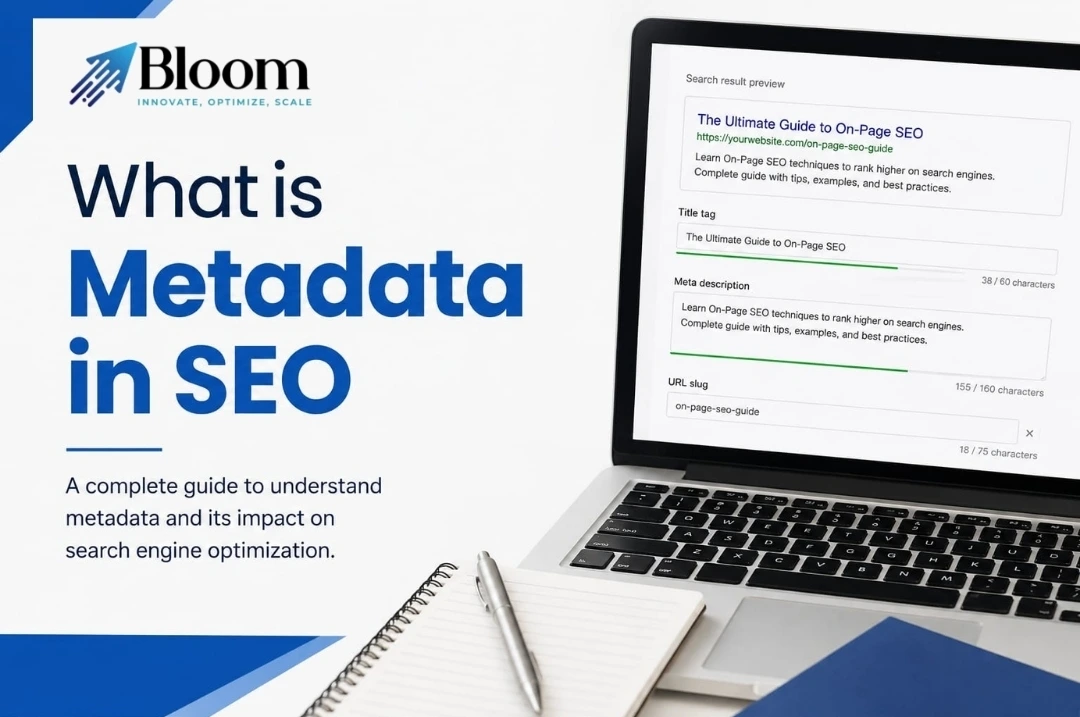
SEO metadata consists of HTML tags which include title tags and meta descriptions to deliver webpage details for search engines and users. The website code contains these elements, which remain hidden from users, yet they function as essential components for boosting search results visibility and user clicks and for establishing content relevance in search results.
The Bloom Agency assists companies in building their SEO base through metadata optimization, which results in better rankings and enhanced visibility and boosted organic traffic.
Did you know? The research reveals that almost half of all websites use identical meta descriptions on different pages, which results in detrimental effects on their SEO performance.
The metadata of your webpage serves as the initial Google contact point for your website. Users will trust your content more when you use a well-crafted title and description, which will result in increased user clicks.
The guide will explain the main metadata types and their operational mechanisms and the best optimization methods together with the most common optimization errors people make.
What Is Metadata SEO and Why Is It Important for Search Rankings?
Metadata SEO services describes the structured HTML elements which web page designers use to create head section elements, which search engines use to comprehend web page content. The process improves search result indexing and ranking, which leads to better visibility in search results.
Why metadata is important for SEO:
- It tells search engines what your page is about
- It influences how your page appears in search results
- It directly impacts click-through rates (CTR)
- It improves crawlability and indexing
- It supports overall SEO performance and content relevance
The Bloom Agency provides complete page optimization through which we establish essential page elements to achieve clear page objectives with relevant conversion-focused metadata.
Types of Metadata You Should Optimize for SEO
The process of effective optimization requires proper understanding of various metadata types. The following list contains the essential metadata types which must be optimized:
Meta Title Tag
The meta title functions as the clickable headline which displays in both search results and browser tabs. The meta title serves as a powerful SEO ranking factor, which requires the inclusion of your primary keyword.
Meta Description
A brief overview of your webpage, which appears below the title in search engine results pages (SERPs). The content acts as an indirect ranking factor, yet it has a strong effect on both CTR and user active participation.
Meta Robots Tag
The tag instructs search engines to either index the page or follow its links. The system enables control over webpage visibility, which prevents users from seeing specific pages.
Charset Meta Tag
The character encoding system defines how your website content displays on different browsers and devices. The system functions as a fundamental component of technical SEO, which maintains system stability.
Social Meta Tags
The tags manage your content presentation on social media networks, which strengthens brand recognition and boosts user interaction.
Structured Data (Schema Markup)
Structured data enables search engines to obtain detailed information about your content, which leads to the appearance of rich results including FAQs and ratings and featured snippets.
| Metadata Type | SEO Impact | Visible to Users |
| Meta Title | High | No (SERP only) |
| Meta Description | Medium | No (SERP only) |
| Meta Robots | High | No |
| Charset Tag | Technical | No |
| Social Tags | Indirect | Yes (social preview) |
| Structured Data | High | Partially |
The AI systems which operate search engines today can comprehend both user intent and contextual meaning together with basic keyword understanding. Modern SEO practice requires even stronger metadata usage because of this development.
We enable websites to succeed in complex search systems through our AI-ready metadata methods at Bloom Agency.
The advantages of AI-optimized metadata include:
- AI systems gain faster understanding of page content through this feature.
- The system enhances search intent matching by producing more relevant results.
- The system boosts your chances of being included in AI-generated content summaries.
- The system helps users distinguish between webpages that feature similar content.
- The system boosts content recognition power which enables strong identification of search results.
How the SEO Metadata System Functions
Metadata functions as the essential component that enables search engines to access your website content and analyze its information to produce search rankings.
- Crawl
Search engine bots access the meta robots tag to decide if they should crawl the page or not.
- Index
Search engines use meta titles and descriptions to understand the topic which they then store in their index.
- Display
Search engines utilize metadata to create search snippets which they display to users during their search engine results page (SERP) browsing.
- Rank
The words which appear in your titles and metadata determine the position of your page in search engine results.
Metadata optimization functions as the essential system which enables search engines to crawl more efficiently by identifying critical content for their operations.
How to Write SEO-Friendly Titles and Meta Descriptions
Writing a Strong Meta Title
The title optimization process leads to improved visibility and increased click-through rates for your content.
Best practices:
- Begin the title with the main keyword.
- The length must remain between 50 and 60 characters.
- Every title must create its own distinct identity.
- Add value or benefit-focused words
- The practice of keyword stuffing must be avoided.
Writing an Effective Meta Description
The strong meta description makes users want to visit your page.
Best practices:
- The content must remain within the 150 to 160 character limit.
- The passage must contain verbs that drive users to take action (Learn, Discover, Get).
- The target keyword should appear in the text.
- A clear call-to-action needs to exist in the text.
- Every page needs to have its own distinct content.
At Bloom Agency, we develop metadata that achieves high rankings while driving successful conversions.
Best Tools for Metadata SEO Optimization
Using the correct tools enhances the ability to achieve precise results while executing tasks with optimal performance.
Google Search Console
The platform delivers real user data about indexing performance and search visibility.
Google Keyword Planner
The tool helps users find effective keywords which they can use to enhance their metadata.
Ahrefs
The platform supports users in conducting keyword research and competitor analysis while gathering backlink information.
Yoast SEO
The WordPress plugin helps users optimize their title and description using its functions.
Rank Math
The SEO services plugin provides users with real-time guidance on how to improve their metadata.
Common Metadata SEO Mistakes to Avoid
Websites encounter ranking problems because their metadata handling procedures fail to meet proper standards.
Leaving Meta Descriptions Blank
Google generates automatic descriptions which users find unhelpful because the content fails to match their interests.
Using Duplicate Titles
Search engines encounter difficulties due to duplicate meta titles which lead to decreased ranking capabilities.
Keyword Stuffing
The process of adding excessive keywords to metadata creates an artificial look which results in decreased click-through rates.
Ignoring Image Metadata
The search visibility of images gets affected by both image SEO factors and alt text implementation.
Poor File Names and Missing Alt Tags
The absence of image metadata causes a major problem because it decreases the probability of images being discovered through image search.
How Bloom Agency Improved CTR by 130% Using Metadata SEO
At Bloom Agency, we developed a complete metadata optimization plan to improve eCommerce performance for the client who faced various challenges with their CTR and organic visibility.
Client Challenges:
- Low CTR (0.8%)
- Heavy dependency on paid ads
- The organization’s weak organic performance.
- The organization had multiple duplicate metadata sections which were not optimized properly.
Our Strategy:
- We rewrote all meta titles and descriptions
- We identified key phrases which corresponded with user search behavior.
- We enhanced existing page metadata through structural upgrades.
- We made the section which focuses on CTR creation more effective.
Results (6 Months):
- The total number of clicks increased by 130 percent.
- The number of impressions increased by 196 percent.
- The average ranking position showed significant improvement.
- The organization experienced strong ongoing growth in their organic traffic.
Improve Your SEO Performance with Bloom Agency
The simplest method to enhance search engine rankings and increase organic traffic involves executing metadata optimization. The proper execution improves visibility while raising click-through rates plus enhancing overall SEO outcomes.
At Bloom Agency, we establish strong SEO foundations for businesses through our:
- The process of metadata optimization
- The implementation of technical SEO enhancements
- The development of content strategy
- The establishment of AI SEO readiness
- Our digital marketing services which concentrate on performance.
Website visitors who experience low visibility and low click-through rates must begin their website growth process by implementing metadata optimization.
FAQs About Metadata SEO
What is metadata in SEO?
Webpage content metadata consists of HTML data elements like title tags and meta descriptions which search engines use to comprehend webpage content.
Does metadata help SEO rankings?
Yes, search engine optimization benefits from metadata because it boosts visibility and click-through rates along with indexing which results in better search engine rankings.
- What is the ideal length for metadata?
- Meta title: 50–60 characters
- Meta description: 150–160 characters
- Does image metadata affect SEO?
Yes, image alt text and file names improve image search rankings and overall SEO.
How does metadata work with AI search?
AI systems use metadata to achieve quick comprehension of content context which enhances their capability to produce relevant search results and summaries.

Neetu Wadhwa is the Director of Bloom Agency, a Mumbai-based full-service digital marketing and web development company. With a strong focus on performance, innovation, and strategy, she leads the agency in delivering SEO, web design, and growth marketing solutions that drive measurable business outcomes.





Rahul M.
B2B Service Provider